
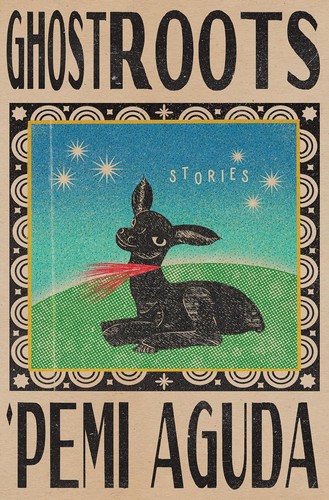
Ghostroots
Stories
Ghostroots is ’Pemi Aguda’s debut collection: twelve stories set in a Lagos where the supernatural presses against ordinary domestic and working life. Among recent short story collections, it stands out for treating haunting as inheritance. A woman may see a dead relative’s cruelty surface in her daughter, a new mother’s body may seem to answer to old family wounds, a whole street may lose its youngest sons, and an architect may meet a house with a will of its own. Aguda moves between outright horror and quieter realism with an uncanny edge, changing voice and form from story to story. The book was a finalist for the 2024 National Book Award for Fiction, and it keeps asking how far a person can separate herself from the family, tradition and history that made her.
Where to buy or borrow
Are you selling this book? Bookstores, publishers, authors and libraries can be listed here for free. Request a listing
About this book
All twelve stories are set in Lagos, the city where Aguda grew up, and the book does not take the usual detour through diaspora or immigrant settings. The supernatural elements are usually small and domestic rather than spectacular. They include a stubborn house, a body that will not do what it is expected to do, and masquerade figures at the edge of a family’s livelihood. The critic and fellow writer Wole Talabi has called her mode “Nigerian gothic”. He also notes that it shares ground with magical realism, Afrosurrealism and postcolonial gothic. What distinguishes the collection is its range of narrative technique, including a second-person opening story, and the way history and politics sit behind the characters’ private struggles instead of being announced.
Deep Overview
Motherhood and the body recur early and often. In “Breastmilk”, a woman who has just given birth is unable to nurse. She links that failure to her anger at her husband’s infidelity and to the model of resistance her own mother set. Kirkus noticed that many of the book’s ghosts travel down maternal lines, and that the women carry the larger share of the haunting. Other stories widen the frame from the home to the street and the city. In “24, Alhaji Williams Street”, the youngest boy in each household dies without a medical explanation, and the story studies how a community gradually adjusts to a loss it cannot prevent. In “The Hollow”, a young architect arrives to survey a house whose layout will not be mapped, and the building turns out to hold a violent history of its own. Reviewers have singled out the way this story joins the technical vocabulary of architecture to the emotional weight that buildings carry.
The collection also moves in tone. “Birdwoman” and “Girlie” turn toward greed, loneliness and the temptation of escape. “Pool House” and the closing story, “Masquerade Season”, return to confined households and to the masquerade figures a boy discovers while his mother, short of money, cuts pieces from them for her dressmaking trade. Locus counted ten reprints and two new stories among the twelve, and observed that the book alternates between overtly speculative work and stories whose strangeness is more muted. Not every reviewer thought the ending worked as well as the opening. Ancillary Review of Books, for example, felt the final story echoed an earlier and stronger one.
What Aguda appears to be demonstrating across these pieces is that freedom, in the sense of becoming an individual, is complicated by obligations that cannot be renounced cleanly. Family, religion, tradition, gender expectations and urban precarity all supply forms of belonging and forms of burden, often in the same gesture. The horror comes less from monsters than from the discovery that a person’s impulses, fears and even her face may have been handed to her. The book’s achievement is to make that discovery feel specific to Lagos while remaining recognisable to readers elsewhere.
Key Themes
Motherhood and the female body come next. Pregnancy, lactation, mothering and the strain between mothers and daughters appear again and again, and they are often entangled with betrayal or with a mother’s unfinished fight.
A third theme is the uneasy relation between individual desire and collective obligation. Characters want autonomy, but family and community ties both support and constrain them.
Buildings and place form a fourth thread. Houses, streets, markets and masquerade grounds act almost as characters, and architecture becomes a way to talk about concealment, violence and memory.
Finally, the collection returns to uncertainty. Many stories decline to settle whether an event is supernatural or psychological, and that unsettled quality is part of what the book is saying about trauma and belief.
Historical Context
Lagos is the necessary setting. It is a dense, fast-moving commercial city where many of the book’s characters make a living through trade, small business and informal work, and where spiritual belief and everyday survival often sit side by side. Masquerades, which feature in the closing story, belong to long-standing ceremonial traditions in parts of Nigeria, and Aguda uses them as a living cultural presence rather than as decoration.
The publication history also frames the book. Aguda earned an MFA at the University of Michigan and won the O. Henry Prize for her short fiction, and “Breastmilk” was a Caine Prize finalist. The collection arrived in 2024 with US, UK and Nigerian publishers, and it reached the New York Times list of 100 Notable Books for that year.
Intended Audience
It may appeal to those who liked other recent speculative story collections, and reviewers have drawn comparisons to Tobi Ogundiran’s Jackal, Jackal and to the work of Lesley Nneka Arimah, among others. Writers interested in how short stories can vary voice and structure will find a lot to study.
It may be less satisfying for readers who want conventional plots with firm resolutions. Several endings are deliberately open. Readers who dislike scenes involving family violence, childbirth difficulties, infidelity or the death of children should also proceed with care.
Reading Difficulty
The stories are self-contained and of moderate length, so the book can be read in short sittings. A reviewer in Locus suggested pausing between stories to take each one in, and that is sound advice, since the emotional intensity builds. At 224 pages in the Norton hardcover, it is not a long book. Readers have noted that Yoruba words and Nigerian idioms are generally not glossed, which most can infer from context. No prior knowledge of horror conventions is needed.
Helpful Background Knowledge
It may also help to know the collection’s publication history: most of the stories were published individually before 2024, so the book rewards attention to how they have been arranged and how themes echo across them. If you enjoy the gothic tradition more generally, with its haunted houses and inherited sins, you will find Aguda working with familiar tools in unfamiliar surroundings.
Why Read This Book?
It is also a strong example of how short story collections can be built as a whole. Across its sequence of voices and moods, the book develops a connected argument about what we owe those who came before us and what we are allowed to refuse. The critical attention it received, including a place among the 2024 National Book Award for Fiction finalists, makes it a useful entry point to current Nigerian and speculative writing. For readers asking what to read next after a novel-length book, a set of twelve compact, distinctive stories is a good change of pace.
Reader Takeaways
Readers may also become more alert to technique: how second-person narration alters intimacy, how a building can carry a plot, and how an open ending can sharpen a story’s question instead of weakening it. Finally, the book gives a picture of Lagos as a place of fine social detail, humour and ordinary pressure, not merely as a backdrop for events.
Strengths
Its thematic cohesion is a real asset. Because motherhood, inheritance and place recur from story to story, the book builds cumulative force instead of reading as an assortment. The supernatural elements are inventive but tied closely to character, so the strangeness always carries emotional meaning.
The Lagos setting is rendered without exoticism, and the stories avoid explaining the city to outsiders, which gives the book confidence and authority.
Limitations and Cautions
The book focuses on personal and family experience, and as Locus noted, wider historical and political structures are acknowledged but not foregrounded. Readers hoping for explicit social or political analysis may want more.
The tone is often dark, and several stories involve abuse, infidelity, bereavement or harm to children. Because ten of the twelve stories were previously published, readers who already know Aguda’s journal work will find less that is new. Finally, the horror here is psychological and atmospheric; it will not satisfy readers wanting graphic or fast-paced scares.
Important Concepts, People, and Places
Lagos: the setting of every story. It is a living, crowded city whose markets, streets, houses and neighbourhoods shape what the characters can do and what haunts them.
Nigerian gothic: Wole Talabi’s term for Aguda’s mode, in which hauntings and uncanny events express family and social tensions. It sits alongside magical realism, Afrosurrealism and postcolonial gothic as related traditions.
“Manifest”: the opening story, in which a woman’s resemblance to a cruel relative raises the question of whether harm can be inherited.
“Breastmilk”: a story of new motherhood and marital betrayal. It was a Caine Prize finalist and, with “The Hollow”, one of the collection’s best-known pieces.
“24, Alhaji Williams Street”: a story about a mysterious, targeted loss of boys on one street, showing how a community absorbs an inexplicable catastrophe.
“The Hollow”: an architect’s encounter with a house marked by cycles of violence, linking buildings to memory and gender.
“Masquerade Season”: the closing story, in which masquerade spirits intersect with a family’s money troubles.
National Book Awards: the US literary prizes whose 2024 fiction finalists included the book.
W. W. Norton & Company, Virago and Masobe Books: the US, UK and Nigerian publishers of the respective editions.
Questions the Book Explores
Reading Group Guide
Ask each member to name the story they found most unsettling and the one they found most moving, then compare the choices. Another useful exercise is to select a pair of stories that handle motherhood differently, such as “Manifest” and “Breastmilk”, and look at how each uses voice and form. Groups who read book club books for their endings may enjoy debating which stories feel complete and which feel deliberately open.
Because some material is distressing, it is considerate to mention at the start that several stories deal with abuse, infidelity and bereavement.
Discussion Questions
2. In which stories is the supernatural best read as literal, and in which as a metaphor? Does the distinction matter?
3. How do the collection’s mothers and daughters shape one another, and where do you see love and constraint overlapping?
4. What does the house in “The Hollow” suggest about memory, gender and violence?
5. How does the story set on Alhaji Williams Street portray a community’s response to loss, and what does the response reveal about the neighbours?
6. Which endings felt most effective to you, and which left you wanting more? What does an open ending accomplish here?
7. How does the Lagos setting influence the characters’ choices and fears?
8. Is freedom from one’s family and tradition possible in these stories, and is it desirable?
9. How do humour and tenderness operate alongside the book’s darker material?
10. If the stories were arranged differently, what might change about the collection’s overall effect?
Sources and Verification
Comments
No published comments yet.
Available editions
Hardcover
US first edition
- Publisher
- W. W. Norton & Company
- ISBN-13
- 9781324065852
- Publication date
- Pages
- 224