
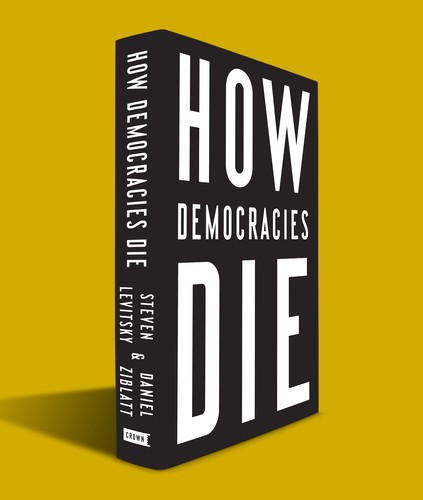
How Democracies Die
How Democracies Die examines how elected leaders can dismantle democratic government without abolishing elections or staging a traditional military coup. Drawing on cases from Europe, Latin America, and the United States, political scientists Steven Levitsky and Daniel Ziblatt describe a gradual process in which incumbents weaken institutional checks, discredit opponents, intimidate independent organizations, and alter political rules in their own favor. The authors emphasize the gatekeeping responsibility of political parties: established leaders can either block authoritarian figures or help normalize them. They also argue that constitutions cannot protect democracy by themselves. Democratic survival depends on unwritten practices—especially accepting opponents as legitimate and exercising restraint in the use of legal power. The book applies this comparative framework to Donald Trump’s rise and to the longer deterioration of political norms in the United States, presenting democrat…
Where to buy or borrow
Are you selling this book? Bookstores, publishers, authors and libraries can be listed here for free. Request a listing
About this book
Deep Overview
The authors first ask how democracies can recognize dangerous political figures before they gain executive power. Adapting ideas associated with political scientist Juan J. Linz, they identify four warning signs: rejection of democratic rules, denial of opponents’ legitimacy, tolerance or encouragement of political violence, and willingness to restrict the civil liberties of opponents or critical media. No single personality type defines an authoritarian, but repeated conduct in these areas should prompt political parties to treat a candidate as a threat rather than an ordinary competitor.
This leads to the book’s argument about gatekeeping. Parties do more than organize elections; they decide which ambitions will receive money, endorsements, legitimacy, and access to governing coalitions. Historical examples show establishment politicians making a disastrous bargain when they believe they can benefit from, contain, or control an extremist outsider. The authors contrast such failures with instances in which rival parties cooperated to isolate antidemocratic movements, accepting short-term electoral costs to preserve the political system.
Once an authoritarian-leaning leader enters office, the authors describe three broad strategies of consolidation. The government can capture or intimidate institutional referees, including courts, law-enforcement agencies, and regulatory bodies. It can marginalize important opponents by prosecuting, financially pressuring, or otherwise disabling political, business, and media figures. It can also rewrite electoral and institutional rules so that formally legal procedures produce an increasingly unequal contest. These actions are often justified as responses to corruption, disorder, national danger, or alleged sabotage.
The discussion then turns to the United States. Levitsky and Ziblatt argue that the constitutional separation of powers has depended on two unwritten guardrails. Mutual toleration means recognizing political opponents as legitimate contenders rather than enemies who must be destroyed. Institutional forbearance means declining to exploit every technically available power when doing so would violate the spirit of democratic competition. The authors trace how these norms developed unevenly and how their apparent stability was partly connected to racial exclusion. They then examine rising partisan polarization and escalating constitutional hardball before and during Donald Trump’s ascent.
The conclusion rejects both complacency and indiscriminate retaliation. The proposed democratic response involves defending institutions through broad coalitions, resisting political violence, preserving legitimate opposition, and addressing social conditions that make extreme polarization durable.
Key Themes
**Political parties as gatekeepers:** Parties influence whether demagogic or authoritarian figures remain marginal. Endorsements, alliances, nominations, and refusals to cooperate can matter as much as constitutional design.
**The limits of written constitutions:** Formal checks and balances require people willing to honor their purpose. Rules alone cannot anticipate or prevent every abusive but technically legal maneuver.
**Mutual toleration and institutional forbearance:** Democracy depends on accepting rivals as legitimate and using governmental powers with restraint. When these habits disappear together, politics can become an escalating struggle in which every defeat appears existential.
**Polarization and authoritarian opportunity:** Extreme partisan hostility encourages voters and elites to excuse misconduct by their own side. Fear of the opposition can make cooperation with an antidemocratic ally seem defensible.
**Inclusion and democratic legitimacy:** American political stability cannot be understood separately from racial exclusion. The authors contend that strengthening democracy requires inclusive citizenship rather than a return to an earlier order that denied equal participation.
Historical and Political Context
Its comparative approach draws on twentieth- and early twenty-first-century cases of democratic crisis. Interwar Europe supplies examples of establishment elites enabling Adolf Hitler and Benito Mussolini. Latin American experience—including Peru under Alberto Fujimori, Venezuela under Hugo Chávez, and Chile’s breakdown before Augusto Pinochet’s dictatorship—illustrates different relationships among elections, polarization, elite choices, and authoritarian consolidation. More recent developments in Hungary, Russia, and Turkey demonstrate how elected governments can reduce political competition without immediately eliminating democratic forms.
For the United States, the relevant background extends beyond the Trump presidency. The book discusses party realignment, the civil-rights era, the political consequences of racial inclusion, and intensifying partisan conflict from the late twentieth century onward. Its account therefore belongs both to the literature on global democratic backsliding and to debates about whether American institutions are exceptionally resistant to breakdown.
Intended Audience
Readers who prefer a strictly chronological history may find its movement among countries and time periods less conventional. Those seeking a neutral catalog of political institutions should also expect a clear argumentative position: the authors regard Donald Trump as displaying multiple authoritarian warning signs and criticize the Republican Party’s failure to contain his rise. At the same time, the analysis is broader than a biography of Trump or an account of a single administration.
Reading Difficulty
The greater challenge is comparative rather than linguistic. The discussion moves rapidly among political systems, leaders, and historical episodes, so readers unfamiliar with European or Latin American history may need to pause or consult brief background references. The argument is cumulative: later chapters depend on distinctions established earlier between formal institutions, informal norms, ordinary partisan competition, and authoritarian conduct.
Helpful Background Knowledge
For the Latin American cases, readers may benefit from knowing that elected and unelected authoritarian governments have both shaped the region’s modern political history. For the American chapters, useful reference points include the Reconstruction era, Jim Crow, the civil-rights movement, the ideological realignment of the major parties, Watergate, congressional impeachment, and the development of modern partisan polarization.
Why Read This Book?
The book is also valuable for placing American politics in comparative perspective. Instead of asking only whether a particular event has happened before in the United States, it asks how similar patterns have developed across different democracies. Its attention to party leaders is particularly useful because it shifts some responsibility away from the personality of a demagogue and toward the coalitions that provide access to power. Finally, the analysis explains why defending democracy may require both firm opposition to authoritarian behavior and restraint in the methods used to oppose it.
Reader Takeaways
The book also encourages attention to elite choices made before crises become obvious. Party endorsements, coalition agreements, institutional appointments, and decisions to excuse violent or antidemocratic rhetoric can shape whether an authoritarian movement reaches power. Readers may further reconsider the role of informal norms: restraint and recognition of legitimate opposition are not signs of political weakness but conditions that permit recurring, peaceful competition.
The American historical discussion adds an important qualification. Political stability is not sufficient if it rests on exclusion. A durable democratic settlement must combine broad participation with institutions and political habits capable of managing genuine disagreement.
Strengths
Another strength is its integration of formal institutions with political behavior. The authors explain why the same constitutional powers may produce different outcomes depending on whether politicians recognize limits not enforced by law. Their treatment of party gatekeeping also corrects explanations that attribute democratic collapse solely to popular attitudes or charismatic leaders.
The discussion of American norms is strongest when it acknowledges their unequal historical foundation. By connecting twentieth-century political cooperation to racial exclusion, the authors avoid presenting the past as an uncomplicated democratic ideal.
Limitations and Scope
Its emphasis on political elites, parties, and democratic norms can leave less space for other explanations of democratic decline, including economic inequality, digital media systems, organized disinformation, institutional design, campaign finance, and changes in the broader information environment. The international cases are used primarily to illuminate mechanisms rather than to provide complete national histories.
The defense of gatekeeping also raises a democratic tension. Party elites may block dangerous candidates, but closed or unaccountable nomination systems can exclude legitimate movements and protect entrenched interests. Readers should therefore distinguish principled opposition to authoritarianism from resistance to political outsiders as such.
Important Concepts, People, and Cases
**Democratic gatekeeping:** The responsibility of political parties and established leaders to prevent antidemocratic figures from gaining mainstream legitimacy and access to power.
**Four indicators of authoritarian behavior:** The authors assess leaders by their commitment to democratic rules, recognition of opponents’ legitimacy, relationship to political violence, and willingness to protect opponents’ civil liberties and independent media.
**Mutual toleration:** The understanding that political rivals have a legitimate right to compete for power and govern when they win.
**Institutional forbearance:** Deliberate restraint in exercising legal authority. It discourages officials from using every available power merely because no written rule expressly forbids it.
**Constitutional hardball:** Conduct that may conform to the formal wording of the law while violating established expectations of restraint and fair competition.
**Donald Trump:** The book’s principal contemporary American case. The authors apply their warning signs to his candidacy, rhetoric, conduct, and relationship with the Republican Party.
**Hugo Chávez and Venezuela:** A major example of an elected outsider who gained establishment assistance and subsequently weakened checks on executive authority.
**Alberto Fujimori and Peru:** A case used to show how an elected president can attack or disable democratic institutions while presenting extraordinary measures as necessary responses to crisis.
**Adolf Hitler and Benito Mussolini:** Their rises illustrate the danger of conservative elites believing that extremist outsiders can be controlled after being admitted to power.
**Viktor Orbán, Vladimir Putin, and Recep Tayyip Erdoğan:** Contemporary leaders used to demonstrate how governments can progressively capture referees, constrain opposition, and alter the competitive political field.
**Juan J. Linz:** A political scientist whose work on democratic breakdown informs the authors’ diagnostic approach to identifying potentially authoritarian leaders.
**The Republican Party:** Central to the American analysis because the authors judge its leaders’ responses to Trump through the gatekeeping framework.
**Jim Crow and the civil-rights movement:** Essential to the book’s qualification of American democratic history. Earlier bipartisan stability was partly sustained by excluding many Black Americans from effective political participation.
Questions the Book Explores
Why do established parties sometimes cooperate with extremists rather than isolate them?
How can elected governments weaken democracy while retaining constitutions, elections, and other formal institutions?
What roles do courts, law enforcement, the press, business leaders, and opposition parties play in resisting or enabling democratic erosion?
Why are unwritten political norms necessary when a country already has a written constitution?
When does aggressive partisan strategy become a threat to continued democratic competition?
How does extreme polarization change what voters and political elites are willing to tolerate?
Can Americans defend norms associated with past political stability without restoring the racial exclusion that accompanied that stability?
Reading Group Guide
Compare one failed gatekeeping case—such as establishment cooperation with Hitler, Mussolini, or Chávez—with an instance in which parties isolated extremists. Consider what political sacrifices democratic leaders were willing or unwilling to make.
Examine the four warning signs separately. A group may find it productive to ask what evidence would be necessary before applying each indicator and how to avoid turning the framework into a label for any disliked politician.
Spend time on the relationship between mutual toleration and forbearance. Discuss whether one can survive without the other and how the collapse of one norm may encourage retaliation that weakens the second.
Finally, consider the authors’ treatment of American racial history. Explore whether inclusive democracy inevitably produces destabilizing conflict or whether institutions and parties can manage pluralism without exclusion.
Discussion Questions
2. Which of the four indicators of authoritarian behavior is most useful, and which is most difficult to apply consistently?
3. When should political parties reject a popular candidate rather than defer to voters or party members?
4. What separates responsible gatekeeping from undemocratic control by party elites?
5. Why do established politicians repeatedly believe they can control extremist allies after helping them gain power?
6. Can institutional forbearance survive when one party believes the other has already abandoned it?
7. At what point does compromise protect democracy, and at what point might it legitimize antidemocratic conduct?
8. How does treating opponents as existential enemies alter the incentives of voters, parties, and public officials?
9. Does the book give sufficient attention to economic inequality, media structures, and political institutions beyond informal norms?
10. How should the history of racial exclusion affect judgments about earlier periods of American political stability?
11. Which parts of the authors’ analysis appear specific to the political conditions of 2016–2018, and which remain broadly applicable?
12. What obligations do citizens have when their preferred party tolerates behavior they would condemn in an opponent?
Sources and Verification
Comments
No published comments yet.
Available editions
Hardcover
First U.S. edition (hardcover)
- Publisher
- Crown
- ISBN-13
- 9781524762933
- Publication date
- Pages
- 320