
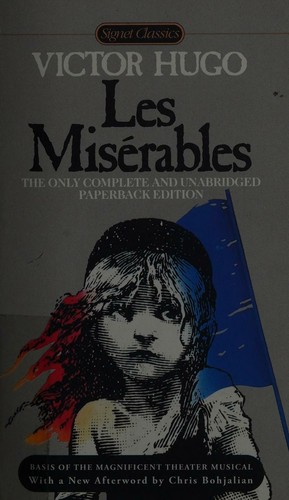
Les Misérables
Victor Hugo's vast 1862 novel follows Jean Valjean, a convict released after nearly two decades in prison, as he tries to build an honest life in post-Napoleonic France while the police inspector Javert pursues him. Around this central chase Hugo gathers Fantine, Cosette, Marius, the Thénardiers and the student revolutionaries of Paris, carrying the story from 1815 to the failed June Rebellion of 1832. The book is historical fiction with a moral and political purpose: it asks how poverty, harsh law and public indifference shape individual lives, and whether mercy can achieve what punishment cannot. This Signet Classics paperback presents the full text in the Fahnestock and MacAfee English version.
Where to buy or borrow
Are you selling this book? Bookstores, publishers, authors and libraries can be listed here for free. Request a listing
About this book
The novel is organized into five parts, each subdivided into books and short chapters. Its scope is panoramic: it spans classes, institutions and nearly two decades of French political change. As translated fiction, the book reaches English readers through several versions. This one, by Lee Fahnestock and Norman MacAfee, is a revision built on the older Charles E. Wilbour translation, and it is accompanied by an introduction by Fahnestock and an afterword by the novelist Chris Bohjalian.
Deep Overview
The opening part is a study of one man's moral crisis. Valjean leaves prison embittered, is refused shelter almost everywhere, and is then treated with unexpected generosity by Bishop Myriel. That encounter becomes the pivot on which the whole book turns. Valjean takes a new name, becomes a respected employer and mayor, and is drawn into the fate of Fantine, a young mother ground down by poverty, gossip and an economy that has no place for her. Pursuing him throughout is Javert, whose devotion to law is complete and unquestioning. The two men are less simple opposites than two answers to the same question: what do we owe a society that has already judged us?
In the second part Hugo widens the lens. He devotes a long section to the Battle of Waterloo before returning to Valjean's rescue of Cosette from the grasping Thénardier family and their retreat into the hidden world of a Paris convent. The third part introduces Marius Pontmercy, a young man divided between a royalist grandfather and the memory of a Napoleonic father, and surrounds him with students, street children such as Gavroche, and a city rendered almost as a character. The fourth part joins a delicate love story to a rising political storm, ending in the barricades of June 1832. The final part follows the consequences of that uprising, including Valjean's passage through the Paris sewers and the settling of accounts between him, Javert and the younger generation.
What keeps this from being a conventional adventure is the narrator. Hugo repeatedly stops the plot to write essays on history, architecture, slang, convent life, urban poverty, revolutions and the sewers beneath the capital. These passages are often misread as padding. They are better understood as the book's argument: individual lives cannot be understood apart from the institutions, economies and historical accidents that shape them. Valjean's stolen bread, Fantine's dismissal and Éponine's desperate loyalty all sit inside a larger picture of how society manufactures its outcasts.
Hugo's moral stance is neither purely political nor purely religious. He is severe about a penal system that turns petty offenders into hardened criminals, and he is sympathetic to republican hope, yet he places the decisive turning points in private acts of conscience and mercy. Readers should note that this is an author's committed view, one that the novel dramatizes rather than proves, and that some contemporaries and later critics found the book's sentimentality, coincidences and moralizing excessive. Its power comes less from realism of the strict kind than from scale, emotional intensity and the sense that an entire society is being put on trial.
Key Themes
Redemption through grace. The novel treats transformation as something often triggered by an undeserved act of kindness rather than by punishment alone. Hugo then asks how long such a change must be tested and whether it can ever be fully accepted by the world.
Poverty as a social product. Hunger, child neglect, prostitution and crime are presented as outcomes of conditions that society could change, not merely as personal failings.
History and progress. Napoleon's fall, the Restoration, the 1830 revolution and the failed 1832 uprising frame a continuing argument about whether, and how, a society improves.
Duty, conscience and self-sacrifice. Characters repeatedly choose between safety and obligation, and the book treats those choices as the true measure of a life.
Love in several forms. Parental devotion, romantic attachment, friendship among comrades and compassion for strangers all shape the plot, and each is shown to carry risk and cost.
Historical Context
Hugo's own politics changed over his life. He began as a conservative-leaning figure, was elected to the Académie Française in 1841, and later became a committed republican. After Louis-Napoleon Bonaparte seized power, Hugo criticized the new ruler and went into exile, first in Belgium and then on the Channel island of Guernsey, where he remained until 1870. He began the project in the mid-1840s, set it aside during the political upheavals around 1848, and completed it in exile. The book was published in 1862 by the Brussels firm Lacroix and Verboeckhoven, with a Paris edition following shortly after.
The nineteenth-century French penal system, with its galleys and harsh treatment of repeat offenders, and the realities of industrial and urban poverty form the background to Valjean's and Fantine's stories. Reading with that backdrop in mind helps clarify why Hugo treated the book as a social intervention as well as a narrative.
Intended Audience
It will also appeal to readers interested in how fiction can argue for social reform, and to those who enjoy novels that mix plot with essay-like reflection.
It may be less comfortable for readers who prefer fast, streamlined storytelling, who dislike lengthy tangents, or who need a physically lightweight book, since the mass-market paperback runs to nearly fifteen hundred pages. Readers wanting a shorter route in may prefer an abridgement, while those who want extensive scholarly notes may look to editions designed around annotation.
Reading Difficulty
The cast is large, many characters have more than one name or identity, and the narrative sometimes moves backward in time. A simple list of characters can help. Because Hugo assumes a degree of familiarity with French politics, some historical references are unexplained in the text. Anyone who enjoys reading translated fiction will recognize that choices by the translators shape tone, and this edition is a revised version built on a nineteenth-century English translation rather than a wholly new rendering.
The physical format matters: a very thick mass-market paperback has small type and narrow margins, so many readers pace themselves by part rather than reading in long sittings.
Helpful Background Knowledge
Some awareness of Hugo as a Romantic writer is also useful. He favored contrast, spectacle, grand emotional gestures and moral clarity, and a reader expecting subtle psychological realism may be surprised. Familiarity with the Catholic ideas of charity and conscience that shape Bishop Myriel's role helps, although the book does not require religious belief.
Readers who have seen the stage musical or a film adaptation will find the broad outline familiar, but the novel contains much material, including whole subplots and characters, that adaptations omit or alter.
Why Read This Book?
This particular edition has practical advantages. It is a complete text rather than a condensed version, it is affordably priced, and it includes a translator's introduction and an afterword by the novelist Chris Bohjalian that offer modern entry points. The publisher presents it as the only fully unabridged paperback currently available in English; that is the publisher's claim, and readers who care about this can check availability for themselves.
Reading the original also clarifies how much popular adaptations have compressed. Gavroche, Éponine, the Thénardiers and Marius's family are more developed here, and the moral questions are more openly argued.
Reader Takeaways
The book invites a fresh look at familiar words such as justice, mercy, duty and revolution. Following Javert's logic closely shows how a person can be honest, disciplined and still cause harm.
Readers also practice a particular skill: sustaining attention across a very long, digressive narrative, noticing how details planted early, such as names, objects and minor characters, return with force later. Finally, comparing the novel with its adaptations sharpens awareness of what each form can and cannot carry.
Strengths
Memorable characters: Valjean, Javert, Fantine, Cosette, Marius, Éponine and Gavroche have remained recognizable cultural figures, and the book gives each of them real moral complexity.
Structure: the division into five parts and many short chapters gives a daunting book a steady rhythm, and plot threads converge with great deliberation.
Moral seriousness: Hugo poses hard questions about punishment and compassion, and he lets the reader feel their consequences through concrete lives.
Edition value: this volume offers the whole text at a modest price with a supporting introduction and an afterword.
Limitations and Cautions
Hugo's argument is a committed one. His belief in social reform, moral progress and the redeeming power of love is the author's view, and it is dramatized rather than demonstrated with evidence. Some critics have found the book's sentimentality or its politics less persuasive than its storytelling, and readers may reasonably disagree with Hugo's portrayal of particular historical figures and events.
This mass-market edition carries limited scholarly apparatus. Anyone wanting detailed notes on French politics, slang or topography will need supplementary material. The English text is a revision of an older translation, so wording will differ from more recent translations, and page counts and layout differ across editions, which matters for group reading schedules.
Important Concepts, People, and Places
Inspector Javert: the police officer who pursues Valjean and embodies an absolute faith in the law.
Fantine: a vulnerable young mother whose decline exposes the harshness of the era's labor and social attitudes.
Cosette: Fantine's daughter, whose rescue gives Valjean a new purpose.
Bishop Myriel: the generous churchman whose mercy changes Valjean's course.
Marius Pontmercy: a young idealist whose political and romantic development links the private story to the 1832 uprising.
The Thénardiers and Éponine: an exploitative innkeeping family and their daughter, who show the moral cost of poverty and greed.
Gavroche and the Friends of the ABC: a Parisian street child and a group of student republicans who anchor the book's revolutionary scenes.
Waterloo (1815): the battle Hugo discusses at length, setting the historical backdrop of the era.
The Paris sewers: the setting of the book's final escapes, treated by Hugo as both a physical and a symbolic underworld.
The June Rebellion of 1832: the failed Paris uprising at the story's climax.
Guernsey: the Channel island where Hugo lived in exile while completing the book.
Charles E. Wilbour: the nineteenth-century translator on whose English version this revised text is based.
Lee Fahnestock and Norman MacAfee: the translators of this edition, with Fahnestock also writing its introduction.
Questions the Book Explores
What is the difference between obeying the law and doing what is right, and what happens to a person whose identity is built on one of them?
To what extent is crime a product of poverty and neglect rather than of individual character?
Is political revolution a path to human progress, or does it risk destroying the people it intends to help?
How do history and private lives intersect, and can a single act of kindness have lasting effects across generations?
What obligations do the fortunate owe to those living in misery, and what does the book suggest about the role of religion, charity and the state?
Reading Group Guide
Consider keeping a shared list of characters and aliases. Valjean alone appears under several names, and the Thénardier family does too.
If members have seen the musical or a film, you might begin each session by identifying one scene that differs from the book, then use the difference as a springboard to talk about what Hugo's version emphasizes.
Confirm that everyone is using the same edition when citing pages. This Signet edition runs to roughly fifteen hundred pages, and other editions paginate very differently, so referring to part, book and chapter is more reliable.
The introduction and afterword in this edition can be saved for a final meeting so they do not influence first impressions.
Discussion Questions
2. Is Javert a villain, a tragic figure, or something else? What would you say his code gets right and wrong?
3. Why might Hugo have chosen to include long digressions on subjects like Waterloo, slang and the sewers? Do they enrich the story or interrupt it?
4. How are women, especially Fantine, Cosette and Éponine, portrayed, and do those portrayals reflect the era, the author's ideals, or both?
5. The novel treats poverty as a social problem. Which scenes make that case most forcefully, and which solutions does Hugo imply?
6. What role does coincidence play in the plot, and does it strengthen or weaken the book's moral argument?
7. How does the 1832 barricade episode complicate the book's attitude toward revolution?
8. If you know an adaptation, which characters or ideas does it make more or less central than the novel does?
9. What responsibilities does the book place on individuals, and which on institutions?
10. Which character's choices stayed with you most, and why?
Sources and Verification
Some limits apply. Page counts for this novel vary widely among editions and sources, so the figure given here follows the publisher's listing for this specific paperback. The exact first publication date of the original French edition is reported differently in different places, so only the year is stated. Claims about the book's unabridged status come from the publisher.
Comments
No published comments yet.
Available editions
Paperback
Signet Classics unabridged mass market paperback, Fahnestock and MacAfee translation
- Publisher
- Signet
- ISBN-13
- 9780451419439
- Publication date
- Pages
- 1488