
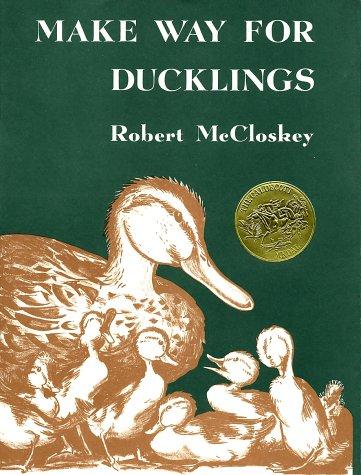
Make Way for Ducklings
Robert McCloskey's 1941 picture book follows Mr. and Mrs. Mallard as they look for a safe home in the middle of Boston. After raising eight ducklings beside the Charles River, Mrs. Mallard leads the family through city streets toward the Public Garden lagoon, and a friendly police officer helps stop the traffic. The story is simple, but the sepia lithographs and the real Boston landmarks gave it lasting appeal. It won the 1942 Caldecott Medal and became a touchstone among books for kids who are learning to read, or being read to, about animals, families and neighbourhoods. It is also the official children's book of Massachusetts, and a bronze sculpture of the duck family now stands in the Public Garden.
Where to buy or borrow
Are you selling this book? Bookstores, publishers, authors and libraries can be listed here for free. Request a listing
About this book
Deep Overview
The middle of the book is largely about raising children in practical terms. Mrs. Mallard teaches the ducklings to swim and dive, to come when called, and to walk in a line without wandering off. McCloskey presents these lessons as the ordinary work of parenting and treats them with a dry kind of humour. The tension builds when the family sets out through Boston, with Mrs. Mallard in front and the ducklings behind her. Cars do not slow down for a duck. A police officer named Michael steps in, stops traffic and calls for backup, and the family is allowed to cross Beacon Street at its own pace. The family arrives at the Public Garden lagoon, where the swan boats and the peanuts offered by visitors make it a welcoming place, and Mr. Mallard is waiting for them there.
The structure is a simple circuit of departure, obstacle and reunion. The text is spare, and it leaves room for the pictures to carry the pacing. Facing pages often show the same scene from changed angles, and the sepia palette keeps the visual mood calm even when the traffic piles up. The illustrations were drawn in charcoal and reproduced as lithographs, which gives the page a soft, grainy texture. McCloskey also made many careful sketches of how ducks move, so a reader can see the waddle, the glide and the sudden dive.
What McCloskey seems to be demonstrating is that a small and ordinary story can be told with seriousness. The book never talks down to its audience. It trusts children to follow a plot with a real problem and a real solution, and it trusts them to notice details in the pictures. It also shows a city as a place where strangers can cooperate: drivers, police officers and passers-by all make room for a family that has no power but a clear purpose. The result is a reassuring story in which kindness, patience and preparation are rewarded without being turned into a lecture.
Key Themes
Parenting as steady, practical work is the second thread. Mrs. Mallard teaches skills, sets rules and keeps count of her brood, and the story gives that daily labour dignity.
Community responsibility appears in the police officer and the drivers who give way. Authority is shown as protective rather than punishing.
Nature inside the city is a quieter theme. Wild animals share the streets with people, and the book suggests that coexistence takes attention and a willingness to slow down.
Place and belonging run through the book's use of real locations. A family arrives somewhere and makes it theirs, which helps explain why generations of Bostonians feel the story belongs to them.
Historical Context
The book appeared in August 1941, when American picture books were growing in artistic ambition. The Caldecott Medal, awarded by the American Library Association for the year's best-illustrated children's book, was still young, and this book received the 1942 medal. The book also belongs to a mid-century tradition of regional picture books rooted in a particular landscape. Its popularity later fed a civic afterlife. Nancy Schön's bronze sculpture of the ducks was installed in the Public Garden in 1987, and a copy was presented to Moscow in 1991 in connection with the START Treaty. In 2003 the book was named the official children's book of the Commonwealth of Massachusetts.
Intended Audience
It also suits readers with a connection to Boston, including visitors who want a story to carry into the Public Garden. Collectors of Caldecott winners and students of picture-book design will find it a useful example of mid-century illustration.
Readers looking for fast action, fantasy or complex plotting may find it too quiet. Older children can enjoy it, but mostly for its art and its place in children's literature rather than for the story.
Reading Difficulty
The book is moderately long for a picture book, with roughly 60 to 70 pages in most hardcover editions, though counts vary by printing. The large format, around the size of a big picture book, suits reading aloud to a small group. The sepia drawings reward slow looking, so allow extra time for children to follow the ducklings through each scene.
Helpful Background Knowledge
A little knowledge of Boston adds a lot. The Public Garden, the Charles River and Beacon Street are all real, and a map or a few photographs of the swan boats can make the book more concrete. Adults reading with children may also want to know that the illustrations are lithographs made from charcoal drawings, which helps explain their soft texture. A quick look at the Caldecott Medal gives context for why the book is so often called a model of the form.
Why Read This Book?
It is also a good entry point to the idea that a book can be tied to a place. Few picture books have shaped a city's identity as strongly, and reading the book before visiting the Public Garden can make the sculpture feel more meaningful. If you are looking for award-winning books that remain popular decades after they won, this is a standard example. The 1942 Caldecott winner is still widely read, which says something about its mix of simplicity, humour and reassurance.
Reader Takeaways
Readers may also reconsider the idea of a city as a shared space. The book encourages young children to notice who helps in their own neighbourhood and how people can make room for others.
For adults, the book offers a model of reading aloud: slow down at the crossing, let the pictures carry the tension, and invite children to predict what comes next.
Strengths
The story is well paced. Its short text, clear structure and satisfying ending suit read-aloud sessions, and the humour is gentle enough for young children but dry enough for adults.
The book's sense of place is also distinctive. Real locations make it concrete, and its long life has created a tangible link between story and city, including the statues, which families still visit.
Finally, the book treats its audience with respect. The problem is real, the solution takes effort, and the officers and drivers are shown as helpful rather than comic.
Limitations and Cautions
The story is gentle and slow, and children used to fast action may need patience. It is also tied to Boston, so readers with no connection to the city may miss some of its resonance, though the basic story still works.
Sources disagree on the page count and exact printing details of different editions, so anyone looking for a particular printing should check the copy in hand. Some details of McCloskey's working methods, such as his time with live ducklings, come from biographical accounts and retellings, and some anecdotes vary between sources.
Important Concepts, People, and Places
Mrs. Mallard: The mother duck is the main character. She judges where it is safe to nest, trains the ducklings and leads the walk through the city. Most of the story's events depend on her decisions, so the book is largely a portrait of a capable parent.
Mr. Mallard: The father helps choose the nesting site. He then leaves to explore the river and arranges to meet the family later. Because he is away, Mrs. Mallard has to make the journey alone, and the meeting gives the story its happy ending.
Jack, Kack, Lack, Mack, Nack, Ouack, Pack and Quack: These are the eight ducklings. Their names run in alphabetical order and rhyme, which makes them fun to say aloud. They also make counting part of the story. Children often recite the names along with the reader, and the ducklings walking in a line became the image most people remember from the book.
Officer Michael: Michael is the Boston police officer who knows the ducks. When the family needs to cross the road, he stops the traffic on Beacon Street and gets other officers to help. He is the clearest example of a theme that runs through the book: adults in the city using their authority to protect someone smaller.
Boston Public Garden: The garden is where the family is headed and where the story ends. Its lagoon, small island and swan boats are drawn from the real park. Because the garden is real, the book now draws visitors there.
Charles River: The river separates Boston from Cambridge. The Mallards nest and hatch their young on a small island in the river. This is the safe place where the ducklings grow up before the family leaves for the busy streets.
Beacon Street: This busy street runs along one side of the Public Garden. Crossing it is the most dangerous moment of the journey. The scene shows how a small thing like a mother duck and her ducklings can stop a whole city's traffic.
Caldecott Medal: The American Library Association gives this award each year to the illustrator of the most distinguished American picture book. Make Way for Ducklings won it in 1942, early in the award's history. The medal has helped keep the book in libraries, school reading lists and gift collections for generations.
Viking Press and May Massee: Viking published the book in 1941. May Massee was the influential children's book editor there, and she worked closely with McCloskey at the start of his career. Their partnership continued through several of his later books.
Lithography: This printing method gives the pictures their grainy, soft texture and single brown tone. Accounts of exactly how McCloskey made the plates differ. Some say his charcoal drawings were reproduced through lithography on zinc plates. Others say he drew the images in reverse directly onto zinc lithographic plates. All accounts agree that lithography made the book's look possible.
Nancy Schön: Schön is the Massachusetts sculptor who made the bronze statues of Mrs. Mallard and her eight ducklings. The statues were installed in the Public Garden in 1987. They turned the book's best-known image into a public monument, and children are encouraged to climb on it. A copy was presented to Moscow in 1991 as a gesture of goodwill between the United States and the Soviet Union. The gift showed that the book had become a symbol of Boston, and in some ways of the United States, around the world.
Questions the Book Explores
How do parents prepare young creatures for a risky world without making them fearful? Mrs. Mallard's lessons suggest one answer.
What do wild animals and city dwellers owe each other? The story imagines a shared space in which drivers and officers adjust their routines.
Can a very simple story have real stakes? McCloskey shows how a short, quiet journey across a street can carry tension and relief.
How can a picture book make a real city feel personal? The book answers with specific landmarks and careful drawing.
Reading Group Guide
For a school or library group, a map of Boston with the Public Garden, the Charles River and Beacon Street marked can anchor the story. A visit to the duck sculpture, or a look at photographs of it, shows how a book can shape a place. A group could also compare the original sepia pictures with later editions or adaptations, noting what changes with colour or format.
Mixed-age groups can pair a retelling by children with a discussion by adults. Children can act out the walk across the street, while adults consider the book's picture of community and its mid-century setting.
Discussion Questions
2. How does McCloskey use repetition, such as the duckling names and the line they walk in, to shape the story?
3. What does the single brown tone add to the pictures, and how might the book feel in full colour?
4. How does the book portray the police officer and the drivers, and what does it suggest about community?
5. Which pictures show the most careful observation of ducks, and how do they affect your trust in the story?
6. Why might a book so tied to Boston appeal to readers elsewhere?
7. What does the book leave out about city life, and does that matter?
8. How do the statues in the Public Garden change the way you imagine the story?
9. What is Mr. Mallard's role, and how does the book balance his part with Mrs. Mallard's?
10. If you were adapting the story to a different city, which details would you change?
Sources and Verification
Factual limits: sources disagree on page count and on the date and printing history of specific copies, so those details are not given for this edition. Several accounts of McCloskey's working methods are retellings of earlier biographical stories, and details may differ between versions.
Comments
No published comments yet.
Available editions
Hardcover
- Publisher
- Viking Press
- ISBN-13
- 9780670451494