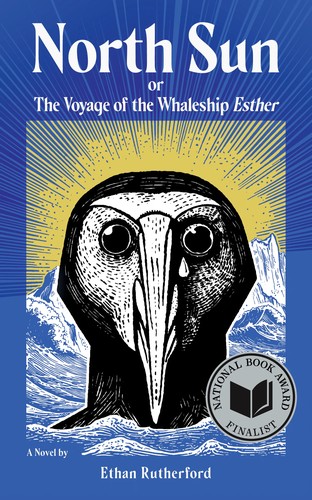
Cover for North Sun

Historical Fiction

North Sun by Ethan Rutherford

Or, the Voyage of the Whaleship Esther

North Sun is Ethan Rutherford's first novel. It follows the whaleship Esther, which leaves New Bedford in 1878, when American whaling is in decline and the oceans have been hunted close to empty. Captain Arnold Lovejoy takes the ship north toward the Chukchi Sea. He has a private errand for the wealthy family that owns the vessel, and that errand sits alongside the ordinary work of killing whales. The book begins as a recognizable sea story, then slowly slides into stranger, more mythic territory. Rutherford writes in short, lyrical chapters and uses period detail to ask what extraction costs the natural world and the men sent to do it. As historical fiction it is unusual: grounded in real industry and then deliberately unsettled. It was a finalist for the 2025 National Book Award for Fiction.

Where to buy or borrow

Are you selling this book? Bookstores, publishers, authors and libraries can be listed here for free. Request a listing

About this book

North Sun is a literary novel that begins as an historical sea adventure and gradually becomes allegorical and fantastical. Rutherford was already known for two short story collections, The Peripatetic Coffin and Other Stories and Farthest South and Other Stories, and this is his first long-form work. It is set in a real industry in real decline, but the ship and its crew are invented. Readers who look for historical fiction will find a carefully researched surface of ships, ports, trade goods and routines. Anyone expecting a strict reconstruction of the period will find the book moves away from that. Melville's Moby-Dick is the obvious point of comparison, and Rutherford has said he admires it. He chooses compression over Melville's encyclopedic sprawl, with brief chapters, spare sentences and a voice closer to ballad than treatise. The first half behaves like a traditional whaling voyage, the second half becomes stranger, and that shift in contract with the reader is the book's defining formal gamble. A companion instrumental and spoken-word album, made with musician Peter C Murray, extends its musical sensibility. For readers of literary fiction, it offers a rare blend of maritime realism, folklore and ecological alarm.

Deep Overview

The story opens on land, in the commercial world that makes whaling possible. Arnold Lovejoy is a tired captain whose latest voyage did not pay. He is offered another job by the Ashley family, a prosperous dynasty of shipowners whose fortune rests on whale products, spermaceti candles among them. In 1878 the Esther sails from New Bedford. Officially she is on a hunting voyage, first across the Pacific and then toward the northern grounds before the ice closes. Lovejoy also carries a second, personal mission connected to another captain, Benjamin Leander, whose own ship was lost to the ice. Around Lovejoy is a crew that includes two boys, and a mysterious protective figure known as Old Sorrell, who is part man and part bird in the retellings of the book's plot.

The novel's structure matters as much as its plot. Rutherford builds the opening as a convincing, almost conventional voyage: the crowded forecastle, the commerce, the routines, the arithmetic of oil and profit. As the ship pushes north, the realism begins to loosen. The ice closes, the hunts grow more brutal, and the book admits ghosts, folklore and visions into what had looked like a documentary world. Rutherford has described the book himself as one that turns strange partway through, and reviewers have noted that this turn is deliberate rather than a loss of control.

The book's central argument is moral and ecological. Everyone aboard the Esther is, in some sense, extracting something. The owners want profit, the captain wants resolution, and others want glory, pleasure, duty or revenge. The ocean, and the animals in it, absorb the cost. Rutherford sets this in a single ship because a ship is a closed system: those who give orders and those who carry them out share the same cramped space, yet they do not share the same risk. The novel is as interested in the ones who are disposable to the enterprise, including the boys and the poorer hands, as it is in the captain.

The prose style sets this book apart from its famous ancestors. Short chapters and clipped, rhythmic sentences give the narrative a musical quality, which is probably why the author collaborated on an imaginary soundtrack for the novel. The pacing is episodic, so scenes feel like songs on a record or stanzas in a long ballad. The result is a book that sits between historical novel, sea allegory and fable, and asks the reader to take the allegory seriously without losing the physical reality of the hull, the cold and the work.

Key Themes

Extraction and appetite: the novel treats whaling as a model for any enterprise that takes from nature until nothing is left, and it links commercial hunger to the personal hungers of individual characters.

Who pays the cost: the owners profit from a safe distance, while the crew, the boys and the animals bear the danger and the loss.

Shared suffering: a reviewer in Rain Taxi reads the book as insisting that suffering is never purely individual, and that people are bound together by harm as much as by cooperation.

Realism versus myth: the movement from the plausible to the uncanny asks whether a historical story can carry truths that plain documentary cannot.

Stories and inheritance: the book keeps returning to storytelling, the way older tales and beliefs shape the way young people understand the sea.

End of an era: the sense of an industry at its terminus, with empty seas and dwindling returns, gives the voyage an elegiac mood.

Historical Context

American commercial whaling was a major economy of the nineteenth century, and New Bedford, Massachusetts, was at its center. A review in the Harvard Review notes that in the mid-1800s the port was the largest whaling center and, per capita, the wealthiest city in the world. Whale products were valued as lamp oil, candle material and industrial raw material, and the trade made some families very rich.

By the 1870s, when the novel is set, the industry was shrinking. Whales had been hunted so heavily that many populations were collapsing, and ships had to travel farther, including into Arctic waters such as the Chukchi Sea, to find them. Competing sources of light and lubrication also eroded demand. These are the circumstances that make the Esther's northern voyage feel like a last gamble.

Literarily, the book enters a tradition shaped by Herman Melville's Moby-Dick, in which a whaleship stands for something larger than a workplace. Rutherford acknowledges the comparison. He has said he admires Melville, and he deliberately works in a different register, with brevity in place of encyclopedic density. The book also belongs to a recent wave of fiction that uses historical settings to think about environmental damage and the economics of extraction.

Intended Audience

The book suits readers who enjoy historical fiction that is willing to break away from strict realism, and those who like atmospheric sea stories, fables or allegory. Readers of Melville, Cormac McCarthy-style stark prose, or ecologically minded fiction may find a good fit. People who like short chapters and a poetic cadence will also feel at home.

It may be less satisfying for readers who want a tightly plotted adventure that stays in one realistic mode, or an accurate technical account of whaling. Those who dislike ambiguity, unexplained supernatural elements or bleak depictions of violence toward animals and people may find it uncomfortable.

Reading Difficulty

The sentences are clear and the chapters are short, so the book is easier to read in a sitting than its nineteenth-century model. The difficulty lies elsewhere. The narrative becomes more fragmentary and symbolic as it proceeds, and the reader must decide how to interpret events that are not explained. The cast is fairly large, and some characters have historical or mythic resonances that are only hinted at. Some nautical vocabulary appears, though the context usually makes it understandable. Printed editions run to roughly 390 pages, with some variation between sources. An ebook edition also exists. The tone is dark in places, with scenes of hunting and death.

Helpful Background Knowledge

No specialist knowledge is needed. A basic picture of nineteenth-century whaling will help: ships sailing from New England ports, long voyages, a hierarchy of owner, captain and crew, and products such as whale oil and spermaceti. It also helps to know, in general terms, how severely whale populations were depleted by the late 1800s. Some familiarity with Moby-Dick, even by reputation, makes the book's choices more visible, though it is not required. Readers who like to approach a work knowing what it is attempting should know that the book moves from a realistic voyage into stranger territory, and that this is intended.

Why Read This Book?

Choose this book if you want a sea novel that treats whaling as a moral and ecological problem rather than as a backdrop for heroics. It is a good case study in how a writer can honor the conventions of a classic genre while quietly breaking them. The short-chapter form gives it momentum, and the shift in the second half creates talking points that stay with a reader. As literary fiction it also shows how a short story writer adapts his craft to a longer canvas. Its recognition as a finalist for the 2025 National Book Award for Fiction, and the existence of an original musical companion, signal that readers and critics have found it distinctive.

Reader Takeaways

A careful reader may come away with a clearer sense of how an industry's economics shape the lives of the people at the bottom of its hierarchy. You may also reconsider what it means for a novel to be historical, since the book uses research as a foundation and then departs from it. You will likely notice how rhythm, repetition and chapter length create mood. Many readers will also find themselves thinking about the connection between historical extraction and present-day environmental crisis, and about the difference between individual guilt and shared responsibility.

Strengths

The prose is controlled and musical, and the short chapters give the book a distinct shape. The research is worn lightly, so period details support the story without overwhelming it. The genre shift is structurally ambitious and gives the book a character of its own among sea novels. The moral argument is built into the situation rather than delivered as commentary, which lets readers reach conclusions through events. Reviewers from several publications have praised its originality and its ecological urgency.

Limitations and Cautions

The turn toward the fantastic is a risk, and readers who prefer consistent realism may feel the book abandons what it established. The symbolic approach means some characters and events function more as representations than as fully individual psychologies. The book is bleak and includes graphic hunting and violence. Because it is an allegory, interpretations differ, and readers should not expect every mystery to be explained. It is not a reliable source on whaling history; characters and the ship are fictional, and the story takes liberties with realism. Some of the praise quoted in promotional material is the publisher's selection, so independent reading is advisable.

Important Concepts, People, and Places

The Esther: the whaleship at the heart of the book, whose voyage from New Bedford in 1878 supplies the structure.

Arnold Lovejoy: the captain, worn down by an unprofitable earlier voyage, who carries a private mission alongside the hunt.

The Ashley family: wealthy owners whose fortune comes from whale products, representing the commercial interests behind the voyage.

Benjamin Leander: a captain tied to the Ashley family whose ship was lost to the ice, and whose fate drives Lovejoy's errand.

Old Sorrell: a mythic, part-bird figure aboard the ship who protects two young boys and links the story to folklore.

New Bedford, Massachusetts: the port from which the Esther sails, once among the richest whaling centers in the world.

The Chukchi Sea: the Arctic destination where the voyage turns harrowing.

Spermaceti and whale oil: the products that fueled light and profit, and that stand for the economy of extraction.

Moby-Dick and Herman Melville: the literary ancestor against which the book is read, and from which it deliberately differs in scale and style.

The National Book Awards: the prize for which the novel was a finalist in the fiction category in 2025.

Peter C Murray: the musician who composed an imaginary soundtrack, with spoken passages read by Rutherford.

Questions the Book Explores

What does it cost, and who pays, when a society builds wealth by depleting the natural world? How do ambition, grief, duty and revenge turn into forms of appetite? Can a historical novel tell the truth about a period by leaving realism behind? What happens to the people who carry out an industry's work but never share its rewards? How do stories, myths and inherited beliefs help people cope with danger and loss at sea? Is suffering ever truly private?

Reading Group Guide

The book rewards a discussion that begins with its shape. Consider pausing at the midpoint of the voyage and asking what the group expected next, then comparing that expectation with what happens. Groups may want to talk about how comfortable each member was with the shift away from realism, since reactions vary widely. It can help to assign different members to track different characters' motives, and to compare how each one wants something from the sea or from other people. Because the chapters are short, a group might read aloud one or two to listen to the rhythm of the language. Anyone who has read Moby-Dick could bring a brief comparison, and a few members might listen to the companion album, which is a separate work, for a different view of the book's mood. Content notes about violence toward animals and humans are worth raising at the outset.

Discussion Questions

1. How did you react when the novel moved away from the conventions of a traditional whaling story, and what did that change accomplish?
2. Which characters seem most responsible for the harm in the book, and does responsibility belong to individuals or to the system around them?
3. How does the author use the Ashley family's wealth and distance to comment on the economics of extraction?
4. What role does Old Sorrell play, and how does a mythic figure change your understanding of the crew's world?
5. In what ways do the two boys shape the book's emotional center?
6. How do the short chapters and spare sentences influence your sense of time and danger?
7. Does the book feel like a commentary on the past, the present, or both?
8. How does comparison with Moby-Dick help or hinder your reading?
9. What does Lovejoy want, and how does his private goal differ from the ship's official purpose?
10. Which details struck you as most vivid, and how do you think they were chosen?

Sources and Verification

This profile draws on the publisher's own product information, the National Book Foundation's finalist listing, and library, retailer and bibliographic records used to confirm the title, author and ISBN. Descriptions of the plot, the style and the historical setting rely on published reviews and interviews from literary, regional and academic outlets, as well as on university news pages about the author. All commentary is original. Sources disagree on the exact release date, giving either March 4 or March 11, 2025, and on the page count, so neither is stated here. Plot details reflect how reviewers and catalogues describe the book, and the later portions of the story are deliberately not summarized.

Comments

No published comments yet.

Sign in to add a comment.

Available editions