
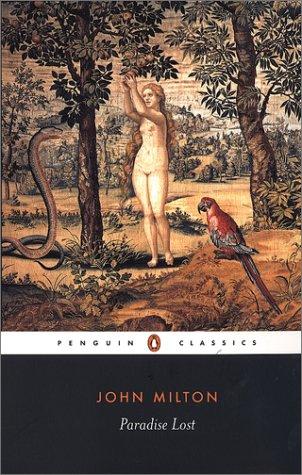
Paradise Lost
Paradise Lost is John Milton's seventeenth-century epic in blank verse, a retelling of the biblical Fall of humankind on a cosmic scale. The poem moves between Hell, where Satan and the defeated rebel angels regroup, Heaven, where divine authority is explained and defended, and Eden, where Adam and Eve are tempted and lose their home. Milton uses the story to ask why a good God permits disobedience and suffering, and he builds the argument through some of the most memorable characters and speeches in English poetry. This Penguin Classics edition, with an introduction and notes by John Leonard, supports modern readers through a demanding text. It remains one of the classic books of English literature, valued for its argumentative force, its imagery and its long influence on later writers.
Where to buy or borrow
Are you selling this book? Bookstores, publishers, authors and libraries can be listed here for free. Request a listing
About this book
Milton chose unrhymed iambic pentameter, known as blank verse, and defended the choice in a short prefatory note that appeared in the early printings. The poem was first issued in ten books in 1667. The second edition of 1674 split two of the longest books to give twelve, in the manner of Virgil's Aeneid, and twelve books is the standard form today. The edition profiled here is a Penguin Classics paperback. John Leonard supplies an introduction, notes and a bibliography, which matter in a poem so dense with biblical, classical and contemporary allusion. This is a reading edition with scholarly apparatus, not a facsimile of a seventeenth-century printing.
Deep Overview
Milton also tells earlier events through other voices. The archangel Raphael visits Adam as a guest and a teacher. He recounts the war in Heaven and the creation of the world, so that Adam is warned about what is at stake before the temptation happens. Satan reaches Eden disguised, studies the couple, and chooses his moment with care. Eve and Adam fall in turn, and Milton gives their choices distinct psychological textures: hers is bound up with ambition and persuasion, his with loyalty and a refusal to be parted from her. The poem's final books move from guilt to consequence. The archangel Michael shows Adam a sweeping vision of human history and the promise of eventual restoration, and the pair leave Paradise into a world that is open before them.
What holds this material together is argument. Early in the poem Milton states an intention to explain the ways of God to people, and much of the narrative is built from speeches that reason, rationalise or deceive. Satan is the most compelling orator in the poem. His rhetoric is vivid and self-justifying, and its power is part of what Milton wants readers to examine. Heaven's own speeches are more stately, and they are meant to show a universe in which obedience is freely chosen and cannot simply be compelled. The poem keeps returning to the question of whether creatures who were made free can be held responsible for what they do.
Milton also gives the poem a personal frame. By 1652 he was blind, and he composed the poem by dictation. The invocations at the openings of several books turn that fact into a poetic subject, as a poet in darkness seeks inward illumination. Milton counts the poem's cosmic story as inseparable from his own situation as a writer who had lived through civil war and then watched the political cause he had served collapse.
The poem's structure rewards attention. Books I and II set out Hell, III opens in Heaven, and the central books fold in the story of the war and the creation. The Fall is delayed until the ninth book, after the reader has been shown nearly everything that could have prevented it. That delay increases the sense of tragedy: Milton wants the reader to feel how avoidable the disaster was and how much it cost.
Key Themes
Authority and rebellion form a second theme. Satan frames his revolt as resistance to tyranny, and the poem invites readers to weigh that language against the actions it justifies. Readers have long debated whether Milton's own political history shapes the poem's treatment of kingship, and the interpretation remains contested.
Temptation and self-deception appear in the way arguments are built. The poem shows rhetoric as a moral force that can enlarge or corrupt a mind, and it pays close attention to how a person can be talked into what they partly want to do already.
Marriage, companionship and gender receive extended treatment. The poem presents Adam and Eve's relationship as intimate and unequal at once, and it is a frequent starting point for critical argument about hierarchy and partnership.
Knowledge and its limits recur, from Raphael's careful answers about astronomy to the forbidden fruit itself. Finally, the poem pairs loss with hope: the Fall is devastating, but the closing books turn towards restoration and the possibility of a changed life.
Historical Context
The poem's publication was affected by the same instability: the political climate of the period delayed its release. The first edition appeared in 1667, printed by Samuel Simmons, and for several years it circulated with different title pages as the publisher adjusted how it was sold. A 1668 printing added short prose arguments summarising each book. The second edition of 1674 reorganised the poem into twelve books, added commendatory verses from Samuel Barrow and Andrew Marvell, and introduced an engraved portrait of the author. Milton died in 1674, shortly after it appeared, which makes that edition the last form of the text he could supervise.
The literary background is the classical epic. Milton knew Homer and Virgil intimately and set out to write an English epic that would match them while rejecting the glorification of war. The biblical Book of Genesis supplies the narrative, but Milton fills its brief account with invented speeches, scenes and characters. The cosmology of the poem, a stationary earth in a layered universe, belongs to the intellectual world before the new astronomy had been widely absorbed.
Intended Audience
Readers who enjoy reading aloud, or who are drawn to ambitious language, may find the poem especially rewarding. Fans of later fantasy and speculative fiction, many of which draw on Milton's images of fallen angels and invented worlds, will recognise a source.
It may be less suitable for readers who want fast, plot-driven storytelling, for those who dislike dense syntax, or for anyone who needs a modernised prose retelling. People wanting a purely devotional text should know that the poem is as much argument and imaginative invention as scripture, and that it takes real liberties with its biblical source.
Reading Difficulty
The vocabulary includes archaic words, words used in older senses and many classical and biblical names. Allusions can be dense, particularly in the catalogues of fallen angels and in passages about geography and astronomy. The explanatory notes in this edition are valuable here, but flipping to them constantly can interrupt momentum, so some readers prefer a first pass guided mainly by the introduction and a summary of each book.
The conceptual difficulty is moderate to high. Theological arguments about foreknowledge, free will and the Son's role are sometimes technical. The pacing is uneven by design, with intense dramatic scenes alongside long explanatory speeches. This is a paperback of 512 pages, which includes the introduction, notes and other editorial matter alongside the poem itself, and it is portable but dense.
Helpful Background Knowledge
Some knowledge of the classical epic is useful, especially the opening conventions of Homer and Virgil. You do not need to have read them, but knowing what an epic invocation and an epic council are makes Milton's variations easier to see.
A short account of English history from the Civil War through the Restoration will give context to the poem's treatment of authority and its tone of resilience after defeat. It also helps to know that the poem was dictated by a blind poet.
Finally, read the editor's introduction first or alongside the poem, and keep the book-by-book arguments in view. Familiarity with how blank verse works, five stresses per line without rhyme, will help you hear the rhythm.
Why Read This Book?
The poem is also valuable for the debates it has produced. Readers have argued for centuries about how to understand Satan, about Milton's theology, and about the poem's treatment of Eve. Reading it yourself lets you take part in those arguments with direct evidence.
This particular edition is a practical way in. It pairs the text with an introduction, notes and bibliography from a single editor, which helps first-time readers keep their bearings. The result is a manageable single-volume route into a poem that otherwise can feel inaccessible.
Reader Takeaways
Readers may reconsider the relationship between persuasion and truth, noticing how a speech can be beautiful and still deceptive. They may also reconsider what freedom means if it includes the capacity to choose badly.
They will likely notice the poem's language in new ways: the long sentence, the placement of a single word at a line break, the use of sound and rhythm for emphasis. And they may find that the poem's final books, often skimmed, change the emotional shape of everything that came before.
Strengths
Milton's control of language is a central strength. His syntax and sound shape meaning, and passages of description, such as the first view of Hell and the Garden, remain striking. The organisation, with its delayed Fall and its frame of invocations, produces dramatic tension even though the outcome is known.
The Penguin Classics edition adds usefulness: editorial introduction, notes and bibliography by John Leonard help readers navigate allusions and difficult passages. The paperback format makes the whole poem available at a modest price.
Limitations and Cautions
The poem's interpretation is contested. Some readers see Satan as the poem's tragic hero, others as a deliberately corrupted rhetorician, and Milton's own theological position has been analysed as departing from orthodoxy in some respects, which is disputed. An editor's introduction offers one informed framing, not the only one.
Practically, the language is demanding and the pace is slow, with long explanatory passages that some readers find static. The edition is an annotated reading text, and readers who want a detailed critical history, a facsimile of the original printings or a modern prose version should look elsewhere.
Important Concepts, People, and Places
Satan, formerly a high-ranking angel, is the poem's most debated figure. He leads the rebellion in Heaven, regroups in Hell and tempts Eve in Eden. His speeches test the poem's claims about freedom and authority.
Adam and Eve are the first human beings, whose life in Eden, disagreement and shared fall form the poem's emotional core.
God the Father and the Son represent divine authority and mercy. Their dialogue in Heaven sets out the poem's account of free will and the promise of redemption.
Raphael and Michael are archangels who instruct Adam: Raphael through warning and cosmic narrative, Michael through a vision of the future that closes the poem.
Hell and Pandemonium, its capital, are where the fallen angels debate, with Beelzebub, Mammon, Belial and Moloch giving distinct political positions. Sin and Death, allegorical figures at Hell's gates, and Chaos, the formless realm Satan must cross, belong to Milton's invented cosmology.
The Garden of Eden is the setting of the central tragedy. The Fall of man is the biblical event the poem expands and interprets.
Blank verse and the epic tradition, especially Homer and Virgil's Aeneid, are the formal and literary frameworks Milton adapts. In medias res, beginning in the middle of the action, shapes the opening.
Samuel Simmons was the printer of the first editions, and Andrew Marvell contributed a commendatory poem to the 1674 second edition. Paradise Regained, a later poem by Milton, continues his treatment of the story. John Leonard is the editor responsible for this edition's introduction and notes.
Questions the Book Explores
What distinguishes legitimate authority from tyranny, and how can language disguise the difference?
Why does evil often seem attractive, and how does a mind rationalise a decision it already wants to make?
What makes a relationship between equals, and what does the poem imply about hierarchy within a loving partnership?
How much knowledge is appropriate for human beings, and who decides where curiosity becomes transgression?
Can loss be endured, or even redeemed, and what kind of future remains after a catastrophic mistake?
And what can poetry do that argument alone cannot, in making readers feel the reasoning of a moral claim?
Reading Group Guide
Encourage members to read passages aloud. Hearing the sentences makes the syntax clearer. Ask each person to choose a short passage they found striking and read it to the group.
Agree beforehand how to use the notes. Some groups prefer to read a book once without notes and then return to selected passages with them. The introduction by John Leonard is best read either before beginning or after finishing the first two books.
Expect disagreement, especially about Satan and about Eve. A good session lets members state different interpretations and point to lines that support them, without trying to settle the matter. The discussion questions below are meant as starting points for that kind of conversation.
Discussion Questions
2. Why might Milton have delayed the Fall until Book IX, after showing readers so much of Heaven, Hell and Eden?
3. How do the speeches of the fallen angels in Pandemonium differ, and what does the council suggest about the politics of rebellion?
4. What does the portrayal of Adam and Eve's daily life add to the tragedy of their choices?
5. Compare the motives of Eve and Adam in the Fall. Does the poem treat their responsibility as equal?
6. What is the function of Raphael's visit? Does his warning change how we judge Adam?
7. How do the invocations to the muse and the references to the poet's blindness shape our sense of the narrator?
8. Does the ending feel hopeful, tragic, or both, and which lines make you think so?
9. Where do you notice Milton departing from or expanding the biblical account, and what does he gain by doing so?
10. How do the form and sound of blank verse affect your experience of a particular passage?
Sources and Verification
Factual limits: listed publication dates and page counts for modern editions vary slightly between sellers and regional listings, so this profile follows the publisher's own US listing. The essay prose is original editorial synthesis. Interpretive points, such as readings of Satan or of Milton's theology, are described as debated, not settled.
Comments
No published comments yet.
Available editions
Paperback
Penguin Classics paperback, edited with introduction and notes by John Leonard
- Publisher
- Penguin Classics
- ISBN-13
- 9780140424393
- Publication date
- Pages
- 512