
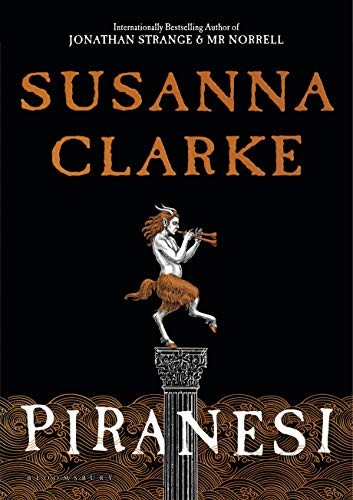
Piranesi
Piranesi lives in the House, an apparently endless world of classical halls, monumental statues, birds, clouds, and seawater. He maps its spaces, predicts its dangerous tides, cares for its dead, and records his discoveries in journals. His only regular companion is the Other, a sharply contrasting figure who treats the House as the possible repository of secret knowledge. When signs suggest that another living person has entered this world, Piranesi begins examining inconsistencies in his records and gaps in his memory. What starts as an account of solitary exploration gradually becomes a mystery about identity, captivity, trust, and the uses of knowledge. Susanna Clarke combines a fantastical setting with the investigative momentum of a psychological mystery, making the narrator’s careful observations both the substance of the world and the means by which its hidden history can be recovered.
Where to buy or borrow
Are you selling this book? Bookstores, publishers, authors and libraries can be listed here for free. Request a listing
About this book
Deep Overview
His journals provide both order and vulnerability. They preserve knowledge more reliably than his memory, yet their unusual chronology and inaccessible early volumes indicate that his account of himself is incomplete. Because the story is restricted to what he notices and understands, familiar objects can appear strange, and seemingly ordinary statements acquire unsettling implications. Readers often recognize discrepancies before Piranesi does, but his intelligence prevents the device from becoming a simple exercise in superior knowledge. He is an accomplished observer whose underlying assumptions have been manipulated.
The Other embodies a rival relationship to the House. Where Piranesi responds with attention, gratitude, and care, the Other searches for power: the supposedly Great and Secret Knowledge once pursued by people associated with occult ideas and forgotten methods. He supplies useful objects and presents himself as Piranesi’s colleague, but their unequal access to information makes the relationship increasingly troubling. A warning about a new arrival forces Piranesi to decide whether loyalty to his sole companion is compatible with the evidence contained in his own records.
The resulting investigation turns reading into action. Piranesi must locate old journals, decipher his earlier system, compare names and events, and confront records he does not remember writing. The book therefore links architecture, text, and mind: exploring halls resembles navigating an archive, while reconstructing the archive becomes a way of reconstructing personal history. Questions of identity grow more complicated rather than simply resolving. Recovering a former name and biography cannot erase the person shaped by years in the House.
Clarke also resists treating the House as merely a prison or psychological symbol. It can endanger, isolate, and alter those who enter it, yet it also sustains life and inspires forms of attention unavailable to characters obsessed with mastery. The novel’s moral distinction is not between wonder and reason—Piranesi possesses both—but between receptive inquiry and possessive ambition. Its mystery supplies momentum, while its deeper force comes from asking what remains of a self after memory is fractured, and whether survival requires returning unchanged to an earlier identity.
Key Themes
• Knowledge and domination: Curiosity appears in sharply different forms. Patient observation creates understanding and relationship; the pursuit of hidden power encourages secrecy, exploitation, and control.
• Wonder as a discipline: Piranesi’s reverence is sustained by close attention rather than ignorance. The novel presents wonder as compatible with classification, measurement, and practical skill.
• Captivity and belonging: The House can be understood as refuge, ecosystem, sacred space, and prison. These meanings coexist, complicating any simple opposition between escape and freedom.
• Care and moral perception: Attention to birds, tides, human remains, and another person’s vulnerability becomes an ethical practice. Small acts of care reveal character more reliably than abstract claims to greatness.
• Fragmented selves: The recovered past does not automatically replace the present. The novel explores how several versions of a life may remain psychologically real at once.
Literary and Cultural Context
The novel also participates in a much older labyrinth tradition. The classical story of the Cretan Labyrinth, Theseus, Ariadne, and the Minotaur supplies a recognizable pattern of confinement, hidden knowledge, and guided escape, but Clarke redistributes those roles rather than simply retelling the myth. The House’s seemingly endless arrangement also places the book in conversation with modern fantastical labyrinths, including the conceptual architectures associated with Jorge Luis Borges. Its journal form adds another lineage: narratives in which documents, incomplete records, and acts of interpretation determine what readers can know.
Intended Audience
Readers seeking extensive magical systems, large ensemble casts, rapid action from the opening pages, or a fully explained secondary world may find its early sections too quiet or enigmatic. The story rewards patience with repeated images, altered meanings, and journal details. Because discovery is central to the experience, first-time readers generally benefit from avoiding highly specific plot descriptions.
Reading Difficulty
The novel is relatively short and its cast is small, so the practical reading burden is moderate. Its greater difficulty is interpretive: readers must distinguish observation from assumption without dismissing the narrator’s perspective. Once the investigative thread becomes prominent, the pacing accelerates and earlier details become easier to place. Some material involving confinement, manipulation, violence, memory loss, and psychological distress may be unsettling.
Helpful Background Knowledge
A general awareness that memory is reconstructive rather than a perfect recording may enrich the novel’s treatment of identity, though the story does not require specialist knowledge of psychology. Readers should resist trying to decode every statue or architectural feature as a fixed allegorical symbol; the House functions as a setting and reality within the fiction, not only as a puzzle to be solved.
Why Read Piranesi?
The book is also valuable for its refusal to equate innocence with stupidity or skepticism with wisdom. Piranesi is vulnerable partly because he trusts, yet his openness allows him to perceive kinds of value that more powerful characters miss. That tension gives the novel emotional and ethical weight beyond the solution to its central puzzle.
Reader Takeaways
Readers may reconsider the difference between possessing a place and belonging within it, or between explaining beauty and responding responsibly to it. The story’s journals demonstrate how records can preserve truth while still requiring interpretation. Above all, the book invites reflection on whether recovery means restoring a former life, integrating incompatible selves, or learning to care for the person one has become.
Strengths
Clarke also manages revelation with considerable economy. Information that first appears to be atmospheric detail later changes the interpretation of relationships and events. The small cast allows subtle contrasts between care, ambition, manipulation, and responsibility. The prose remains accessible while supporting religious, psychological, architectural, and philosophical readings without insisting that one interpretation exhausts the House.
Limitations and Considerations
The secondary characters are seen through a tightly restricted viewpoint and consequently have less interior depth than the narrator. Some later disclosures arrive through recovered documents and explanatory conversation, shifting the book toward a more conventional mystery solution after its highly strange opening. Readers who prefer the House to remain completely unexplained may find that movement less compelling than the initial ambiguity.
The story uses memory disruption and psychological vulnerability as central fictional mechanisms, but it should not be treated as a clinical representation of one specific disorder. Its treatment is imaginative, symbolic, and plot-driven rather than diagnostic.
Important Concepts, People, and Places
• The House: An apparently endless architecture of halls, vestibules, statues, clouds, birds, and tides. It is simultaneously a material environment, an object of study, a source of sustenance, and the novel’s central metaphysical mystery.
• The Other: Piranesi’s only regular living companion at the beginning. His search for Great and Secret Knowledge places ambition and instrumental thinking against Piranesi’s receptive attention.
• The journals: A large personal archive containing observations and forgotten history. Their indexing, recovery, and rereading transform written records into the machinery of the plot.
• The tides: Predictable but dangerous movements of water through the lower halls. Piranesi’s knowledge of them demonstrates his competence and the House’s indifference to human assumptions.
• The statues: Innumerable representations of people, creatures, and actions. They make the House resemble a vast repository of forms and stories without yielding one definitive code.
• Giovanni Battista Piranesi: The eighteenth-century Italian artist whose name is imposed on the narrator. His monumental architectural prints, especially the Imaginary Prisons, provide an important cultural frame for the novel’s labyrinth.
• Arne-Sayles: An occult thinker within the novel’s backstory whose theories about other worlds help connect intellectual speculation to the later pursuit of power.
• Raphael: A significant investigator whose actions introduce an alternative model of knowledge grounded in evidence, responsibility, and concern for another person.
• Personal identity: The philosophical problem at the novel’s center—whether continuity depends on name, memory, body, history, relationships, or some combination of them.
Questions the Book Explores
• When does intellectual curiosity become entitlement to other people, places, or knowledge?
• Can a place be both a prison and a beloved home?
• Does naming something create understanding, ownership, or distortion?
• What kinds of truth can journals preserve, and what must a reader reconstruct around them?
• Is wonder a barrier to critical thought, or can disciplined attention unite the two?
• What obligations arise when one person controls information another needs to understand their own life?
• Can returning to ordinary society ever restore someone whose fundamental way of seeing has changed?
Reading Group Guide
Trace how the journals change function across the novel: field notes, calendar, archive, concealed testimony, and instrument of self-recovery. Discuss whether written evidence deserves greater trust than memory in this story, and where interpretation remains necessary.
Compare the principal approaches to knowledge. Piranesi observes and cares; the Other seeks advantage; Raphael investigates with an ethical purpose. Consider whether the novel opposes science to spirituality or instead distinguishes responsible inquiry from domination.
Finally, discuss the ending through the problem of identity rather than only plot resolution. Which version of the protagonist does the group regard as most authentic, and does the novel itself require a single answer? Readers may also compare images from Giovanni Battista Piranesi’s Imaginary Prisons with Clarke’s descriptions, noting similarities without assuming direct one-to-one correspondences.
Discussion Questions
2. How does the journal format shape suspense differently from a conventional first-person narrative?
3. Is the House benevolent, indifferent, sacred, dangerous, or some combination of these?
4. What is gained and lost when Piranesi recovers information about his former life?
5. How do the tides affect the novel’s treatment of time, danger, and human control?
6. What do Piranesi’s relationships with birds and the dead reveal about his moral character?
7. Does the pursuit of Great and Secret Knowledge corrupt the characters, or does it expose traits they already possess?
8. What is the significance of receiving a name associated with Giovanni Battista Piranesi and his imaginary prisons?
9. How does Raphael’s method of investigation differ from the Other’s use of knowledge?
10. Does leaving captivity necessarily mean achieving freedom in this novel?
11. Which details from the opening acquire the most different meanings after later revelations?
12. How should readers interpret the protagonist’s final relationship to his multiple identities?
Sources and Verification
Comments
No published comments yet.
Available editions
Hardcover
First U.S. edition; hardcover
- Publisher
- Bloomsbury Publishing
- ISBN-13
- 9781635575637
- Publication date