
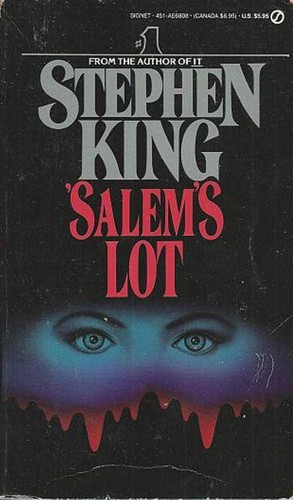
Salem's Lot
'Salem's Lot is Stephen King's second published novel, a vampire story set in the fictional Maine town of Jerusalem's Lot. Writer Ben Mears returns to the hometown he left as a boy, hoping to finish a book about the decaying Marsten House that frightened him in childhood. He finds a place of gossip, quiet resentments and ordinary routines, then slowly realizes that something is feeding on it. King sets Bram Stoker's Dracula inside a believable American community, and the horror grows from how a town fails to notice its own destruction. It has also become one of the Stephen King books made into movies and television miniseries. It remains a foundational title for modern horror and for King's Maine fiction.
Where to buy or borrow
Are you selling this book? Bookstores, publishers, authors and libraries can be listed here for free. Request a listing
About this book
Deep Overview
What distinguishes the structure is patience. King spends a large share of the novel on the Lot's ordinary life: marriages in trouble, a bitter family, a lonely priest, a sceptical doctor, teenagers, gossips, and local officials. These portraits do double duty. They make the town feel inhabited, and they make the later victims people the reader has already judged, liked, or pitied. The first disappearances and illnesses are easy for the townspeople to explain away as accidents, flu, or runaways, and the narrative lets readers see the pattern before most characters do.
The vampire plot follows the broad outline of Stoker's Dracula: an old evil arrives under cover of commerce, preys on the vulnerable, and is opposed by a small group who must first persuade themselves that what they suspect is real. King's group is not a team of experts. It includes a writer, a teacher, a physician, a priest whose faith is shaky, and a boy with an unusual knowledge of monster lore. Their difficulty is as much social as supernatural, because belief has to overcome embarrassment, habit, and the town's reluctance to look closely at itself.
The second half accelerates and becomes more openly violent, as the spread of the vampires turns private fears into a public catastrophe. Yet the book keeps returning to questions of responsibility. Some characters resist from courage, others from stubbornness, and some fail at the moment when conviction counts. Religion is treated with particular seriousness: crosses and rituals are not magic tokens, and the story asks what they require of the person using them.
Above all, King is demonstrating that horror feels sharper when it grows out of recognisable social material. The vampire is frightening, but the town's quiet complicity, its secrets and its tendency to look away give the invasion its force. The novel's ending is best left for readers to discover, but it leaves the aftermath in view rather than offering a neat restoration of order.
Key Themes
Belief and disbelief run through the book. Characters have to decide when a strange explanation deserves to be taken seriously, and what it costs to act on it. Faith, doubt and moral courage are tested most directly through the priest, whose crisis shows that holding an idea sincerely is different from having the nerve to act on it.
The novel also explores how the past lingers in a place. Old crimes, family stories and childhood fears keep shaping the present. Finally, it considers isolation and community together: the town's closeness is its comfort and its vulnerability, and the vampire exploits loneliness, grievance and appetite that were already there.
Historical Context
King's own background in rural Maine matters here. He spent part of his boyhood in Durham, a small inland town, and many readers and commentators see that kind of place behind the fictional Lot. This helps explain why the town feels so closely observed. King was writing about a world he knew from the inside, not a postcard version of New England.
The novel also came out during a strong period for American supernatural fiction. Ira Levin's Rosemary's Baby (1967) and William Peter Blatty's The Exorcist (1971) had shown that horror set in modern, everyday surroundings could become a bestseller. King was taking a nineteenth-century European monster and setting it in the same kind of present-day America.
The political mood of the time is relevant as well. The book was written and published in the years of Watergate and the end of the Vietnam War, when many Americans had lost trust in officials and institutions. King has said that this disillusionment fed into the story. Readers can feel it in the novel's suspicion of people in authority who fail to act, and in its picture of a community that prefers comfortable explanations to uncomfortable facts.
Intended Audience
It may be less suitable for readers who want a fast, minimal plot from the first page, since the early chapters build their community slowly. People sensitive to depictions of child endangerment, death, and graphic violence should approach it with care. Those who prefer a purely psychological or quiet kind of horror may find the later sections too overt.
Reading Difficulty
No literary or historical preparation is required. This is a long novel, and a mass-market paperback has small type and tight margins that some readers find tiring, so a larger print or ebook edition may suit those who prefer easier reading. The content, rather than the vocabulary, is the more difficult element.
Helpful Background Knowledge
It can also help to know that Jerusalem's Lot is fictional, a Maine town in King's wider imagined geography. Readers who plan to move on to King's short stories or the Dark Tower books may later want to revisit this novel, but it stands on its own.
Why Read This Book?
It is also historically useful. As an early King novel, it shows themes he returns to throughout his career, including community, fear, faith, and the damage done by ignored warning signs. Because it has inspired radio, television, and film versions, it is among the Stephen King books made into movies that readers often want to compare with the original. Reading the novel first shows what a shorter adaptation has to compress or leave out.
Reader Takeaways
Readers may reconsider how communities talk about unsettling events, who is believed, and who is dismissed. They may also notice how King uses minor characters to show that a town's weakness lies in a thousand private compromises rather than in one dramatic failure.
Strengths
It is also a well-judged adaptation of a literary model. King respects the machinery of the vampire tale while shifting its emphasis to social behaviour and belief. The central characters are credible as amateurs facing something beyond their experience, and the early sections create a long run-up to the confrontations that follow.
Limitations and Cautions
Content cautions apply, including violence, death and the threatening of children. Details also vary by edition: the novel was first published in 1975 by Doubleday, and later paperbacks, including this Signet printing, may differ in front matter and extras. Some paperback and special editions also include related material, such as King's own commentary, that this profile does not rely on.
Important Concepts, People, and Places
Ben Mears: A writer who left the Lot as a boy and comes back as an adult. He is an outsider with an insider's memories. Because he is writing about the town's past, he notices things that long-time residents have stopped seeing. His old fear of the Marsten House makes the investigation personal as well as practical.
The Marsten House and Hubert "Hubie" Marsten: The mansion on the hill gets its reputation from Hubie Marsten, the 1930s owner whose violent end still hangs over it. The house stands for the idea that a place can store up evil and draw more of it in. It looks down on the town, and it is the reason the new arrivals pick the Lot.
Kurt Barlow and Richard Straker: Barlow and Straker arrive posing as partners in an antiques business. Straker is the human front man who deals with the town by day, while Barlow stays out of sight. Their arrangement reworks the Dracula pattern of an ancient predator using property deals and an agent to get a foothold in a new place.
Matt Burke: The high school English teacher. He is one of the first to take the impossible seriously, and his reading and teaching give him a way to name what is happening. His friendship with Ben helps form the small group that fights back.
Susan Norton: A young local woman who becomes involved with Ben. She feels torn between leaving the Lot and staying, which makes her a link between the outsider and the community. What happens to her raises the personal cost of the conflict.
Mark Petrie: A boy whose love of monster stories leaves him better prepared than most adults. His role makes a recurring King point: children are sometimes quicker to accept the truth than grown-ups bound by reason and respectability.
Father Donald Callahan: The town's Catholic priest, already struggling with drink and doubt. Through him the novel asks whether religious symbols mean anything without the believer's conviction. His story carries the book's main argument about faith.
Dr. Jimmy Cody: The local physician, whose medical training first pushes him toward natural explanations for the deaths. His change of mind shows that rational, educated people can be made to face something their training cannot explain.
Parkins Gillespie: The town constable, the only official in a position to act. His tired reluctance to get involved reflects the novel's theme of authority that looks away.
Dracula by Bram Stoker: The 1897 novel that gives King his model. Knowing it helps readers see how he moves an aristocratic European threat into a modern American small town.
"Jerusalem's Lot" and "One for the Road": Two separate short stories in King's 1978 collection Night Shift, both set in the novel's world. "Jerusalem's Lot" is a prequel told in letters from the mid-nineteenth century, showing that the area's darkness goes back long before Barlow arrived. "One for the Road" is a sequel set a few years after the novel's events, following travellers who stray too close to the abandoned town on a winter night. Each is a self-contained story, not a prologue or epilogue to the novel. The prequel was later printed alongside the novel in an illustrated 2005 edition.
The Dark Tower: King's long fantasy series, in which Father Callahan returns in the later volumes. His reappearance links the novel to the wider network of shared characters and places across King's work, and it gives readers who finish 'Salem's Lot a reason to follow one of its characters beyond the town.
Questions the Book Explores
The novel also asks how the past shapes a place, how loneliness and resentment can be turned against the people who feel them, and whether recovering from loss is possible when the damage is both personal and collective.
Reading Group Guide
It can help to read a short passage of Dracula or summarise its plot beforehand, so that participants can talk concretely about what King keeps and what he changes. Groups should agree in advance how much of the ending they wish to reveal to anyone who has not finished. If members have seen any of the film or television versions, comparing a single scene across formats can start a lively conversation. The book discussion questions below are written to work with or without that comparison.
Discussion Questions
2. Which characters are most responsible for the town's vulnerability, and is that responsibility individual or shared?
3. How does the Marsten House shape Ben's motives, and does his personal history help or hinder him?
4. What role does religious belief play, and how does the novel treat the gap between belief and action?
5. In what ways does the story echo Dracula, and where does it depart from it most meaningfully?
6. How does the 1970s American setting affect the way the characters interpret strange events?
7. Which scenes depend most on what is not shown, and why do they work?
8. What does the novel suggest about loneliness, secrecy and appetite as openings for evil?
9. If you have seen an adaptation, what did it gain or lose in condensing the town's many stories?
Sources and Verification
The edition profiled is a Signet mass-market paperback dated 1976. Sources disagree on its exact date and page count, so these are not stated. Details of the first Doubleday edition should not be assumed to apply to this printing.
Comments
No published comments yet.
Available editions
Paperback
Signet mass-market paperback reprint (1976)
- Publisher
- Signet
- ISBN-13
- 9780451168085