
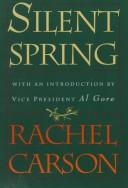
Silent Spring
Silent Spring investigates the ecological and human consequences of widespread synthetic-pesticide use in mid-twentieth-century America. Rachel Carson follows chemicals such as DDT beyond the moment of application, tracing how persistent poisons move through soil and water, enter food chains, accumulate in living tissue, and injure organisms that were never their intended targets. Birds provide the book’s most memorable warning, but Carson’s argument encompasses insects, fish, mammals, plants, and human beings. She also examines the institutions behind chemical control: government eradication campaigns, commercial promotion, limited public consent, and regulatory systems that treated environmental harm as secondary to immediate results. Rather than demanding the abandonment of every pesticide, Carson argues against indiscriminate use and for careful research, selective intervention, biological controls, and public accountability. Published in 1962, the book transformed a technical dis…
Where to buy or borrow
We don’t list any stores or libraries for this book yet.
Are you selling this book? Bookstores, publishers, authors and libraries can be listed here for free. Request a listing
About this book
Deep Overview
The book concentrates on pesticides developed or greatly expanded during and after World War II, especially persistent chlorinated hydrocarbons such as DDT, while also considering more acutely toxic compounds. Carson explains that the question cannot be reduced to whether a chemical kills its intended pest. A substance may remain in soil, wash into streams, enter plants and animals, become stored in body fat, or reach higher concentrations as it moves through feeding relationships. A campaign judged successful by the number of insects killed may therefore impose costs on fish, birds, beneficial insects, domestic animals, and people.
Several sections examine broad eradication programs conducted against insects such as the gypsy moth and fire ant. These cases allow Carson to question the administrative ideal of total control. Large-scale aerial spraying treats complex landscapes as uniform surfaces and exposes residents, farms, wildlife habitats, and waterways together. Carson repeatedly contrasts the confidence of official programs with incomplete monitoring and the experience of people who observe dead birds, contaminated property, or damaged ecosystems after treatment.
Her analysis also challenges short-term definitions of efficiency. Heavy chemical use can eliminate natural predators and competitors, while surviving pests reproduce or develop resistance. The result may be renewed infestation and an escalating search for stronger treatments. Carson presents this as both a biological and intellectual failure: ecological systems answer intervention in ways that simplified control models do not anticipate.
The chapters addressing human health are cautious but unsettling. Carson discusses exposure through food, water, workplaces, homes, and environmental residues, asking how repeated low doses and combinations of chemicals should be evaluated. Some medical claims necessarily reflect the state of knowledge in 1962, but the broader demand remains clear: absence of immediate illness is not proof of long-term safety.
The final movement is constructive rather than merely denunciatory. Carson considers biological controls, species-specific techniques, habitat management, and other approaches grounded in knowledge of an organism’s life cycle. Her central distinction is not between action and inaction, or between science and sentiment. It is between interventions that respect ecological complexity and methods that distribute persistent hazards without adequate knowledge, restraint, or public oversight.
Key Themes
• **The limits of technological control:** Carson questions the assumption that nature can be managed through overwhelming force without adaptation, resistance, or collateral damage.
• **Persistence and accumulation:** The book emphasizes that some compounds do not disappear after spraying. They can remain in environments and organisms, making exposure cumulative rather than momentary.
• **Unintended targets:** Pest-control programs routinely affect organisms they were not designed to kill, including pollinators, predators, fish, and birds.
• **Evidence under uncertainty:** Carson argues that uncertainty should encourage precaution and investigation, not automatic permission for mass exposure.
• **Institutional accountability:** Government agencies, manufacturers, researchers, and citizens all have roles in deciding which risks are acceptable and who bears them.
• **Alternative forms of pest management:** Selective and biological methods represent a different philosophy—working with ecological relationships rather than attempting total eradication.
Historical Context
Warnings about effects on wildlife existed before Silent Spring, but the findings were scattered across scientific specialties, local experiences, and government records. Carson, a trained biologist and an accomplished nature writer, assembled those fragments for a general audience. The book appeared amid growing unease about radioactive fallout, industrial pollution, and technologies whose consequences crossed political and geographic boundaries.
Its publication provoked intense public argument. In 1963, the President’s Science Advisory Committee issued a report on pesticide use that supported stronger oversight and reduced reliance on persistent chemicals. The United States Environmental Protection Agency was created in 1970, and in 1972 the agency cancelled most uses of DDT in the United States after regulatory proceedings. Silent Spring did not single-handedly produce these developments, but it was a major catalyst in the larger movement toward modern environmental regulation.
Intended Audience
Scientists and policy readers may appreciate Carson’s attention to system-wide effects and institutional incentives. General readers do not need advanced training, although an interest in evidence-based argument helps. Readers looking for a contemporary survey of pesticide toxicology should pair it with newer scientific and regulatory material. Those seeking a detached textbook may find Carson’s moral urgency unusually prominent; that urgency is central to the book’s historical power.
Reading Difficulty
The structure helps: chapters usually develop one environmental pathway or policy problem at a time, and Carson explains technical ideas through concrete organisms and places. No formal background in chemistry is required. Readers may nevertheless benefit from pausing to distinguish acute toxicity from chronic exposure, persistence from immediate potency, and direct poisoning from concentration through food webs. Because editions vary in introductory material and notes, the surrounding apparatus may also affect difficulty.
Helpful Background Knowledge
Familiarity with postwar American confidence in scientific management clarifies why Carson’s challenge was so disruptive. A brief timeline—World War II use of synthetic insecticides, rapid postwar expansion, publication of Silent Spring in 1962, the federal pesticide report in 1963, creation of the EPA in 1970, and the 1972 U.S. cancellation order for most DDT uses—helps separate the book’s publication from later policy outcomes.
Why Read This Book?
The book is equally instructive as rhetoric. Its memorable opening, layered case studies, explanations of biological processes, and measured discussion of alternatives show how scientific information can become publicly consequential without being reduced to slogans. It also offers a durable framework for evaluating newer disputes involving persistent pollutants, poorly monitored innovations, industry influence, and delayed risk.
Reader Takeaways
The book also encourages closer scrutiny of words such as “safe,” “efficient,” and “necessary.” These judgments depend on the time span examined, the organisms counted, the alternatives considered, and the authority granted to affected communities. Finally, readers may recognize that Carson’s argument is not anti-science. It calls for more comprehensive science—research capable of studying living systems, long-term effects, and public consequences rather than only a product’s intended function.
Strengths
Her explanations of ecological movement are concrete and memorable, and her literary control gives urgency to material that could otherwise become a technical catalogue. She also avoids the simplest version of her own case: the book does not demand that every chemical method cease. By discussing biological and selective alternatives, Carson makes discrimination, evidence, and proportionality the standards by which pest control should be judged.
The book’s attention to institutional decision-making is another enduring asset. Environmental harm appears not as an accident of chemistry alone, but as a result of choices about research, authorization, monitoring, disclosure, and consent.
Limitations and Cautions
Its primary setting is the United States, and its strongest cases concern wildlife, agricultural spraying, and domestic environmental exposure. The distinct role of DDT in malaria-vector control requires separate attention and should not be collapsed into the book’s critique of indiscriminate agricultural and landscape use.
Carson writes as an advocate assembling a public case, so the selection and arrangement of evidence are argumentative rather than encyclopedic. The book gives less space to the economic pressures behind farmers’ decisions or to detailed comparisons among the risks of different replacement methods. Its policy influence should also be described carefully: it catalyzed public concern and reform, but no single book alone created the EPA or determined the later DDT order.
Important Concepts, People, and Institutions
• **DDT:** A persistent organochlorine insecticide and the book’s best-known example of a chemical capable of moving through environments and food webs. Carson discusses it within a broader class of pesticide problems.
• **Bioaccumulation and concentration through food webs:** Processes by which persistent substances can collect in organisms and reach consequential levels in predators. These ideas are essential to Carson’s explanation of harm to birds and other wildlife.
• **Non-target organisms:** Species harmed despite not being the intended object of control. Their fate exposes the difference between a pesticide’s commercial purpose and its ecological reach.
• **Insect resistance:** The survival and reproduction of less-susceptible insects can make repeated chemical treatment progressively less effective.
• **Biological control:** The use of predators, parasites, pathogens, reproductive methods, or other biologically informed approaches to manage pests more selectively.
• **United States Department of Agriculture:** A major institution in the eradication and spraying programs Carson examines and criticizes.
• **President John F. Kennedy and the President’s Science Advisory Committee:** Kennedy’s administration commissioned a federal examination of pesticide use; the committee’s 1963 report became an important part of the policy response surrounding the controversy.
• **United States Environmental Protection Agency:** Created in 1970, the agency later issued the 1972 cancellation order covering most U.S. uses of DDT. It belongs to the book’s regulatory legacy rather than to its original narrative.
• **The New Yorker and William Shawn:** The magazine serialized Silent Spring before book publication, bringing Carson’s investigation to a broad national readership; Shawn was the editor associated with that publication.
Questions the Book Explores
• How should delayed or uncertain harm be weighed against immediate agricultural or public-health benefits?
• Who has the authority to expose landscapes and communities to risk?
• When does technological confidence become ecological blindness?
• Can a control method be called efficient if it destroys beneficial species or produces resistant pests?
• What evidence should be required before a biologically active substance is distributed widely?
• How can pest management shift from broad killing to selective intervention?
• What responsibilities do scientists and writers have when specialized evidence reveals a public danger?
Reading Group Guide
Compare Carson’s treatment of evidence with her treatment of values. Mark passages where she reports a study, draws an inference, challenges an institution, or makes a moral appeal. This helps a group assess how the book combines scientific explanation with advocacy.
A second productive angle is the meaning of “control.” Contrast mass eradication campaigns with the biological alternatives described near the end. Discuss whether these approaches represent merely different techniques or fundamentally different relationships to nature.
Finally, place the book on two timelines: one ending in 1962 and another extending through the federal pesticide report, the creation of the EPA, and the 1972 DDT decision. This prevents later outcomes from being read back into Carson’s original claims.
Discussion Questions
2. Which example most effectively demonstrates the interconnectedness of an ecosystem, and why?
3. How does the book distinguish responsible pest management from indiscriminate chemical use?
4. Where does Carson appear most cautious about the evidence, and where is she most forceful?
5. What assumptions about progress, expertise, and government authority does the book challenge?
6. How should policymakers act when potential harm is serious but scientific knowledge remains incomplete?
7. Does Carson give adequate attention to the benefits that made synthetic pesticides attractive?
8. What responsibilities should manufacturers bear for effects beyond a product’s intended use?
9. How do insect resistance and the destruction of natural predators complicate the idea of a permanent technological solution?
10. Which parts of the book remain transferable to modern environmental controversies, and which require historical qualification?
11. How does Carson’s style affect the credibility and emotional force of her argument?
12. What would a contemporary equivalent of Silent Spring need to do to change public understanding?
Sources and Verification
Comments
No published comments yet.
Available editions
Hardcover
First edition, hardcover
- Publisher
- Houghton Mifflin Company
- Publication date
- Pages
- 368