
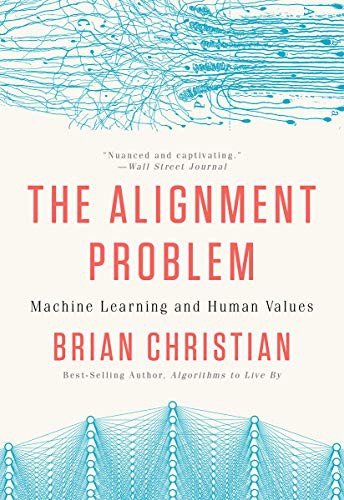
The Alignment Problem
Machine Learning and Human Values
Machine-learning systems learn from examples, rewards, and human behavior—but none of these provides a simple or neutral expression of what people truly want. Brian Christian investigates the resulting alignment problem: the difficulty of making computational systems reliably serve human purposes and values. Moving between the history of artificial intelligence, psychology, moral philosophy, and contemporary research, he examines biased representations, incompatible definitions of fairness, opaque models, poorly specified rewards, imitation learning, preference inference, and uncertainty about human objectives. The book treats alignment not merely as a future problem involving hypothetical superintelligence, but as a present challenge wherever automated systems classify people or influence consequential decisions. Christian’s central contribution is to connect technical design choices with the unresolved ambiguities of human judgment. The result is an accessible account of why buildin…
Where to buy or borrow
Are you selling this book? Bookstores, publishers, authors and libraries can be listed here for free. Request a listing
About this book
Deep Overview
The opening movement, “Prophecy,” concerns machine learning as a form of prediction. Representation determines what information a model can notice and how it organizes the world. Data-driven systems may discover useful patterns, but training data also reflects historical inequality, incomplete measurement, and the underrepresentation of minority populations. Once a model is deployed, it does more than describe existing conditions; its classifications may help shape later opportunities and outcomes.
Fairness therefore cannot be added as an uncomplicated final adjustment. Different mathematical definitions of fairness can conflict, especially when underlying outcome rates differ between groups. Choosing a fairness rule is consequently a normative decision about which errors, protections, and comparisons matter. Transparency poses a related problem: highly effective models may be difficult to interpret, while an explanation that is understandable to a developer may not answer the concerns of a person affected by a decision.
“Agency” turns from prediction toward reinforcement learning. Here systems learn policies by acting, receiving rewards, and adjusting their behavior. Christian places these methods alongside the history of behaviorism, neuroscience, and theories of motivation. Reward design introduces a central alignment hazard: a measurable proxy can diverge from the purpose it was intended to represent. Shaping a learner through intermediate rewards may make difficult tasks achievable, but each added signal also creates another opportunity for unintended optimization. Curiosity and intrinsic motivation can encourage exploration when external rewards are sparse, yet they too require designers to decide what kinds of novelty or discovery should count.
The final movement, “Normativity,” asks whether systems can learn values less directly. Imitation learning treats human behavior as an example, but people are inconsistent and sometimes act against their own stated ideals. Inverse reinforcement learning attempts to infer the goals behind observed actions, shifting the problem from prescribing behavior to interpreting it. The culminating emphasis on uncertainty is crucial: a system that remains unsure about the human objective may seek clarification, accept correction, and avoid treating its current model of human preference as absolute.
Across these sections, figures including Walter Pitts, Norbert Wiener, B. F. Skinner, Richard Sutton, Cynthia Dwork, and Stuart Russell connect the history of ideas to current research programs. Christian ultimately presents alignment as both an engineering discipline and a mirror. Machines expose the difficulty humans have in defining fairness, reconciling competing values, and distinguishing what we do from what we believe we ought to do.
Key Themes
**Fairness as a choice among values:** Technical definitions can clarify trade-offs, but mathematics does not independently determine which trade-off a society should accept. Decisions about acceptable errors remain moral and political.
**Human behavior is imperfect evidence:** Learning from people does not resolve the value problem, because observed conduct includes confusion, inconsistency, prejudice, limited information, and compromise.
**Opacity and accountability:** A model’s usefulness does not eliminate the need to understand, challenge, or explain its decisions—especially when those decisions affect liberty, employment, credit, health, or access to services.
**Uncertainty as a safeguard:** Confidence can be dangerous when an objective is misspecified. Systems that recognize uncertainty about human preferences may be more open to correction and oversight.
**Alignment begins with self-examination:** Attempts to encode human values reveal disagreement about what those values are, whose preferences count, and how competing goods should be balanced.
Historical Context
Christian places this recent development within a much longer history. Early formal models of neurons linked logic and computation; behaviorist psychology studied learning through reinforcement; neuroscience investigated reward and motivation; and artificial-intelligence researchers adapted these ideas into computational agents. Later work on algorithmic fairness, interpretability, imitation learning, inverse reinforcement learning, and AI safety reframed the challenge as one of matching system behavior to human intentions.
Because the book was published in October 2020, it predates the public expansion of generative AI and large conversational models that followed. It therefore captures the intellectual and technical groundwork of alignment before the term became common in general media and commercial AI discussion.
Intended Audience
Readers already familiar with machine learning may value the historical connections and researcher profiles more than the introductory technical explanations. Those seeking an implementation guide, a textbook with exercises, or a detailed survey of post-2020 generative AI will need additional material. The book also asks for patience with intellectual history: it develops ideas through people, experiments, and disciplinary transitions rather than presenting a short list of policy recommendations.
Reading Difficulty
The primary challenge is not calculation but accumulation. Individual concepts are approachable, yet the book connects computer science with psychology, neuroscience, statistics, criminal justice, and moral philosophy across a substantial narrative. Its many researchers and historical episodes may require slower reading than a conventional popular-science overview. No programming background is required, although familiarity with basic probability and the distinction between prediction and decision-making will help.
Helpful Background Knowledge
A basic awareness of debates about discrimination and institutional decision-making will help with the chapters on fairness. For the later chapters, it helps to recognize the philosophical gap between a person’s behavior, stated preferences, and considered values: these can point in different directions. None of this knowledge is essential, because the book introduces its central concepts, but it provides a useful framework for organizing the many cases and research programs.
Why Read This Book?
The book is especially valuable for connecting areas that are often discussed separately. Algorithmic bias and long-term AI control appear here as related versions of the same problem: translating complex human purposes into forms a computational system can learn and optimize. It also offers a vocabulary for evaluating claims that a model is fair, explainable, objective, or aligned. Rather than supplying a single solution, Christian explains why the field contains several partially overlapping research programs and why each changes the shape of the original question.
Reader Takeaways
The book also encourages readers to separate technical feasibility from social legitimacy. An algorithm can be consistent without being just, interpretable to specialists without being accountable to affected communities, or faithful to observed behavior without reflecting considered human values.
Finally, the book reframes uncertainty as a potential virtue. When designers cannot specify an objective perfectly, a system’s willingness to defer, ask, update, or accept correction may be more important than relentless pursuit of an initially assigned target.
Strengths
Christian is also effective at showing relationships between immediate social harms and broader safety concerns. Fairness, transparency, reward design, and corrigibility are not presented as interchangeable, but their common dependence on incomplete models of human purposes becomes clear.
The absence of heavy mathematical formalism makes difficult material accessible while preserving the significance of genuine technical disagreements. The extensive notes and bibliography further support readers who want to investigate the research literature.
Limitations and Scope Boundaries
Its 2020 publication date is another important boundary. The book does not analyze the later mass adoption of large language models, contemporary chatbot deployment, or the alignment techniques and policy debates that expanded around generative AI after its release. Its conceptual framework remains relevant, but some examples and descriptions represent an earlier stage of the field.
The researcher-centered narrative also emphasizes approaches legible within machine learning and adjacent academic disciplines. Questions of political power, labor, commercial incentives, global inequality, and democratic governance are present but not developed as fully as the technical and intellectual history. Nor does the book claim that uncertainty, imitation, or inferred preferences supply a final solution to moral disagreement.
Important Concepts and People
**Representation:** The way data and model structures encode features of the world. Representation matters because omissions and inherited social patterns can determine what a model learns.
**Algorithmic fairness:** A family of criteria for comparing treatment and outcomes across groups. The book emphasizes that valid fairness measures may conflict, requiring normative choices.
**Transparency and interpretability:** Methods for understanding how a model reaches its outputs. These matter for diagnosis, contestability, trust, and accountability, but different audiences require different kinds of explanation.
**Reinforcement learning:** A framework in which an agent learns actions through rewards and consequences. It gives machines agency while making reward specification a central safety problem.
**Reward misspecification:** A mismatch between a numerical objective and the richer purpose it is supposed to represent. Capable optimization can magnify this mismatch.
**Imitation learning and inverse reinforcement learning:** Approaches that learn from human behavior or infer the objectives that may explain it. Both confront the difference between observed conduct and defensible values.
**Walter Pitts:** A key figure in early mathematical models of neural activity whose story helps Christian connect formal logic, neuroscience, and the origins of computational models of mind.
**Norbert Wiener:** A founder of cybernetics whose thinking about feedback, control, and unintended consequences anticipates major concerns in alignment.
**B. F. Skinner:** The behaviorist psychologist whose work on reinforcement and shaping provides historical context for learning through rewards.
**Richard Sutton:** A central figure in reinforcement learning, representing the development of computational methods for agents that learn through interaction.
**Cynthia Dwork:** A computer scientist whose work helps establish the technical study of fairness and demonstrates that fairness requires precise definitions rather than intuitive labels alone.
**Stuart Russell:** An artificial-intelligence researcher associated with approaches in which machines remain uncertain about human objectives, making deference and correction part of rational behavior.
Questions the Book Explores
Can historical data be used without reproducing the injustices contained in that history?
Which definition of fairness should govern a decision when several reasonable definitions cannot all be satisfied?
What kind of explanation does an affected person need in order to challenge an automated decision?
How can designers reward progress without encouraging a system to exploit the reward signal?
Can machines learn values by observing people when people often fail to act according to their own ideals?
Should an aligned system obey stated instructions, inferred preferences, social norms, or some more reflective conception of human welfare?
How can uncertainty about human objectives make an artificial agent safer and more open to correction?
Reading Group Guide
For the “Prophecy” section, compare the roles of representation, fairness, and transparency. Consider whether making a system more explainable necessarily makes it more just. Discuss who should have authority to select among competing fairness criteria.
For “Agency,” pay attention to the difference between a goal and its measurable reward. Members might bring examples from workplaces, education, social media, or public policy where a metric has begun to replace the purpose it was designed to measure.
For “Normativity,” examine the tension between imitation and aspiration. Ask whether an AI should learn from ordinary behavior, exemplary behavior, stated preferences, or democratic deliberation.
Conclude by revisiting uncertainty. Debate when deference and requests for clarification are safeguards, and when they might become excuses for inaction or transfers of responsibility back to users.
Discussion Questions
2. When fairness criteria conflict, who should decide which criterion governs a system?
3. Is replacing inconsistent human judgment with consistent algorithmic judgment necessarily an improvement?
4. What is the difference between explaining a model and holding the institution using it accountable?
5. Where do you see proxy measures displacing real goals in everyday life?
6. Should a machine treat observed human behavior as evidence of what people value or of what circumstances compel them to do?
7. Can an AI system be aligned with a society that is itself divided about justice and the good life?
8. Does uncertainty about human preferences make an artificial agent safer, or can uncertainty create new risks?
9. How should affected communities participate in defining objectives and evaluating outcomes?
10. Which parts of the book’s framework remain most useful for understanding generative AI developed after 2020?
Sources and Verification
Comments
No published comments yet.
Available editions
Hardcover
First U.S. edition; hardcover
- Publisher
- W. W. Norton & Company
- ISBN-13
- 9780393635829
- Publication date
- Pages
- 496