
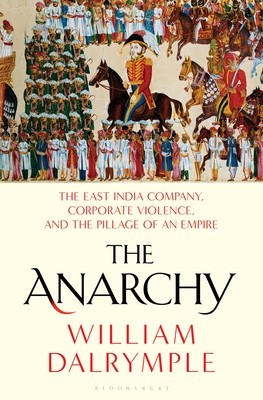
The Anarchy
The East India Company, Corporate Violence, and the Pillage of an Empire
The Anarchy is a large-scale narrative history of how the English East India Company evolved from a commercial enterprise into a military and governmental power in South Asia. Its central story runs through the eighteenth century, when Mughal authority fragmented, regional powers competed for territory and revenue, and Company officials learned to exploit both Indian political rivalries and financial resources. The book is not simply a chronicle of British expansion. Dalrymple reconstructs a crowded political field involving the Mughal court, Bengal’s nawabs, the Maratha Confederacy, Mysore, Afghan invaders, Indian bankers and financiers, European mercenaries, Company shareholders and officials in London. Figures such as Shah Alam II, Robert Clive, Warren Hastings, Tipu Sultan and the Maratha leader Mahadji Scindia appear within a history shaped as much by negotiation, credit and revenue collection as by battles. Dalrymple’s organizing argument is that the conquest was extraordinary b…
Where to buy or borrow
Are you selling this book? Bookstores, publishers, authors and libraries can be listed here for free. Request a listing
About this book
The book is not simply a chronicle of British expansion. Dalrymple reconstructs a crowded political field involving the Mughal court, Bengal’s nawabs, the Maratha Confederacy, Mysore, Afghan invaders, Indian bankers and financiers, European mercenaries, Company shareholders and officials in London. Figures such as Shah Alam II, Robert Clive, Warren Hastings, Tipu Sultan and the Maratha leader Mahadji Scindia appear within a history shaped as much by negotiation, credit and revenue collection as by battles.
Dalrymple’s organizing argument is that the conquest was extraordinary because it was initially carried out not by the British state directly but by a joint-stock corporation with shareholders, commercial privileges, political connections and an increasingly formidable private army. The narrative emphasizes the feedback loop between Indian taxation and Company warfare: territorial revenues helped finance military expansion, and military victories opened access to further revenues.
The account moves from the weakening of Mughal central authority and the destabilizing invasion of Nader Shah through the Company’s emergence in Bengal, the battles of Plassey and Buxar, its acquisition of revenue rights in 1765, subsequent crises and parliamentary intervention, and the campaigns that made it a dominant power by the beginning of the nineteenth century. The endpoint is substantially earlier than the 1857 uprising and the transfer of Company territories to Crown rule, so this is chiefly a history of corporate conquest rather than a comprehensive history of the British Raj.
Deep Overview
The book is not simply a chronicle of British expansion. Dalrymple reconstructs a crowded political field involving the Mughal court, Bengal’s nawabs, the Maratha Confederacy, Mysore, Afghan invaders, Indian bankers and financiers, European mercenaries, Company shareholders and officials in London. Figures such as Shah Alam II, Robert Clive, Warren Hastings, Tipu Sultan and the Maratha leader Mahadji Scindia appear within a history shaped as much by negotiation, credit and revenue collection as by battles.
Dalrymple’s organizing argument is that the conquest was extraordinary because it was initially carried out not by the British state directly but by a joint-stock corporation with shareholders, commercial privileges, political connections and an increasingly formidable private army. The narrative emphasizes the feedback loop between Indian taxation and Company warfare: territorial revenues helped finance military expansion, and military victories opened access to further revenues.
The account moves from the weakening of Mughal central authority and the destabilizing invasion of Nader Shah through the Company’s emergence in Bengal, the battles of Plassey and Buxar, its acquisition of revenue rights in 1765, subsequent crises and parliamentary intervention, and the campaigns that made it a dominant power by the beginning of the nineteenth century. The endpoint is substantially earlier than the 1857 uprising and the transfer of Company territories to Crown rule, so this is chiefly a history of corporate conquest rather than a comprehensive history of the British Raj.
Key Themes
• Finance and conquest: Indian revenues, banking networks, credit and shareholder interests are presented as integral to military expansion rather than as background economic details.
• Mughal fragmentation: The decline of centralized Mughal power creates opportunities, but Dalrymple portrays the period as a struggle among multiple capable Indian and European actors rather than a simple transfer from one unified empire to another.
• Collaboration and resistance: Company power depended on Indian soldiers, financiers, administrators and political allies, even while other Indian rulers and coalitions resisted its advance.
• Violence and extraction: Battles, punitive campaigns, revenue demands and famine reveal the human consequences of subordinating government to commercial and military priorities.
• Distance and accountability: Decisions affecting South Asia were connected to investors and politicians in Britain, raising questions about what happens when political power is geographically and institutionally separated from the people subject to it.
• Historical memory: The narrative challenges versions of empire that begin with an orderly British state bringing unified administration to India. Instead, it foregrounds improvisation, private interests, opportunism and repeated institutional crises.
Historical Context
A major turning point in the background to Dalrymple’s narrative was Nader Shah’s invasion and sack of Delhi in 1739, which exposed Mughal vulnerability and accelerated struggles among provincial governors, regional dynasties and military coalitions. The Company’s victory at Plassey in 1757 increased its influence in Bengal, while the Battle of Buxar in 1764 strengthened its position against a broader alliance. In 1765, Mughal emperor Shah Alam II granted the Company the diwani—the right to collect revenue in Bengal, Bihar and Orissa—giving a commercial corporation access to an enormous territorial tax base.
The book’s period also includes British conflict with Mysore and the Marathas, intervention by Parliament in Company affairs, and recurrent debate over corruption and misgovernment. Dalrymple carries the central narrative to 1803, when Company forces captured Delhi and placed the Mughal emperor under their protection. This stopping point marks the Company’s emergence as the paramount military force across much of the subcontinent, not the end of either Indian resistance or Company rule.
Intended Audience
Its narrative style makes it more accessible than a specialized academic monograph, but it is still a long, densely populated history. Readers looking for a brief introduction may find the quantity of rulers, commanders, financiers, battles and changing alliances demanding. It is also not a neutral business case study: Dalrymple frames the Company’s ascent as a history of corporate violence, extraction and failed accountability.
Reading Difficulty
Maps, a running list of major figures and occasional pauses to reconstruct the chronology can help. Readers should expect descriptions of warfare, atrocities, political betrayal, famine and imperial extraction. The extensive notes and bibliography support further research, although general readers can follow the main narrative without consulting every reference.
Helpful Background Knowledge
• The Mughal Empire remained politically and symbolically important even as effective authority became decentralized.
• “British rule” did not begin as a single, coordinated state project. The East India Company had its own institutional interests and often operated at considerable distance from government supervision.
• Eighteenth-century India contained numerous competing centers of power, including Bengal, Awadh, Mysore, the Maratha Confederacy and Hyderabad.
• Company armies relied heavily on Indian soldiers, commonly called sepoys; conquest therefore cannot be reduced to a small number of Europeans defeating India without extensive local participation.
• Revenue collection was essential to military power. Control of prosperous territory supplied the money needed to recruit, equip and expand armies.
Why Read This Book?
It also restores complexity to a period often compressed into a simple story of Mughal decline followed by British rule. Dalrymple gives substantial narrative attention to Indian rulers, financiers, commanders and court politics, demonstrating that Company ascendancy emerged from a competitive South Asian system rather than from an uncontested British master plan.
For contemporary readers, the history provides material for thinking about private power and public responsibility. Parallels with modern corporations should be handled cautiously—the East India Company operated under distinctive early-modern legal and imperial conditions—but the book makes the underlying questions about accountability, lobbying and concentrated economic power difficult to ignore.
Reader Takeaways
The book also demonstrates that conquest depended on institutions beyond the battlefield. Access to taxation, Indian credit, local intelligence, diplomatic agreements and trained Indian troops mattered alongside European military techniques. Political fragmentation created openings for the Company, but its eventual dominance was neither automatic nor inevitable.
Another major takeaway is that accountability mechanisms frequently lagged behind events. Company officials could accumulate wealth and exercise coercive authority in India while directors, shareholders and politicians in Britain argued over regulation, responsibility and profit. The result invites readers to examine how legal form can conceal or diffuse responsibility for political violence.
Editorial Strengths
Dalrymple is especially effective at transforming complicated political transitions into readable scenes and character-driven sequences. The use of Indian and Persian-language material helps broaden the perspective beyond Company correspondence and later imperial narratives. Established reviews have particularly noted the book’s narrative energy, detail and effort to include colonized voices.
The corporate framework also gives the book unusual coherence. Rather than treating commerce as separate from imperial politics, it shows how a commercial institution acquired territory and how territorial revenues subsequently strengthened that institution’s military capacity.
Limitations and Cautions
Some critics have argued that the book does not engage deeply enough with established historiographical debates and that its moral emphasis on Company conduct can overshadow broader comparisons with other states, empires and episodes of conquest. These criticisms do not invalidate the narrative, but they indicate why readers pursuing academic study should consult specialized scholarship alongside it.
Its geographic and chronological scope is also selective. Bengal, the Mughal court, Mysore, the Marathas and Company politics receive substantial attention, but this is not a comprehensive social history of all regions or communities in India. Nor does it provide a full account of Company rule after 1803, the 1857 uprising, Crown government or the later nationalist movement.
Finally, contemporary analogies to multinational corporations are interpretive prompts rather than exact equivalences. The Company’s chartered monopoly, military authority and relationship to the British state differ sharply from the legal position of most modern firms.
Important Concepts and Figures
• Mughal Empire: The imperial order whose weakening central authority forms the political setting for much of the book, while continuing to confer legitimacy and symbolic status.
• Diwani: Revenue-collection rights granted to the Company in 1765 for Bengal, Bihar and Orissa; a crucial bridge between commercial influence and territorial government.
• Sepoys: Indian soldiers employed and trained by European-controlled armies, including the Company’s forces.
• Robert Clive: Company commander and official closely associated with its rise in Bengal and with debates over private enrichment and political corruption.
• Shah Alam II: Mughal emperor whose changing fortunes embody both the persistence of Mughal legitimacy and the erosion of effective imperial power.
• Warren Hastings: A major Company administrator whose career became central to British arguments about imperial government, corruption and accountability.
• Tipu Sultan: Ruler of Mysore and one of the Company’s most formidable military opponents.
• Mahadji Scindia: Maratha statesman and commander who became a dominant figure in northern India and at the Mughal court before Company forces captured Delhi.
• Jagat Seths and Indian banking networks: Financiers whose credit and political influence demonstrate the importance of Indian capital to shifts in power.
• Plassey and Buxar: Battles that helped transform Company influence in Bengal into more durable political and fiscal power.
Questions the Book Explores
Why did Mughal political fragmentation benefit the East India Company more than its Indian and European rivals?
What roles did Indian soldiers, bankers, merchants and political allies play in Company expansion?
How did territorial revenue enable further conquest?
Where should responsibility lie when a corporation exercises governmental power but remains accountable to distant investors and political patrons?
Was Company rule an improvised response to South Asian instability, a deliberate project of conquest, or a developing combination of both?
How should historians balance the agency of Indian powers with the destructive consequences of colonial expansion?
Reading Group Guide
Assign members recurring figures or institutions to follow, such as Shah Alam II, Robert Clive, the Marathas, Mysore, Company directors or Indian financiers. This reduces confusion and reveals how differently the same events look from London, Calcutta, Delhi, Bengal or Mysore.
Discussion should distinguish documented historical mechanisms from present-day analogies. Groups can ask what is genuinely comparable to modern corporate power and what belongs specifically to the world of chartered monopolies, imperial competition and eighteenth-century warfare.
Discussion Questions
2. Does the title refer mainly to political fragmentation, to disorder produced by Company intervention, or to both?
3. Which mattered more to Company success: military organization, Indian revenue, political alliances or the weakness of opponents?
4. How does the book complicate the idea that Britain simply conquered India?
5. What kinds of agency does Dalrymple give Indian rulers, soldiers, financiers and administrators?
6. How does Shah Alam II’s career help organize the larger history of Mughal decline and Company ascent?
7. Does a character-driven narrative clarify structural history, or can memorable personalities distract from institutions and economic systems?
8. How persuasive is the book’s treatment of the Company as an early multinational corporation?
9. Where does responsibility for Company conduct reside: with officials in India, directors and shareholders, Parliament, or the wider imperial system?
10. Which modern corporate analogies are illuminating, and which risk oversimplifying the historical differences?
11. How might the narrative change if written primarily as a social history of peasants, artisans or ordinary soldiers?
12. What additional scholarship or perspectives would you consult before treating the book as a definitive account?
Sources and Verification
Editorial assessment was informed by the publisher’s description, established reviews in The Guardian/Observer and LSE Review of Books, a contemporary interview in Time, and a critical response by historian Jeremy Black. These sources support the profile’s account of the book’s scope, narrative method, corporate-power framework and principal areas of criticism.
The ISBN-10 is marked “Verification needed” because non-publisher listings report inconsistent or potentially invalid metadata.
Comments
No published comments yet.
Available editions
Hardcover
1st US hardcover edition
- Publisher
- Bloomsbury Publishing
- ISBN-13
- 9781635573954
- Publication date
- Pages
- 576