
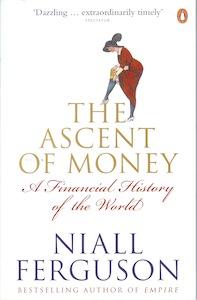
The Ascent of Money
A Financial History of the World
Niall Ferguson presents finance as a central force in world history rather than a technical activity confined to banks and trading floors. Moving from early money and credit through banking, government bonds, joint-stock companies, insurance, mortgages, and global capital flows, he connects financial institutions to war, empire, revolution, social policy, homeownership, and economic crisis. The book’s recurring claim is that financial innovation has expanded societies’ capacity to mobilize resources and distribute risk, while repeatedly generating new forms of instability and inequality. Ferguson builds his account around vivid cases—including the Medici, the Rothschilds, John Law’s Mississippi scheme, the development of insurance, and the financial relationship between China and the United States. The result is a broad narrative explaining both how modern finance acquired its power and why systems built on credit, confidence, and leverage remain vulnerable to panic and collapse.
Where to buy or borrow
Are you selling this book? Bookstores, publishers, authors and libraries can be listed here for free. Request a listing
About this book
Deep Overview
The narrative then turns to government borrowing. Bonds enabled states to raise resources beyond immediate taxation, especially for war, but subjected rulers to continuing judgments about solvency. The Rothschild family illustrates how information networks, reputation, and access to multiple markets could convert sovereign debt into extraordinary influence. Finance and state power emerge as mutually dependent: governments need lenders, while markets depend on legal protection, enforceable contracts, and political stability.
Equity finance introduces a different arrangement. Joint-stock companies divide ownership into tradable claims, allowing large ventures to pool capital and distribute exposure. Yet markets in shares also create conditions for speculation. Through the Dutch East India Company, John Law and the Mississippi Bubble, later market crashes, and corporate scandals such as Enron, Ferguson explores how persuasive stories, imitation, easy credit, and uncertain valuation can drive prices away from sustainable expectations.
Insurance and welfare institutions form the book’s answer to unavoidable uncertainty. Rather than eliminating danger, insurance gathers and redistributes it through premiums, probability, and large pools of participants. Ferguson contrasts private insurance with public systems for pensions and social protection, asking which risks markets can price and which require collective provision. His discussion of Hurricane Katrina demonstrates how formal coverage, public policy, poverty, and exposure to catastrophe can interact unevenly.
The housing chapter challenges the belief that property is intrinsically safe. Mortgages can widen ownership and unlock capital, but political promotion of homeownership, discriminatory lending practices, excessive leverage, and securitization can turn houses into channels of systemic risk. This discussion leads into globalization and “Chimerica,” Ferguson’s name for the interdependent relationship in which Chinese savings helped finance American borrowing and consumption.
Across these episodes, finance resembles an evolving ecosystem: innovations spread, institutions compete, crises remove some arrangements, and governments reshape the survivors. Ferguson’s larger purpose is not to portray finance as either salvation or conspiracy. He argues that it is a powerful human technology whose benefits and failures cannot be separated from politics, psychology, law, and historical memory.
Key Themes
**Credit and power:** The capacity to borrow can enlarge opportunity for households, companies, and states. It can also produce dependency, transfer control to creditors, and amplify losses when income or confidence disappears.
**Innovation and instability:** Banks, bonds, shares, insurance, mortgages, and derivatives solve genuine coordination or risk-management problems. Each innovation also creates incentives and connections capable of carrying failure farther through the system.
**Finance and the state:** Taxation, public debt, warfare, regulation, welfare, and monetary credibility are closely linked. Markets do not operate outside politics; governments are borrowers, guarantors, rule-makers, and sometimes rescuers.
**Booms, bubbles, and human behavior:** Financial markets aggregate information, but they also magnify imitation, optimism, fear, and the attraction of compelling narratives. Rising prices can validate speculation until confidence reverses.
**The unequal distribution of risk:** Financial development may expand access to capital without distributing its benefits and dangers evenly. Housing, disaster insurance, and international lending expose how class, geography, and policy shape who receives protection and who bears loss.
Historical Context
Intellectually, the book belongs to a tradition that connects fiscal capacity and financial institutions to the rise of states and empires. It also adopts an evolutionary metaphor: institutions develop through variation, competition, selection, and adaptation rather than through a single plan. The tenth-anniversary revision broadens the endpoint to include the political aftermath of the crisis, conflict in U.S.–China economic relations, European monetary problems, and cryptocurrencies.
Intended Audience
Specialists may value its synthesis more than its depth. Readers seeking practical budgeting or investment instructions will not find a personal-finance manual, while those wanting a comprehensive, data-heavy economic history may prefer to use it as an entry point and supplement it with specialized scholarship.
Reading Difficulty
The episodic chapter structure makes the book easier to read in sections, but readers should track the distinction between a bond, a share, an insurance contract, and a mortgage because the larger argument depends on how these instruments allocate ownership, obligation, and risk differently.
Helpful Background Knowledge
Before the housing discussion, it is useful to understand that a mortgage is a loan secured by property and that securitization converts pools of loans into tradable securities. For the international chapters, readers should keep in mind that persistent trade imbalances are connected to cross-border flows of savings and investment.
Why Read It?
It also gives readers a durable vocabulary for interpreting financial news. Once the historical functions of credit, equity, insurance, and leverage are clear, contemporary disputes about bailouts, public debt, homeownership, and market regulation become easier to frame—even when one disagrees with Ferguson’s conclusions.
Reader Takeaways
Readers may also reconsider the moral language surrounding debt. Borrowing is neither inherently predatory nor automatically liberating; its effects depend on terms, enforcement, productive opportunity, information, and bargaining power. More broadly, the book develops a habit of looking beneath political and military events for their financial foundations: who could borrow, who supplied the funds, how risk was distributed, and what happened when confidence failed.
Strengths
The book is also effective as conceptual translation. Instead of defining financial instruments in isolation, it explains what historical problem each instrument addressed and what new vulnerabilities followed. The structure supports comparison across periods, especially between speculative bubbles, debt crises, and different methods of pooling risk. Its publication near the financial crisis adds force to the chapters on housing and leverage.
Limitations and Cautions
The book favors vivid examples and strong causal connections over systematic comparison. That makes it compelling, but readers should distinguish illustrative cases from demonstrations that a financial cause was decisive. Scholarly reviewers have also noted omissions and uneven depth, including limited treatment of some regions and institutions. Ferguson’s broadly favorable view of financial innovation is balanced by attention to crisis, but readers may reasonably question whether distributional conflict, regulation, labor, colonial coercion, and public alternatives receive equal weight.
Edition matters: the original ending reflects the immediate context of 2008, while the tenth-anniversary edition adds retrospective chapters. Neither should be treated as a complete guide to developments after its publication.
Important Concepts, People, and Institutions
**The Rothschild family:** Their international network illustrates the growing power of sovereign bond markets, rapid information, and credibility in nineteenth-century government finance.
**John Law and the Mississippi Company:** Law’s monetary experiments and the Mississippi Bubble provide a central example of how credit expansion, government debt, equity speculation, and public enthusiasm can become dangerously entangled.
**The Dutch East India Company:** As an early major joint-stock corporation with tradable shares, it demonstrates how equity markets could mobilize capital for ventures too large and risky for individual merchants.
**Lloyd’s and organized insurance:** The development of marine and other forms of insurance shows how information, probability, premiums, and risk pooling converted uncertain losses into financial contracts.
**Hurricane Katrina and New Orleans:** This disaster serves as a case study in the limits of private coverage, public protection, and recovery when catastrophic risk overlaps with poverty and unequal exposure.
**Fannie Mae and the American mortgage system:** Federal support for housing finance illustrates the political effort to expand homeownership and the long relationship between public policy and private mortgage markets.
**Securitization:** By pooling loans and selling claims on their cash flows, securitization can broaden funding and disperse exposure, while also obscuring loan quality and connecting distant investors to household defaults.
**Chimerica:** Ferguson’s term for the economic interdependence of China and the United States highlights the pairing of Chinese savings and exports with American borrowing and consumption.
**Financial evolution:** The book’s organizing metaphor treats financial institutions as competing and adapting forms. Innovation produces useful diversity, but selection often occurs through disruptive failures rather than orderly planning.
Questions the Book Explores
Reading Group Guide
A productive discussion can compare John Law’s scheme, modern corporate failures, and the mortgage crisis without assuming that all bubbles are identical. Another useful angle is geography: map where capital originates, where it travels, and who controls the institutions moving it. Groups reading the revised edition should compare its new closing chapters with the original afterword and consider how hindsight changes Ferguson’s interpretation of 2008.
Discussion Questions
2. When does credit expand freedom, and when does it deepen dependency?
3. Which financial innovation in the book produced the greatest social benefit? Which created the most serious systemic danger?
4. How does government involvement change the moral and economic meaning of financial risk?
5. Are speculative bubbles primarily failures of individual judgment, institutional incentives, regulation, or collective psychology?
6. What does the history of sovereign debt reveal about the relationship between markets and democratic choice?
7. Does widespread homeownership create security, or can it concentrate household risk too heavily in one asset?
8. How persuasive is “Chimerica” as an explanation of pre-crisis globalization?
9. What histories or regions would need fuller treatment for the book to justify its global subtitle?
10. Does the evolutionary metaphor clarify financial change, or does it make avoidable political choices appear natural?
11. How should the social value of financial innovation be measured when benefits and losses fall on different groups?
12. Which parts of the argument have aged best, and which are most dependent on the edition’s publication date?
Sources and Verification
Comments
No published comments yet.
Available editions
Paperback
U.S. paperback edition
- Publisher
- Penguin Books
- ISBN-13
- 9780143116172
- Publication date
- Pages
- 496