Category

Economic History

How money, trade and technology made the modern world. Niall Ferguson's The Ascent of Money tells the history of finance from ancient credit to the 2008 crash; Marc Levinson's The Box shows how the humble shipping container transformed world trade. Chris Miller's Chip War traces the global battle over semiconductors, Javier Blas and Jack Farchy's The World for Sale follows the commodity traders who move oil, metals and food, and Sebastian Mallaby's The Man Who Knew covers Alan Greenspan's Federal Reserve. Our article on ten economics books suggests what to read next. Clear, story-driven history for readers without an economics background.

5 published books 1 published article

Books in this category

Primary category

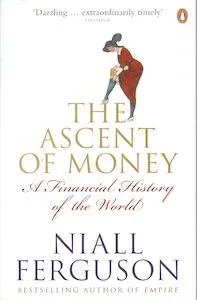
The Ascent of Money

A Financial History of the World

By Niall Ferguson

Niall Ferguson presents finance as a central force in world history rather than a technical activity confined to banks and trading floors. Moving from early money and credit through banking, government bonds, joint-stock companies, insurance, mortgages, and global capital flows, he connects financial institutions to war, empire, revolution, social policy, homeownership, and economic crisis. The book’s recurring claim is that financial innovation has expanded societies’ capacity to mobilize resources and distribute risk, while repeatedly generating new forms of instability and inequality. Ferguson builds his account around vivid cases—including the Medici, the Rothschilds, John Law’s Mississippi scheme, the development of insurance, and the financial relationship between China and the United States. The result is a broad narrative explaining both how modern finance acquired its power and why systems built on credit, confidence, and leverage remain vulnerable to panic and collapse.
View book

Primary category

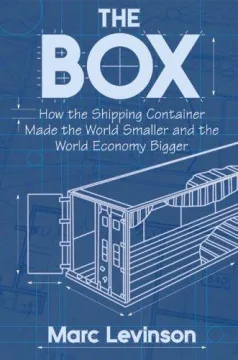
The Box

How the Shipping Container Made the World Smaller and the World Economy Bigger

By Marc Levinson

A standardized steel box might seem an unlikely agent of economic transformation, but Marc Levinson shows how container shipping reorganized the movement of goods and helped create the infrastructure of globalization. Beginning with Malcom McLean’s 1956 experiment aboard the Ideal-X, the book follows containerization through technical disputes, labor conflict, costly port reconstruction, military logistics, international standardization, and commercial expansion. Its subject is not merely an invention but an interconnected system of ships, cranes, trucks, railways, terminals, regulations, and business practices. Levinson explains how sharply lower freight-handling costs altered the location of factories and warehouses, weakened older waterfront economies, strengthened new ports, and enabled longer supply chains. The result is both a history of modern logistics and an argument about technological change: simple devices become revolutionary only when institutions, infrastructure, invest…

View book

Related category

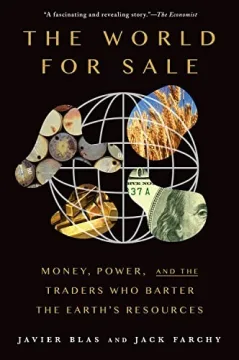
The World for Sale

Money, Power and the Traders Who Barter the Earth’s Resources

By Javier Blas , Jack Farchy

The World for Sale investigates the private commodity-trading firms that move oil, metals, grain, and other raw materials between producers and buyers. Javier Blas and Jack Farchy show how these firms became essential intermediaries in the global economy while remaining far less visible than banks, oil majors, or governments. Their account follows traders into markets transformed by decolonization, resource nationalization, the rise of OPEC, the Soviet Union’s collapse, China’s economic expansion, sanctions, and civil war. Companies such as Glencore, Vitol, Trafigura, and Cargill emerge not merely as brokers but as financiers, logisticians, intelligence gatherers, and sometimes politically consequential actors. The book’s central significance lies in connecting ordinary consumption to transactions conducted in distant ports, mines, ministries, and financial centers. It presents commodity trading as a form of capitalism built on information, credit, appetite for risk, and a willingness…

View book

Related category

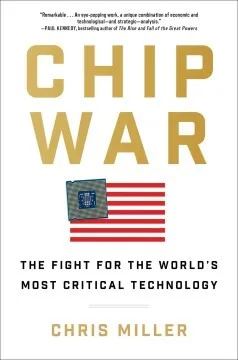
Chip War

The Fight for the World's Most Critical Technology

By Chris Miller

Chip War is a global history of the semiconductor and an argument about technological power. Chris Miller traces how transistors and integrated circuits moved from American laboratories and Cold War weapons programs into nearly every part of modern economic life. He follows the industry’s expansion through the United States, Japan, South Korea, Taiwan, Europe, and China, showing how design, fabrication, manufacturing equipment, and intellectual property became distributed across a remarkably intricate supply chain. That specialization made chips cheaper and more capable, but it also concentrated indispensable expertise in a small number of firms and locations. Miller connects business decisions by companies such as Intel and TSMC with military strategy, industrial policy, globalization, and the intensifying rivalry between the United States and China. The result is both a history of technological development and a warning that access to computing power now shapes prosperity, national…

View book

Related category

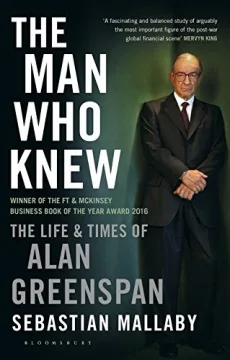
The Man Who Knew

The Life and Times of Alan Greenspan

By Sebastian Mallaby

Sebastian Mallaby’s biography follows Alan Greenspan from a statistics-obsessed childhood and early career as a jazz musician through economic consulting, Republican politics, and more than eighteen years as chair of the Federal Reserve. Its central concern is not simply whether Greenspan was a brilliant policymaker or a principal architect of financial disaster. Mallaby instead examines the contradiction between Greenspan’s ability to recognize economic danger and his reluctance to use public power against leverage, speculation, and asset bubbles. The result is simultaneously a life story, an institutional history of the Federal Reserve, and an account of the transformation of American finance after World War II. By tracing Greenspan’s encounters with Ayn Rand, Richard Nixon, Gerald Ford, Ronald Reagan, and successive presidential administrations, the book shows monetary policy as a product of political calculation, incomplete evidence, personal influence, and ideas about markets. Gr…

View book

Articles in this category