
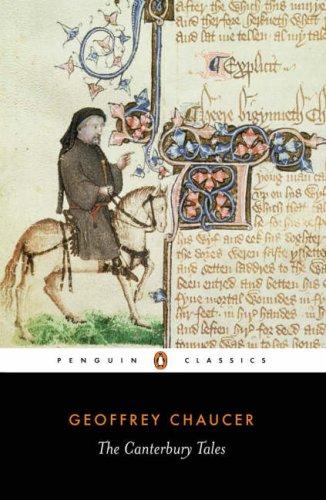
The Canterbury Tales
Geoffrey Chaucer's unfinished late-medieval masterpiece is a storytelling contest set on a pilgrimage from Southwark to the shrine of Thomas Becket at Canterbury. Around thirty travellers from very different walks of life, among them a knight, a miller, a prioress, a pardoner and the Wife of Bath, entertain one another with tales. The tales include courtly romance, bawdy comedy, saints' legends, beast fable and sermon. Each speaker is shaped by a vivid portrait and by the quarrels that break out between stories. The result is both a survey of medieval literary forms and a lively picture of English society in the 1380s and 1390s. It is one of the classic books of English literature. This Penguin Classics edition presents the Middle English text with reader aids and notes by Jill Mann.
Where to buy or borrow
Are you selling this book? Bookstores, publishers, authors and libraries can be listed here for free. Request a listing
About this book
This is a scholarly but readable edition for readers who want Chaucer in his own language rather than in modern English. Jill Mann edited the text and wrote the introduction and notes. According to the publisher's contents listing and catalogue records, the volume includes a chronology, a discussion of Chaucer's language, a note on the text, further reading, notes and a glossary, and the text is glossed on the page. For readers who think of poetry books as short lyrics, this is something different: a sustained narrative in verse with a large cast. It is also one of the most durable classic books in the English canon, and it rewards the effort a Middle English text asks for.
Deep Overview
The contest is where the book's ambition shows. The first tale, the Knight's, is a stately romance about two rival lovers, and it sets a high tone that the Miller promptly disrupts with a comic story of adultery and trickery. The Reeve answers with a story of his own, and the sequence shows how tales respond to each other and to the social tensions between their tellers. Elsewhere the Wife of Bath turns a prologue about her five marriages into a challenge to clerical views of women, and the Pardoner exposes his own greed while preaching against it. The Nun's Priest turns a beast fable into a comic reflection on vanity and rhetoric. Two long prose pieces, the Tale of Melibee and the Parson's sermon, show that the book also holds earnest moral instruction.
Chaucer's design remained incomplete. Britannica notes that the return journey is missing, that some pilgrims never tell a tale, and that surviving manuscripts leave the intended order uncertain, though the surviving work still reads as a unified book. About two dozen tales survive, far fewer than a planned scheme in the opening part of the book seems to promise. The end of the work is a Retraction, in which the poet-pilgrim asks forgiveness for his worldly writings. Readers have long argued over whether it should be read as sincere piety, conventional closure or one more ironic performance.
The book's lasting force comes from the way it makes voice a form of meaning. A tale may tell us as much about its speaker's appetites, class, profession or insecurity as about its plot, and Chaucer often leaves the reader to decide where the narrator's sympathy ends and criticism begins. That ambiguity is part of what the book demonstrates: a storytelling culture in which authority, entertainment and morality are always being negotiated. This edition lets readers meet that effect in the Middle English itself, where rhythm, rhyme and tone are part of the characterisation.
Key Themes
Social estate and its tensions come up repeatedly. Knights, clerics, merchants, tradespeople and women of different standing speak from their own positions, and the book keeps asking whether rank and character match.
Religion and its abuses appear in the pilgrimage setting and in the portraits of the Pardoner, the Friar, the Summoner and others, alongside genuine devotion in figures such as the Parson.
Love, marriage and power are explored in different registers, from idealised courtly desire to fabliau farce to the Wife of Bath's argument over who should govern in marriage.
Truth, fiction and authority are a further concern. The book repeatedly asks who can be believed, what a story is for, and how a narrator's reliability should be judged.
Mixed genres and tones are a theme in themselves. Laughter and seriousness sit side by side, and the book's closing Retraction invites the reader to reconsider everything that came before.
Historical Context
The pilgrimage frame draws on a real and popular medieval practice. Travellers went to Canterbury to visit the shrine of Thomas Becket, the archbishop murdered in the cathedral in 1170. Southwark, where the journey begins, was a real place on the road out of London, so the fiction rests on familiar social ground.
The text also has a complicated transmission history. No manuscript in Chaucer's own hand survives. The two earliest known copies, the Hengwrt manuscript and the Ellesmere manuscript, differ in some details, and scholars have disagreed over which better reflects his intentions and over how to order the fragments. The ordering and presentation a modern edition uses is therefore an editorial decision, which is why a note on the text matters in a scholarly edition.
Intended Audience
Curious general readers who enjoy long narrative poems, ensemble casts or the origins of English storytelling may find it very rewarding, provided they are willing to read slowly.
It may be a harder choice for readers who want an immediate, effortless read. People who would prefer a modern English version, or a shorter selection of the most famous tales, may be better served by one of the translated or abridged editions that are widely available. The volume is also physically substantial, which matters for casual or commuting readers.
Reading Difficulty
The structure is episodic, so the book can be read in sections, tale by tale, without losing the thread. Pace varies. Some tales are brisk and funny, while others, such as the prose Melibee and the Parson's sermon, are slower and more doctrinal.
Conceptual difficulty is moderate. Readers benefit from understanding medieval genres, religious practice and social categories, which the introduction and notes help to supply. The volume is long and dense, so many readers choose to read in short daily stretches or alongside an audio recording in Middle English.
Helpful Background Knowledge
It also helps to know the main medieval forms Chaucer uses, including courtly romance, fabliau, saint's legend and beast fable, because the book often plays with their conventions. Some familiarity with Bible stories and classical myth makes many allusions easier to catch.
For the language, it is worth reading the edition's guide to Chaucer's language before starting and trying a few passages aloud. Hearing the lines read helps with the rhythm. Readers need not know any Middle English in advance.
Why Read This Book?
This edition is a good choice for readers who want the original language with serious editorial support, rather than a modern rendering. If you are looking for classic books that have shaped later English writing, the Tales is a central example, and its pilgrim-narrator device has inspired later writers of ensemble fiction. For people exploring poetry books beyond lyric verse, it offers a long narrative with a social canvas that is closer to a novel's in breadth.
The unfinished state is itself part of the interest, since readers can see a great writer's plan and its gaps, and can join a scholarly discussion that has lasted for centuries.
Reader Takeaways
They may learn to notice how a speaker's voice shapes a story's moral message, and to ask whether a tale confirms or undercuts what the teller says about himself or herself.
They may also reconsider ideas about medieval literature as uniformly pious or simple. The book shows satire, play, psychological insight and sharp social observation.
Finally, readers may gain confidence reading older English, picking up Middle English vocabulary and rhythm, and understanding why editors' choices matter for a text that survives in many manuscripts.
Strengths
This edition provides the Middle English text with scholarly apparatus, including on-page glossing, notes, a glossary, a chronology, a language guide, a note on the text and a further reading list, according to the publisher's contents listing and catalogue records. The introduction and notes are by Jill Mann, a recognised Chaucer scholar.
A single volume that covers the whole work makes it practical for course use and for readers who want to explore beyond the most famous tales.
Limitations and Cautions
The Middle English text demands patience, and readers who prefer a smooth modern reading experience should consider a translation instead. Some language and attitudes toward women, religion, ethnicity and class reflect the period, and some tales contain sexual content or prejudice that readers may find uncomfortable. Scholars disagree over how ironically some passages, including the Retraction and the portraits of figures such as the Prioress, should be read.
This volume is a text-focused edition and does not aim to offer a full critical survey of the large body of Chaucer scholarship. Sources also disagree on its page count, so readers should treat the length as approximate.
Important Concepts, People, and Places
Jill Mann: the scholar who edited this edition and wrote its introduction and notes.
Tabard Inn, Southwark: the starting point of the pilgrimage, where the company meets and the contest is proposed.
Canterbury and Thomas Becket: the destination and the martyred archbishop whose shrine gives the journey its purpose.
Harry Bailly: the innkeeper who organises and judges the contest and often keeps order in the links.
General Prologue: the opening portrait gallery that introduces most of the pilgrims.
Frame narrative: the device that holds the tales together and lets them respond to one another.
The Knight, the Miller and the Reeve: tellers whose linked tales open the contest and demonstrate how class tension drives the storytelling.
The Wife of Bath and the Pardoner: two of the most discussed tellers, whose prologues examine marriage, authority and hypocrisy.
Courtly romance and fabliau: contrasting medieval genres, one idealised and one earthy, that Chaucer sets against each other.
The Retraction: the closing statement in which the poet-pilgrim takes leave of his work, which shapes how the whole book is read.
Middle English: the language of the text, which this edition supports with glosses and a language guide.
Hengwrt and Ellesmere manuscripts: the two earliest known copies, central to debates over the text and order of the tales.
Questions the Book Explores
Can a person's social role explain the kind of tale they choose to tell?
How far can religious authority be trusted when its representatives are shown to be flawed?
Who should hold power in marriage and in society, and who gets to speak about it?
How reliable is a narrator who claims simplicity but arranges every portrait?
What is the relationship between entertainment and moral instruction?
What does it mean for a great work to end unfinished, and how should readers handle that uncertainty?
Reading Group Guide
It works well to read aloud. Even a few lines of Middle English can change how the group hears the tone. Members who find the language daunting can pair this edition with a modern translation or an audio recording, as a comparison rather than a substitute.
Useful starting points include comparing the portraits with the tales their subjects tell, tracing the links between tales, and discussing how the notes in this edition change a reading. Groups looking for book club books with plenty of room for disagreement will find that the book's ambiguities generate strong debate.
Discussion Questions
2. What is the effect of having Chaucer appear as a pilgrim within his own book?
3. How do the Miller's and Reeve's tales respond to the Knight's, and what does that exchange suggest about class and storytelling?
4. In what ways does the Wife of Bath's prologue complicate the tale she goes on to tell?
5. Is the Pardoner's tale undermined or strengthened by what he reveals about himself?
6. Which tellers do you trust, and what makes you trust or doubt them?
7. How should we read the Retraction: as sincere, conventional, ironic, or something else?
8. What do the book's gaps and unfinished state add to or take away from your experience?
9. How did reading the Middle English, with the edition's glosses and notes, affect your sense of the characters' voices?
10. Which themes or attitudes in the book feel closest to or furthest from contemporary life?
Sources and Verification
Background on the work, its frame, its unfinished state and its manuscripts draws on Encyclopaedia Britannica, an institutional page on the Becket pilgrimage tradition, a university-level open textbook chapter, a Huntington Library catalogue entry for the Ellesmere manuscript and a general reference article. Details of the edition's apparatus come from the publisher's contents listing and catalogue notes. Readers should consult the book itself for the specific wording of Jill Mann's introduction and note on the text, which were not reviewed in full.
Comments
No published comments yet.
Available editions
Paperback
Original-spelling (Middle English) edition, with introduction and notes by Jill Mann
- Publisher
- Penguin Classics
- ISBN-13
- 9780140422344
- Publication date