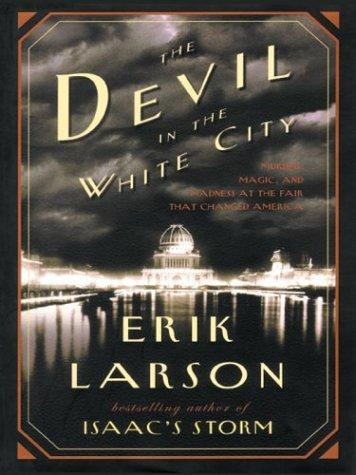
About this book
Erik Larson reconstructs two histories unfolding in and around Chicago during the early 1890s. The larger strand follows architect Daniel H. Burnham and the formidable effort to design, finance, construct, and open the World’s Columbian Exposition of 1893. Burnham must coordinate prominent architects, landscape designer Frederick Law Olmsted, engineers, laborers, civic leaders, and exhibitors while confronting deadlines, weather, economic instability, construction accidents, and the death of his partner John Root. The second strand follows Herman Webster Mudgett, better known as H. H. Holmes, a physician, swindler, bigamist, and murderer operating not far from the fairgrounds. Larson alternates between these narratives rather than treating the fair as background decoration for a conventional crime account. The result is a study in contrasting forms of ambition: Burnham’s public, collaborative effort to create a temporary ideal city and Holmes’s private manipulation of people, property, credit, and identity. The exposition material occupies substantial attention, including architectural rivalries, the search for an engineering spectacle to rival the Eiffel Tower, Olmsted’s landscape plans, labor conflict, and the pressure Chicago felt to prove itself against older American cities. The Holmes chapters narrow the scale from civic spectacle to interpersonal deception and violence. Their juxtaposition makes the book as much about the promises and dangers of rapid urban modernity as about either central figure individually. ([penguinrandomhouse.com](https://www.penguinrandomhouse.com/books/98115/the-devil-in-the-white-city-by-erik-larson/?utm_source=openai))
Deep Overview
Erik Larson reconstructs two histories unfolding in and around Chicago during the early 1890s. The larger strand follows architect Daniel H. Burnham and the formidable effort to design, finance, construct, and open the World’s Columbian Exposition of 1893. Burnham must coordinate prominent architects, landscape designer Frederick Law Olmsted, engineers, laborers, civic leaders, and exhibitors while confronting deadlines, weather, economic instability, construction accidents, and the death of his partner John Root. The second strand follows Herman Webster Mudgett, better known as H. H. Holmes, a physician, swindler, bigamist, and murderer operating not far from the fairgrounds. Larson alternates between these narratives rather than treating the fair as background decoration for a conventional crime account. The result is a study in contrasting forms of ambition: Burnham’s public, collaborative effort to create a temporary ideal city and Holmes’s private manipulation of people, property, credit, and identity. The exposition material occupies substantial attention, including architectural rivalries, the search for an engineering spectacle to rival the Eiffel Tower, Olmsted’s landscape plans, labor conflict, and the pressure Chicago felt to prove itself against older American cities. The Holmes chapters narrow the scale from civic spectacle to interpersonal deception and violence. Their juxtaposition makes the book as much about the promises and dangers of rapid urban modernity as about either central figure individually. ([penguinrandomhouse.com](https://www.penguinrandomhouse.com/books/98115/the-devil-in-the-white-city-by-erik-larson/?utm_source=openai))
Key Themes
The book’s organizing contrast is between creation and destruction. Burnham marshals institutions and specialists to build the White City, while Holmes exploits trust and the anonymity of a growing metropolis. Larson also examines civic ambition, professional rivalry, technological spectacle, architectural power, commercial promotion, and the human cost of compressed deadlines. The fair presents an idealized vision of order and progress, but the surrounding city contains poverty, exploitation, dangerous working conditions, and crime. Other recurring concerns include the vulnerability of young women seeking independence in an expanding city, the persuasive power of charm and status, the tension between temporary achievement and lasting influence, and the ways spectacular public narratives can conceal less flattering realities.
Historical Context
The World’s Columbian Exposition opened in Chicago in 1893 as the United States moved through rapid industrialization, urban growth, mass immigration, and expanding consumer culture. Its monumental Court of Honor helped popularize neoclassical civic architecture, while the fair presented technological, commercial, artistic, and imperial claims about American progress. The exposition also produced exclusions and conflicts that complicate its image as a unified national celebration, including disputes over representation, race, labor, and gender. Larson’s narrative concentrates on the fair’s organizers and physical creation rather than providing a comprehensive social history of every group affected by it. The book also belongs to the tradition of narrative history that uses documented scenes, alternating viewpoints, and suspense techniques associated with fiction. ([architecture.org](https://www.architecture.org/online-resources/architecture-encyclopedia/worlds-columbian-exposition-of-1893?utm_source=openai))
Intended Audience
This book is especially suitable for readers interested in American urban history, architecture, world’s fairs, the Gilded Age, true crime, or nonfiction written with thriller-like momentum. It can serve as an accessible entry point for readers who rarely choose conventional history because Larson organizes complex events around individuals, obstacles, and approaching deadlines. Readers expecting a predominantly Holmes-centered serial-killer account should know that the planning and construction of the exposition constitute a major—and arguably dominant—part of the book. It is less appropriate for readers seeking an academic monograph, a comprehensive history of late-nineteenth-century Chicago, or an exclusively victim-centered crime study.
Reading Difficulty
The prose is accessible to a general adult audience, and no specialized knowledge is required. The principal challenge is organizational rather than linguistic: readers must track two major narrative lines and a sizable cast of architects, officials, engineers, workers, investors, and people connected to Holmes. Short chapters and regular shifts of perspective create momentum, but they can also make the connection between the Burnham and Holmes stories feel thematic rather than continuously causal. Architectural terminology appears, although Larson generally supplies enough context for nonspecialists. The crime material includes murder, manipulation, the endangerment and killing of children, and discussion of bodies and human remains.
Helpful Background Knowledge
Readers may benefit from a basic understanding of the Gilded Age, the Great Chicago Fire of 1871, the growth of Chicago as an industrial and transportation center, and the international exposition movement. Familiarity with neoclassical architecture, Frederick Law Olmsted’s landscape work, nineteenth-century labor conditions, and the economic Panic of 1893 can add depth but is not necessary. It is also useful to approach claims about Holmes with caution: later historical investigation has challenged parts of the familiar legend, including extreme victim estimates and stories that his Chicago building functioned as a completed hotel designed to trap unknown fair visitors. ([history.com](https://www.history.com/articles/murder-castle-h-h-holmes-chicago?utm_source=openai))
Why Read This Book
The book offers an unusually vivid account of how a celebrated public spectacle was produced under intense institutional and physical pressure. It turns architectural planning, landscape design, municipal competition, engineering, and project management into sources of narrative suspense. Its paired structure encourages readers to consider how beauty, violence, innovation, fraud, opportunity, and vulnerability could coexist in the same rapidly modernizing city. It is also a useful case study in how narrative nonfiction shapes historical material: Larson creates forward motion through scene selection and parallel plotting without presenting the work as a novel.
Reader Takeaways
A careful reader will gain a stronger sense of the logistical scale behind the 1893 exposition and of the many professions and personalities involved in creating it. The book illustrates how civic identity can be deliberately constructed through architecture and spectacle, how temporary events can influence later city planning and popular culture, and how urban anonymity may create opportunities for both independence and exploitation. It may also prompt readers to distinguish between documented history, contemporary newspaper sensationalism, retrospective legend, and the interpretive choices required to turn archival evidence into a coherent narrative.
Strengths
Larson’s central editorial achievement is making a complex construction project intelligible and suspenseful without reducing it to a list of buildings and dates. Alternating between the fair and Holmes creates tonal contrast and keeps several forms of risk in view. The book introduces readers to figures such as Burnham, Root, Olmsted, George Washington Gale Ferris Jr., and Sol Bloom while preserving a clear narrative direction. Its notes and source discussion make the documentary foundation visible to readers who want to investigate further. The work is particularly effective at conveying deadline pressure, the fragility of large public undertakings, and the mixture of cooperation, ego, improvisation, and promotion behind apparently unified civic achievements.
Limitations and Cautions
The two primary narratives share a time and metropolitan setting, but their direct intersection is limited; readers may therefore find the alternating structure more symbolically persuasive than historically interconnected. The focus on prominent organizers and Holmes cannot provide a comprehensive account of the exposition’s racial politics, colonial displays, labor history, women’s participation, or the experiences of ordinary visitors and Chicago residents. More importantly, parts of the popular Holmes narrative have been disputed by later researchers. Reports of an enormous victim count, a fully functioning hotel for fair visitors, and an elaborate purpose-built torture complex are not all supported equally by surviving evidence. The book should therefore be read as an influential narrative history based on the sources available to Larson, not as the final word on every Holmes claim. ([history.com](https://www.history.com/articles/murder-castle-h-h-holmes-chicago?utm_source=openai))
Important People and Concepts
Daniel H. Burnham was the exposition’s director of works and the central figure in Larson’s construction narrative. John Wellborn Root, Burnham’s architectural partner, played an important early role before his unexpected death. Frederick Law Olmsted was responsible for landscape planning and faced practical and health-related obstacles. George Washington Gale Ferris Jr. proposed the great wheel intended as an American engineering answer to the Eiffel Tower. H. H. Holmes was the alias of Herman Webster Mudgett, whose activities combined fraud, intimate manipulation, multiple identities, and murder. The “White City” refers to the fair’s visually coordinated principal exhibition buildings and grounds; it represented planned order and monumental beauty while standing apart from much of everyday Chicago. The City Beautiful movement, neoclassicism, yellow journalism, the Panic of 1893, and the growth of urban anonymity are useful concepts for interpreting the book.
Questions the Book Explores
What does a city hope to gain by staging a spectacle for the world? How are extraordinary public projects shaped by ambition, rivalry, compromise, and chance? Why do idealized spaces depend upon labor and conditions that their finished appearance hides? What makes charm and professional respectability effective instruments of deception? How does a rapidly growing city expand personal freedom while increasing anonymity and vulnerability? Why do stories about spectacular crimes become embellished, repeated, and culturally persistent? Can two lives that barely intersect illuminate the same historical moment through contrast?
Reading Group Guide
A group may divide discussion into three stages. First, map the principal actors and identify the practical obstacles confronting Burnham’s team. Second, compare Larson’s methods in the fair chapters with those in the Holmes chapters: note pacing, scene construction, evidence, foreshadowing, and tone. Third, examine the larger interpretation created by placing the stories together. Groups can supplement the book with photographs and plans of the exposition and with newer research separating documented facts about Holmes from later legend. Because the book includes violence against women and children, facilitators should advise participants about disturbing content before the meeting. Penguin Random House also provides an official reader’s guide. ([penguinrandomhouse.com](https://www.penguinrandomhouse.com/books/98115/the-devil-in-the-white-city-by-erik-larson/9780609608449/readers-guide/?utm_source=openai))
Discussion Questions
1. Does the alternating structure deepen the history, or does it make two largely separate stories appear more connected than they were? 2. How does Burnham’s concept of civic honor influence his decisions and relationships? 3. What does the White City reveal—and conceal—about Chicago and the United States in the 1890s? 4. Which obstacles to building the fair arise from nature, institutions, personalities, economics, or technology? 5. How does Larson create suspense when readers already know that the exposition opened? 6. What forms of trust does Holmes exploit, and what social conditions make that exploitation possible? 7. Does the narrative devote sufficient attention to Holmes’s victims as individuals? 8. How should readers respond when later scholarship complicates claims in a popular work of narrative history? 9. Which parts of the fair had the greatest lasting cultural or architectural significance? 10. What does the book suggest about the relationship between grand achievement and hidden human cost?
Sources and Verification
Book identity was checked against the official Penguin Random House record and WorldCat. The first hardcover and later Vintage paperback must not be treated as the same edition: the first U.S. hardcover carries ISBN 9780609608449, while the 2004 Vintage paperback carries ISBN 9780375725609. The publisher lists 464 pages for its editions, while some library descriptions report xi preliminary pages plus 447 numbered text pages; this is a pagination convention rather than necessarily a substantive disagreement. Historical context was checked against institutional resources from PBS and the Chicago Architecture Center. Cautions about Holmes’s victim count and the “Murder Castle” legend rely on a fact-checked History article presenting later research and evidentiary disputes. Editorial judgments about audience, structure, strengths, and limitations are WebToTell analysis rather than claims attributed to those sources. ([penguinrandomhouse.com](https://www.penguinrandomhouse.com/books/98115/the-devil-in-the-white-city-by-erik-larson/?utm_source=openai))