
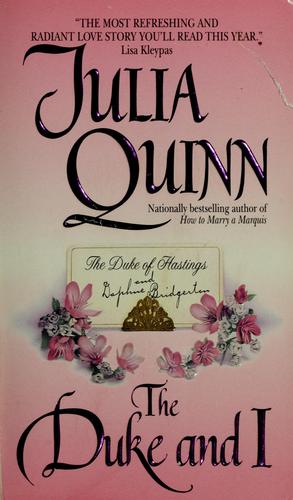
The Duke and I
In Regency-era London, Daphne Bridgerton wants a loving marriage but finds that eligible men treat her more like a friend than a prospective wife. Simon Basset, the newly returned Duke of Hastings, has the opposite problem: ambitious families relentlessly pursue him, though he has privately resolved never to marry or father children. They arrange a false courtship that promises to make Daphne appear more desirable while discouraging Simon’s unwanted admirers. Predictably, the performance begins to produce real intimacy. Their attraction, however, cannot erase Simon’s childhood wounds or Daphne’s limited understanding of marriage and sexuality. What begins as a witty social bargain consequently develops into a more difficult story about trust, family expectations, reproductive choice, and the harm caused by secrecy. The novel launches Julia Quinn’s Bridgerton series by combining a central romance with the lively dynamics of the large Bridgerton family and the sharp observations of anon…
Where to buy or borrow
Are you selling this book? Bookstores, publishers, authors and libraries can be listed here for free. Request a listing
About this book
Deep Overview
Daphne Bridgerton’s conflict initially seems lighter. She is socially accomplished, practical, and surrounded by a loving family, but potential husbands regard her as approachable rather than mysterious. Her brother Anthony’s protectiveness further narrows her prospects. When Daphne and Simon meet, their easy verbal rapport suggests compatibility before either is willing to name it. They devise a false attachment: association with a duke should increase Daphne’s social value, while his apparent preference for her should protect Simon from matchmaking mothers.
The scheme allows Quinn to turn courtship into a study of collective judgment. Members of the ton imitate one another, and Daphne’s desirability rises once Simon appears to validate it. Lady Whistledown’s anonymous column acts as both comic commentary and a mechanism of social pressure, showing how reputation can become more influential than private truth. Yet the novel’s emotional center lies less in public gossip than in the contrast between two families. The noisy, loyal Bridgertons demonstrate that family can be intrusive without being cruel; Simon’s childhood shows how lineage can become abusive when an heir is valued only as a continuation of a title.
After attraction compromises their arrangement, marriage does not resolve the underlying conflict. Daphne wants children and interprets Simon’s statement that he cannot have them as a physical incapacity. Simon knows that his refusal is voluntary but does not fully explain it. Their failure to communicate turns reproductive choice into a struggle over trust and control. A pivotal encounter occurs when Simon is intoxicated and Daphne attempts to become pregnant despite knowing that he does not consent to fatherhood. The scene is ethically disturbing and materially changes how many modern readers assess the romance.
The concluding movement emphasizes disclosure, confrontation, and reconciliation. Daphne comes to understand the injured child behind Simon’s vow, while Simon must decide whether organizing his future around revenge gives his dead father continuing authority over him. The eventual romantic resolution affirms intimacy and chosen family, but it does not erase the seriousness of the couple’s violations of trust. That tension—between buoyant romantic comedy and a darker marital conflict—is central to the book’s continuing ability to provoke discussion.
Key Themes
**Inheritance and parental power:** Simon’s dukedom gives him wealth and status, but succession also binds him psychologically to an abusive father. His refusal to produce an heir is an attempt to reclaim control.
**Secrecy within intimacy:** Both protagonists act on incomplete information. Their marriage demonstrates that affection cannot substitute for candid communication about sex, children, and personal boundaries.
**Chosen family versus bloodline:** The Bridgertons embody affectionate, imperfect family life, while the Hastings household treats a child as a dynastic instrument. The contrast asks what actually makes a family worth continuing.
**Consent and reproductive agency:** Simon and Daphne each attempt to control whether they will have children, but neither handles the conflict honestly or ethically. The resulting encounter is the novel’s most troubling and contested element.
**Performance becoming reality:** The false courtship succeeds because performance changes how society sees Daphne, but it also gives the pair permission to develop a relationship they initially deny.
Historical Context
Its social world should not be treated as a comprehensive portrait of Britain in 1813. The narrative concentrates on a wealthy, titled circle and largely excludes the labor, imperial wealth, war, poverty, and racial diversity that also shaped the period. Its rapid dialogue, sexual attitudes, and family comedy reflect late-twentieth-century popular romance conventions as much as documented Regency behavior. The result is best understood as Regency-set romantic fiction: history supplies rules and pressures that enable the plot, while emotional accessibility and entertainment take priority over exhaustive historical representation.
Intended Audience
It may be less suitable for readers seeking meticulous historical realism, broad representation of Regency society, or an uncomplicated comfort read. The marital conflict includes deception concerning reproduction and a sexual encounter in which an intoxicated character cannot meaningfully consent. Readers for whom sexual coercion is a significant concern may wish to approach the novel cautiously.
Reading Difficulty
The principal difficulty is ethical rather than linguistic. The movement from light courtship comedy to a serious dispute about sex and pregnancy is abrupt, and the narrative’s treatment of the pivotal encounter may not provide the degree of reckoning some readers expect. Keeping Simon’s childhood history and his distinction between inability and refusal in view is essential to understanding the later conflict.
Helpful Background Knowledge
Readers may also benefit from recognizing several genre conventions: a marriage-centered resolution, a hero emotionally isolated by childhood trauma, a heroine constrained by sexual ignorance, and a courtship arranged for practical reasons. Awareness that the book was published in 2000 can help explain why some of its assumptions—particularly surrounding consent and reproductive conflict—are now discussed more critically.
Why Read It
The novel is also valuable as a discussion text because its pleasures and problems cannot be neatly separated. The banter and family scenes show Quinn’s skill at creating social momentum, while Simon’s history gives the inheritance plot genuine psychological weight. At the same time, the sexual and reproductive conflict invites examination of how genre conventions and standards for representing consent have changed since 2000.
Reader Takeaways
The marriage plot also demonstrates why ambiguity is dangerous in intimate relationships. Simon’s misleading wording and Daphne’s inadequate sexual education create unequal knowledge, but those circumstances do not excuse either partner’s later choices. More broadly, the novel encourages readers to distinguish understanding trauma from absolving harmful conduct and to consider whether a romantic ending adequately addresses the breaches of trust that precede it.
Strengths
Quinn also uses the false courtship effectively to expose the imitative behavior of elite society. Lady Whistledown’s commentary supplies wit while connecting individual choices to a larger economy of reputation. Simon’s childhood gives emotional logic to his fear of fatherhood, and the contrast between inherited rank and emotional deprivation complicates the fantasy of marrying a duke.
Limitations and Content Considerations
The central conflict also depends on Daphne’s profound ignorance of sex and Simon’s calculatedly incomplete explanation of his reproductive intentions. That construction can feel contrived even within the historical setting. The novel offers a narrow aristocratic version of Regency England and gives little attention to the economic and imperial structures supporting its characters’ privileges. Readers coming from the television adaptation should additionally expect significant differences in characterization, representation, and world-building.
Important Concepts, People, and Institutions
**Simon Basset, Duke of Hastings:** The hero, whose childhood stammer and rejection by his father shape his guarded adult identity. His determination to end the Hastings line drives the book’s central marital dispute.
**Anthony Bridgerton:** Daphne’s eldest brother and Simon’s friend. His protective interference reveals how male relatives can control a woman’s prospects even when motivated by affection.
**Violet Bridgerton:** The widowed mother of the eight Bridgerton siblings. Her energetic matchmaking can embarrass Daphne, but the household she sustains offers Simon a model of family based on attachment rather than lineage alone.
**Lady Danbury:** An older aristocratic woman who recognized Simon’s abilities and supported him during childhood. She represents the care and confidence denied to him by his father.
**Lady Whistledown’s Society Papers:** An anonymous gossip column that interprets—and helps create—the social reputations on which the courtship scheme depends. It also becomes a unifying device across the series.
**The ton:** A conventional term for fashionable elite society. Its members enforce behavioral rules through invitations, gossip, approval, and exclusion.
**Primogeniture and dynastic succession:** The inheritance practices behind the pressure to produce a male heir. Simon’s refusal of fatherhood is aimed at this system and at his father’s obsession with continuity.
**The London social season:** The recurring cycle of balls, visits, and presentations during which aristocratic families sought advantageous marriages. It provides the public stage for Daphne and Simon’s deception.
Questions the Book Explores
Can a person defeat an abusive parent by rejecting everything that parent valued, or does such rejection preserve the parent’s control?
What obligations do partners have to disclose their intentions about marriage and children?
How does inadequate sexual education make people vulnerable without removing responsibility for their actions?
Can a relationship recover when each partner has violated the other’s trust in a different way?
What separates a family built around affection from a dynasty concerned principally with inheritance and appearances?
Reading Group Guide
Track what Daphne and Simon know at each stage of their relationship. A useful discussion can distinguish direct lies, strategic omissions, mistaken assumptions, and knowledge withheld by the wider culture. Groups should address the pivotal sexual encounter explicitly rather than treating it as a minor obstacle, asking how intoxication, intent, reproductive consequences, and power affect consent.
Readers familiar with the television adaptation may compare choices rather than simply listing changes: which alterations reshape the ethics of the story, Simon’s identity, Daphne’s agency, or the meaning of elite society? Finally, consider Lady Whistledown not only as comic entertainment but as an institution whose attention changes behavior.
Discussion Questions
2. Is Simon’s vow primarily an assertion of freedom, an act of revenge, or evidence that his father still controls him?
3. At what point does the false courtship become emotionally dishonest rather than merely strategic?
4. How does Anthony’s protectiveness help Daphne, and how does it limit her autonomy?
5. What responsibilities does Simon bear for allowing Daphne to misunderstand his statement that he cannot have children?
6. How should readers evaluate Daphne’s actions during the disputed sexual encounter?
7. Does the novel devote enough attention to rebuilding trust after that encounter? Why or why not?
8. What does Lady Danbury provide that Simon’s wealth and title cannot?
9. How does Lady Whistledown influence events instead of simply reporting them?
10. In what ways does the Bridgerton family function as an alternative to the Hastings model of lineage?
11. Does the romantic conclusion resolve the central ethical conflict, or mainly satisfy the conventions of the genre?
12. How might the novel differ if Daphne had entered marriage with fuller knowledge of sex and reproduction?
Sources and Verification
Comments
No published comments yet.
Available editions
Paperback
paperback
- Publisher
- Avon Books
- ISBN-13
- 9780380800827
- Publication date