About this book
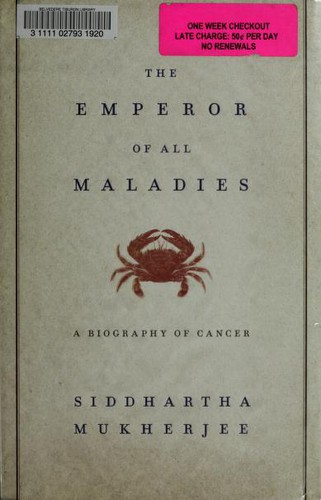
Siddhartha Mukherjee approaches cancer as though it were the subject of a biography: an entity with ancient appearances, changing identities, influential interpreters, periods of apparent defeat, and repeated transformations. The book moves from early descriptions of tumors through surgery, radiation, chemotherapy, epidemiology, prevention, genetics, targeted treatment, and the political campaign commonly called the War on Cancer. Rather than presenting medical progress as a smooth accumulation of discoveries, Mukherjee reconstructs a history shaped by experiments, rival theories, institutional ambitions, public advocacy, commercial interests, clinical failures, and patients willing to undergo uncertain treatments. A contemporary leukemia patient, Carla Reed, helps anchor the historical account in the realities of diagnosis and care. The result combines medical history, popular science, clinical narrative, and institutional history while repeatedly returning to a central biological insight: cancer is not a single external invader but a diverse family of diseases arising from altered human cells.
Deep Overview
Siddhartha Mukherjee approaches cancer as though it were the subject of a biography: an entity with ancient appearances, changing identities, influential interpreters, periods of apparent defeat, and repeated transformations. The book moves from early descriptions of tumors through surgery, radiation, chemotherapy, epidemiology, prevention, genetics, targeted treatment, and the political campaign commonly called the War on Cancer. Rather than presenting medical progress as a smooth accumulation of discoveries, Mukherjee reconstructs a history shaped by experiments, rival theories, institutional ambitions, public advocacy, commercial interests, clinical failures, and patients willing to undergo uncertain treatments. A contemporary leukemia patient, Carla Reed, helps anchor the historical account in the realities of diagnosis and care. The result combines medical history, popular science, clinical narrative, and institutional history while repeatedly returning to a central biological insight: cancer is not a single external invader but a diverse family of diseases arising from altered human cells.
Key Themes
Major themes include the uneasy relationship between scientific ambition and patient welfare; the difference between treating cancer and curing it; the evolution from broadly destructive therapies toward biologically targeted interventions; and the power of public language, fundraising, and political organization to direct research. The book also considers stigma, secrecy, fear, informed consent, medical paternalism, tobacco and preventable risk, the ethics of experimentation, and the recurrent temptation to announce victory before evidence justifies it. A deeper theme is cancer's biological intimacy: malignant cells exploit ordinary mechanisms of growth, survival, mutation, and adaptation, making the disease difficult to separate cleanly from the processes of life itself.
Historical and Intellectual Context
The narrative spans ancient medical descriptions and humoral theories, the development of pathological anatomy, nineteenth-century surgery, the discovery and medical use of radiation, early chemical treatments, childhood-leukemia research, combination chemotherapy, epidemiological evidence connecting smoking with lung cancer, and the emergence of molecular oncology. Important institutional and political developments include Sidney Farber's research and advocacy, Mary Lasker's public campaigning, the creation of a national War on Cancer, debates over screening, and the growth of randomized clinical trials. The book was first published in 2010, when cancer genomics and targeted drugs had substantially changed the intellectual landscape but before many later advances in immunotherapy, liquid biopsy, and precision oncology entered routine public discussion.
Intended Audience
The book is especially suited to readers of narrative science, medical history, public-health history, and biographies of ideas or institutions. It may benefit clinicians and medical students seeking historical perspective, as well as patients, caregivers, and general readers who want to understand why progress against cancer has been real but uneven. It is not a treatment manual and should not be used to make personal medical decisions. Readers currently experiencing cancer may also find its accounts of suffering, relapse, aggressive treatment, and death emotionally demanding.
Reading Difficulty
The prose is written for a general audience, but the original hardcover is long and intellectually dense. Mukherjee explains much of the necessary biology in context, so formal scientific training is not required. Readers will nevertheless encounter terminology from genetics, cell biology, pathology, chemotherapy, clinical-trial design, and epidemiology. The structure moves between centuries, institutions, researchers, and individual patients rather than following a strictly uninterrupted chronology. A slow reading pace, brief notes, or supplementary reference checks may help readers retain names and connect scientific developments.
Helpful Background Knowledge
No specialist preparation is essential. It is useful to know that cancer is a broad category encompassing many diseases rather than one uniform condition; that tumors can differ biologically even when they arise in the same organ; and that treatment outcomes must be judged through evidence rather than isolated success stories. Familiarity with basic concepts such as cells, genes, mutations, metastasis, chemotherapy, radiation, screening, risk, and randomized trials will make the scientific passages easier. Readers should also distinguish historical medical practice from current standards of care.
Why Read This Book
This book offers a rare integrated account of cancer as a biological problem, clinical challenge, political cause, and human experience. It helps explain why certain treatments once regarded as breakthroughs later proved limited, why apparently unsuccessful experiments sometimes opened productive lines of inquiry, and why the language of war can mobilize resources while oversimplifying the disease. Its patient narratives prevent the scientific history from becoming an abstract chronology. The book also provides a framework for evaluating medical progress with greater patience: advances may be substantial without producing a single universal cure.
Reader Takeaways
A careful reader may come away understanding that cancer research advances through revision, comparison, and accumulated evidence rather than isolated moments of genius. The history shows how improved classification can be as important as a new drug, because meaningful treatment depends on recognizing biological differences among cancers. Readers may also reconsider easy distinctions between success and failure: temporary remission, reduced mortality, prevention, earlier detection, longer survival, and improved quality of life represent different forms of progress. The book encourages skepticism toward miracle-cure rhetoric while preserving respect for the genuine achievements of researchers, clinicians, advocates, and trial participants.
Strengths
The principal editorial strength is synthesis. Mukherjee connects cellular biology with surgery, pharmacology, epidemiology, politics, fundraising, public rhetoric, and bedside medicine. His organizing metaphor—a biography of a disease—gives coherence to a subject that could otherwise become a list of discoveries. The book also resists a triumphalist version of medical history by including false leads, excessive interventions, ethical conflicts, and institutional competition. Patient stories create moral and emotional stakes, while portraits of researchers and advocates clarify how scientific knowledge depends on personalities, organizations, funding, and historical opportunity. The book received the 2011 Pulitzer Prize for General Nonfiction.
Limitations and Cautions
The original edition's account largely ends around 2010. It therefore cannot serve as a current overview of cancer science or treatment, particularly in areas transformed by later developments. The publisher has since issued a revised edition with four additional chapters; readers primarily seeking contemporary coverage should verify which edition they are obtaining. The biographical metaphor is powerful but may encourage readers to imagine cancer as a more unified adversary than its many forms warrant. The narrative is also selective rather than encyclopedic, giving greater attention to particular researchers, institutions, cancers, and developments that support its historical arc. Clinical examples describe specific historical circumstances and must not be treated as personalized medical guidance.
Important Concepts, People, and Developments
Important concepts include malignant cell growth, mutation, oncogenes, tumor-suppressor mechanisms, metastasis, remission, drug resistance, combination chemotherapy, targeted therapy, screening, prevention, randomized clinical trials, statistical evidence, and informed consent. Historically significant figures and subjects include Queen Atossa as an emblem of cancer's ancient presence; Sidney Farber and early antifolate treatment for childhood leukemia; Mary Lasker and organized cancer advocacy; radical surgery and debates over treatment intensity; radiation as both discovery and therapy; the relationship between tobacco and lung cancer; Min Chiu Li and disputes over experimental treatment; the War on Cancer; Herceptin as an example of oncogene-targeted treatment; and the cancer genome as a way of understanding malignant diversity.
Questions the Book Explores
Can a disease meaningfully have a biography? Why has cancer proved resistant to the idea of one decisive cure? When does aggressive experimentation become justified, and who bears its risks? How should physicians balance urgency, uncertainty, compassion, and informed consent? What counts as success when a treatment produces remission but not permanent cure? How do metaphors such as war shape funding, expectations, and patient experience? Why did public advocacy become central to cancer research? How should screening programs be evaluated when early detection does not automatically translate into reduced mortality? What can historical failures teach researchers working under very different scientific conditions?
Reading Group Guide
Groups may wish to divide the book into three broad conversations: changing theories of what cancer is; changing methods of treating and studying it; and changing relationships among patients, physicians, researchers, advocates, government, and industry. Ask each participant to track one recurring concern, such as consent, evidence, stigma, political rhetoric, prevention, or the meaning of cure. Because the subject can be personal, establish at the outset that nobody must disclose a diagnosis or caregiving experience. For a contemporary perspective, compare the original edition's concluding outlook with reputable current information or with the revised edition, clearly separating developments after 2010 from the historical narrative being discussed.
Discussion Questions
1. What does the biography metaphor reveal about cancer, and what might it obscure? 2. Which episode most clearly demonstrates that medical progress is not linear? 3. How does Carla Reed's story affect the way the historical and scientific material is understood? 4. When researchers pursue treatments for otherwise fatal diseases, how should they distinguish necessary experimentation from unacceptable risk? 5. Does the language of a War on Cancer clarify the challenge or create unrealistic expectations of total victory? 6. How do political advocacy and fundraising both help and distort scientific priorities? 7. Which definition of progress—cure, prevention, remission, longer survival, lower mortality, or improved quality of life—seems most useful? 8. How does cancer's origin in the body's own cells complicate the conventional idea of disease as an outside enemy? 9. What responsibilities do writers have when turning patients' suffering into a public history? 10. Which parts of the original edition most clearly require updating, and does later knowledge change the meaning of its historical argument?
Sources and Verification
Identity and original-edition metadata were checked against official publisher information and library catalog records. The Pulitzer Prize website independently confirms the author, title, Scribner imprint, and 2011 General Nonfiction award. The publisher's current listing also establishes the existence of a later revised hardcover containing four new chapters, so the original 2010 edition and revised edition should not be conflated. The profile's thematic and reader-guidance sections are original editorial synthesis based on verified descriptions, the publisher-hosted excerpt and reading-group material, and bibliographic evidence.