
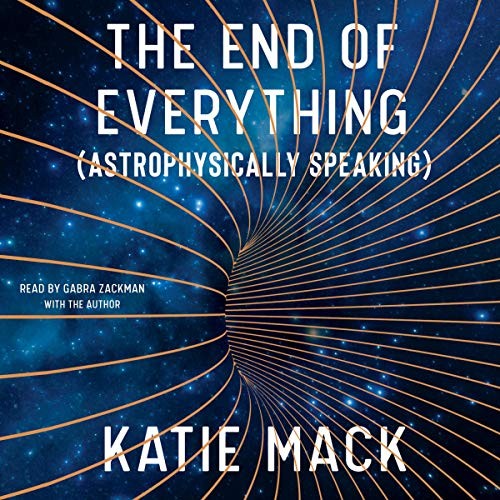
The End of Everything
(Astrophysically Speaking)
In The End of Everything (Astrophysically Speaking), theoretical astrophysicist Katie Mack examines five scientifically discussed ways the universe might meet its ultimate fate: the Big Crunch, heat death, the Big Rip, vacuum decay, and a cosmic bounce. Each possibility depends on unresolved questions about expansion, dark energy, gravity, quantum fields, and the earliest moments of cosmic history. Rather than treating these endings as disaster entertainment, Mack uses them to explain how cosmologists test theories about the universe as a whole. The result is both an introduction to modern cosmology and an exploration of scientific uncertainty. Mack distinguishes evidence-supported conclusions from increasingly speculative possibilities while showing how small changes in physical assumptions can produce radically different futures. Her informal humor makes the subject approachable without removing its intellectual or existential weight: even if humanity cannot influence the final dest…
Where to buy or borrow
Are you selling this book? Bookstores, publishers, authors and libraries can be listed here for free. Request a listing
About this book
Deep Overview
The five principal scenarios function as case studies in modern physics. A Big Crunch would reverse cosmic expansion and drive the universe toward collapse. Whether such a reversal is possible depends on the universe’s contents, geometry, expansion history, and the behavior of dark energy. Heat death takes the opposite path: expansion continues, usable energy becomes increasingly unavailable, stars cease to shine, and the cosmos approaches a thin, cold state in which complex processes become extraordinarily difficult or impossible. This is not a single explosive finale but an extended erosion of structure and thermodynamic possibility.
The Big Rip emerges if dark energy has particular properties that cause expansion to accelerate ever more violently. Under that model, gravitationally bound systems—and eventually smaller forms of physical organization—could be pulled apart. Vacuum decay introduces a different danger rooted in quantum field theory. If the universe occupies a metastable rather than absolutely stable vacuum state, a transition to a lower-energy state could spread through space, replacing the physical conditions that make existing structures possible. Because the transformation would propagate without useful advance warning, it represents a limit not only on survival but also on observation.
The final family of possibilities involves bounces and cyclic models. Here an apparent ending may form part of a larger sequence in which collapse, collision, or another transition gives rise to a new cosmic phase. Mack presents such ideas as an entry into more speculative territory, including models involving extra dimensions and universes beyond the directly observable one.
Across these scenarios, the book’s deeper subject is the relationship between evidence and theory. Cosmologists cannot wait to observe the end directly. They instead measure present expansion, map matter and radiation, investigate fundamental particles, and test gravitational theories. Those observations restrict the range of futures compatible with known physics. Mack therefore treats cosmic endings as diagnostic tools: imagining how the universe dies exposes what scientists do and do not understand about how it works now. The concluding reflections bring this scientific uncertainty into contact with human questions about significance, impermanence, and the value of understanding realities beyond our power to control.
Key Themes
A second theme is the productive role of extreme thought. By extending physical theories into the remote future or applying them under extraordinary conditions, scientists can discover hidden implications, contradictions, and limits within those theories.
The book also emphasizes degrees of scientific confidence. Some outcomes follow fairly directly from current models, while others require more speculative assumptions. Mack repeatedly shows that uncertainty is not equivalent to ignorance: evidence can make some possibilities more plausible than others without producing a final verdict.
Finally, the book considers cosmic perspective. Human life is physically minute and temporary, yet the human ability to reconstruct cosmic history and investigate possible futures gives intellectual significance to our place in the universe.
Scientific and Intellectual Context
Later measurements indicating accelerated expansion transformed the discussion again by giving dark energy a central role. At the same time, particle physics and quantum field theory introduced possibilities—such as vacuum instability—that cannot be understood through astronomy alone. Mack’s five endings therefore reflect the modern convergence of observational cosmology, gravitational theory, thermodynamics, and particle physics.
The book also places scientific eschatology beside older religious, philosophical, and literary efforts to imagine the end. Its purpose is not to adjudicate theology, but to show how empirical methods have changed the kinds of answers that can be defended.
Intended Audience
It is less suitable for readers seeking a mathematical derivation of cosmological models, a technical reference work, or a single definitive prediction. The discussion is exploratory and comparative because the scientific question remains open.
Reading Difficulty
The scenario-based organization helps because each major chapter has a clear physical outcome, but the later discussion moves into less intuitive territory. Vacuum decay and bounce models are likely to require the most careful reading. Mack’s analogies and humor reduce the formality, although they do not eliminate the genuine strangeness of the underlying physics.
Helpful Background Knowledge
Before beginning, it may also help to distinguish the observable universe—the region from which light has had time to reach us—from any larger totality that may exist beyond it. That distinction becomes important when the book considers claims about what can be measured and what remains theoretical.
Why Read This Book?
It is also valuable as a demonstration of science in progress. Mack does not conceal disagreement, missing evidence, or theoretical uncertainty. Readers can see how scientists compare scenarios without pretending that every open question has already been settled. The book’s wit makes these discussions inviting, while its attention to mortality and impermanence gives them relevance beyond technical curiosity.
Reader Takeaways
Readers will also learn to distinguish several meanings of an ending: sudden destruction, gravitational collapse, progressive thermodynamic exhaustion, transformation of the vacuum, or transition into another cosmic phase. More broadly, the book encourages comfort with provisional knowledge. Scientific conclusions can be rigorous and useful even when they do not yet identify one final answer.
Strengths
Her most distinctive strength is tonal control. Humor and personal reflection make difficult material less intimidating without turning the subject into parody. The book also handles uncertainty responsibly, separating relatively conventional projections from ideas that depend on more speculative physics. Its cross-disciplinary range shows why the largest astronomical questions often depend on the behavior of the smallest particles and fields.
Limitations and Cautions
The book reflects the evidence and debates available around its 2020 publication. Cosmology is an active field, so later measurements may change the relative plausibility of particular models or refine constraints on dark energy and fundamental particles. The speculative scenarios can also occupy more memorable space than their evidential standing warrants; readers should retain Mack’s distinctions between established physics, model-dependent extrapolation, and conjecture.
Important Concepts and People
Albert Einstein matters because general relativity describes gravity through spacetime geometry and makes dynamic cosmological models possible. Edwin Hubble is associated with observational evidence that the universe is expanding. Stephen Hawking appears as an important influence on Mack’s early interest in cosmology and represents the modern tradition of explaining theoretical physics to general readers.
The Big Bang is the book’s starting framework for an evolving universe. Cosmic inflation refers to a proposed period of extremely rapid early expansion. Dark energy is the name given to the still-mysterious component associated with the universe’s accelerated expansion, and its behavior is crucial to several end scenarios.
Heat death describes a future in which continued expansion and increasing entropy leave little or no usable free energy for organized processes. The Big Crunch is a hypothetical reversal from expansion into collapse. The Big Rip is a model in which increasingly powerful accelerated expansion destroys bound structures. Vacuum decay is a possible quantum transition from the universe’s present vacuum state to a lower-energy state with different physical conditions. A cosmic bounce or cyclic cosmology proposes that an apparent end may be followed by—or form part of—another cosmic phase.
The observable universe is the region from which information has been able to reach us. Mack’s claims about cosmic fate must be understood partly through this observational boundary.
Questions the Book Explores
What does dark energy imply about the universe’s long-term future?
Could physical structures disappear gradually through thermodynamic exhaustion rather than through a single catastrophe?
Is the quantum vacuum fundamentally stable?
Can an ending also be a transition into another universe or cosmic cycle?
How do observations made in the present constrain events unimaginably far in the future?
What can hypothetical cosmic endings reveal about gaps in current physics?
Does awareness of universal impermanence diminish human significance, or provide a new context for it?
Reading Group Guide
Notice where Mack moves from established observations to model-dependent projections and then into more speculative proposals. Discuss whether her tonal shifts—between technical explanation, humor, fear, and wonder—clarify the science or change how its seriousness is perceived.
Another productive angle is the relationship between scientific and cultural end-times narratives. Consider what changes when an account of the end is based on impersonal physical processes rather than moral judgment or narrative resolution. Finally, compare the book’s scientific uncertainty with its philosophical confidence that the attempt to understand the universe remains worthwhile.
Discussion Questions
2. How effectively does the book distinguish established evidence from theoretical extrapolation and speculation?
3. What does the fate of the universe reveal about the limits of present-day physics?
4. Does Mack’s humor improve your understanding of difficult ideas, or occasionally distract from them?
5. How does heat death challenge familiar expectations that an ending must be a sudden event?
6. Why are observations of cosmic expansion relevant to events in the extremely distant future?
7. What is gained by discussing vacuum decay even if it cannot be predicted or survived?
8. Do cyclic cosmologies meaningfully avoid an ending, or merely redefine it?
9. How does the book’s cosmic scale affect your view of human importance and responsibility?
10. What would count as a satisfying scientific answer to the question of how the universe ends?
Sources and Verification
Comments
No published comments yet.
Available editions
Hardcover
First Scribner hardcover edition
- Publisher
- Scribner
- ISBN-13
- 9781982103545
- Publication date
- Pages
- 240