
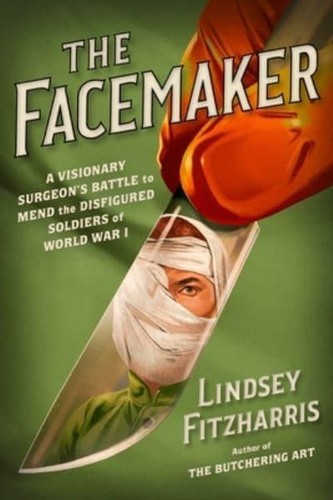
The Facemaker
A Visionary Surgeon's Battle to Mend the Disfigured Soldiers of World War I
The Facemaker recounts how surgeon Harold Gillies and an interdisciplinary medical team confronted the devastating facial wounds of the First World War. Modern artillery and trench combat produced injuries that existing surgical practice was poorly equipped to treat, leaving survivors with impaired breathing, eating, speech, and vision as well as severe social isolation. Lindsey Fitzharris follows Gillies from wartime service to his leadership of specialized treatment in Britain, where repeated operations, skin grafts, dental work, anesthesia, medical illustration, and careful experimentation helped establish modern reconstructive plastic surgery. The book is both a historical biography and a patient-centered account of medical innovation. It emphasizes that repairing a face was never solely a technical problem: the work also concerned identity, dignity, relationships, and the possibility of returning to public life. By placing surgical progress beside individual experiences of injury…
Where to buy or borrow
Are you selling this book? Bookstores, publishers, authors and libraries can be listed here for free. Request a listing
About this book
Deep Overview
Harold Delf Gillies, a New Zealand-born surgeon trained in Britain, becomes the book’s central figure because he recognized that these injuries demanded a specialty, not occasional treatment within general surgery. After wartime experience in France and exposure to emerging reconstructive methods, he helped establish a dedicated facial-injury service at Cambridge Military Hospital in Aldershot. As casualties exceeded its capacity, the work expanded to the Queen’s Hospital at Sidcup, opened in 1917 for facial reconstruction.
Fitzharris presents this development as collective rather than solitary. Repairing a shattered face required coordination among surgeons, dental and maxillofacial specialists, anesthetists, nurses, orderlies, technicians, and artists. Dental appliances could stabilize jaws; drawings, photographs, casts, and models documented injuries and guided planning; anesthesia made lengthy procedures possible; nursing sustained patients through infections, repeated operations, and prolonged convalescence. Artist and surgeon Henry Tonks occupies an important place in this world because his pastel portraits recorded injured men as individuals rather than reducing them to clinical specimens.
The surgical challenge involved both function and appearance. Gillies used and refined grafting and flap techniques, including the tubed pedicle, which preserved a blood supply while tissue was transferred from one area of the body to another. Reconstruction often proceeded through several operations over months or years. The uncertainty of these procedures is central to the narrative: progress came through observation, revision, failure, collaboration, and careful attention to what each patient’s remaining tissue would permit.
The book also asks what a face means socially. Facial injury could alter eating, speech, breathing, and sight, but it also affected recognition, intimacy, employment, and a veteran’s willingness to enter public spaces. Wartime cultures could celebrate an amputated limb as proof of sacrifice while reacting to facial difference with avoidance or disgust. Fitzharris therefore frames reconstruction as an attempt to restore social possibility as well as bodily function.
Gillies’s work helped make reconstructive plastic surgery a coherent field, but the book does not treat war as beneficial. Its medical advances emerged because immense numbers of people had been subjected to industrialized violence. That tension—between ingenuity and catastrophe—gives the history its moral weight.
Key Themes
• The face and personal identity: Facial appearance affects recognition and social interaction, so injury can threaten a person’s sense of belonging as well as physical function.
• Collaboration behind innovation: Gillies’s achievement depended on a network of dental surgeons, anesthetists, nurses, artists, technicians, and patients.
• Surgery as science and craft: Reconstruction required anatomical knowledge, manual skill, visual imagination, improvisation, and the ability to revise a plan across several operations.
• Visibility, stigma, and disability: The book examines why societies may respond differently to facial injuries than to other visible signs of military sacrifice.
• Progress born from destruction: Medical advances appear alongside the violence that made them urgently necessary, preventing a simple triumphalist account of innovation.
Historical Context
British social expectations intensified the consequences of survival. Veterans were publicly honored, yet men with pronounced facial differences could encounter staring, revulsion, unemployment, or withdrawal from ordinary community life. The development of specialized hospitals such as the Queen’s Hospital at Sidcup should therefore be understood within both military medicine and the wider history of disability. Gillies’s innovations were part of an international wartime effort; surgeons in France, Germany, and elsewhere were also advancing facial and maxillofacial reconstruction.
Intended Audience
It may be less suitable for readers who wish to avoid descriptions or images of traumatic injury, surgery, infection, and bodily damage. Those looking for a comprehensive military history of the First World War will find the focus comparatively narrow, centered on facial casualties and their care.
Reading Difficulty
The narrative movement between biography, patient stories, military events, and medical explanation demands moderate attention, especially when several specialists and procedures enter the account. The structure remains more accessible than an academic monograph, while end matter supports readers who want to trace the research.
Helpful Background Knowledge
It is useful to approach the period without assuming present-day antibiotics, imaging, microsurgery, trauma systems, or standards of rehabilitation. Gillies and his colleagues worked with comparatively limited tools, making staged operations and multidisciplinary planning especially important.
Why Read It
The book is particularly valuable because it complicates the familiar lone-genius story. Gillies is central, but the work also depends on colleagues who repaired jaws, administered anesthesia, documented cases, provided nursing care, and endured the procedures themselves. Readers therefore gain a fuller picture of how medical change actually occurs.
Reader Takeaways
Readers may become more attentive to the ethics of viewing historical medical images and to the danger of treating patients as illustrations of professional achievement. The history further demonstrates that innovation is usually cumulative and collaborative, even when one influential figure becomes its public symbol.
Strengths
The book also handles a difficult contrast effectively: the procedures can be ingenious and hopeful without making the war that necessitated them seem productive or redemptive. Its focus on the face creates a distinctive avenue into the histories of disability, masculinity, medical representation, and veteran reintegration.
Limitations and Cautions
Because surviving archives were created largely by medical and military institutions, patients’ experiences may be filtered through clinical records and professional documentation. The narrative is also graphic. Descriptions and images of facial trauma, operations, burns, infection, and disfigurement can be distressing. Finally, this is a historical narrative rather than a guide to current surgical practice or rehabilitation.
Important Concepts, People, and Institutions
• The First World War: The conflict whose industrial weapons and trench conditions generated an extraordinary number of severe facial injuries and exposed the limits of contemporary medicine.
• Cambridge Military Hospital, Aldershot: The site where Gillies led an early specialized unit for facial wounds after returning to Britain.
• The Queen’s Hospital, Sidcup: The dedicated center opened in 1917 where an international and multidisciplinary community treated facial casualties and developed reconstructive methods.
• Henry Tonks: A surgeon and artist whose portraits of wounded servicemen form an important record of facial injury. His work highlights the relationship among clinical observation, art, documentation, and human dignity.
• Hippolyte Morestin: A French surgeon whose reconstructive work influenced Gillies and helped direct his attention toward the possibilities of facial repair.
• Charles Auguste Valadier: A dental surgeon associated with Gillies’s early wartime exposure to specialized treatment of jaw and facial injuries, illustrating the foundational role of dentistry in reconstruction.
• Tubed pedicle flap: A method of transferring living tissue while maintaining its blood supply. It became an important tool for covering extensive facial defects.
• Multidisciplinary care: The coordination of surgery, dentistry, anesthesia, nursing, artistic documentation, technical work, and rehabilitation. The book presents this cooperation as essential rather than incidental.
• Facial difference and stigma: The social responses that could isolate injured veterans despite public praise for military sacrifice. This concept links surgical history to disability and social history.
• Reconstructive plastic surgery: Surgery intended to restore form and function after injury or disease. In this history, appearance is not a superficial concern but part of communication, recognition, and social participation.
Questions the Book Explores
• How did Gillies and his collaborators turn scattered reconstructive techniques into an organized field of practice?
• Is a successful facial reconstruction measured by function, appearance, psychological recovery, social acceptance, or some combination of these?
• Why did facial wounds provoke responses different from those associated with other war injuries?
• How should medical history divide credit among celebrated surgeons, supporting professionals, institutions, and patients?
• Can medical progress arising from war be acknowledged without presenting warfare as a constructive force?
• What responsibilities do historians and readers have when encountering intimate clinical images of injured people?
Reading Group Guide
Notice how the book shifts between technical reconstruction and social reintegration. When does the meaning of “recovery” expand beyond healing tissue? Consider Henry Tonks’s portraits alongside clinical photography and ask how each form of representation shapes the viewer’s response.
It may also be productive to distinguish admiration for innovation from celebration of wartime progress. Discuss whether the narrative maintains that distinction and how its patient stories affect the balance. Because the material is graphic, groups should agree in advance that participants may step away from particular images or descriptions without having to justify doing so.
Discussion Questions
2. In the book’s terms, what does it mean to “mend” a face? Which forms of repair remain beyond surgery?
3. How did the organization of the Queen’s Hospital encourage experimentation and cooperation?
4. Why is the face especially significant to identity and social belonging?
5. What do the patients’ experiences reveal about public attitudes toward disability and visible difference during and after the war?
6. How should credit for a medical breakthrough be distributed among surgeons, nurses, dental specialists, anesthetists, artists, technicians, and patients?
7. What ethical questions arise from publishing or viewing photographs, portraits, and case records of severely injured people?
8. Does the book successfully describe wartime medical advances without implying that war was beneficial? Why or why not?
9. How does Henry Tonks’s art differ in purpose or effect from clinical documentation?
10. Which aspects of Gillies’s approach appear most relevant to contemporary ideas of patient-centered and multidisciplinary care?
Sources and Verification
Comments
No published comments yet.
Available editions
Hardcover
hardcover
- Publisher
- Farrar, Straus and Giroux
- ISBN-13
- 9780374282301
- Publication date
- Pages
- 336