
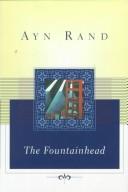
The Fountainhead
Ayn Rand's 1943 novel follows Howard Roark, a young architect who refuses to alter his designs to suit fashion, clients or public taste, and the people who orbit him: the pliable careerist Peter Keating, the manipulative critic Ellsworth Toohey, the newspaper magnate Gail Wynand and the conflicted Dominique Francon. Set in the New York of skyscrapers and tabloids, it turns a story about buildings into an argument about originality, conformity and the price of independence. It remains one of the classic novels to read for anyone curious about Rand's ideas, and it is still fiercely debated. This Signet edition adds an afterword by Leonard Peikoff drawing on Rand's working notes.
Where to buy or borrow
Are you selling this book? Bookstores, publishers, authors and libraries can be listed here for free. Request a listing
About this book
Deep Overview
Rand surrounds him with figures who each represent a different relationship to other people's opinions. Peter Keating, Roark's classmate, is the most successful of them in conventional terms: he gets ahead by sensing what his superiors and the public want, and he repeatedly relies on Roark's talent to rescue his own work. Ellsworth Toohey is a socialist critic whose influence over taste and public sentiment is the real source of his power, and Rand presents his stated concern for the common good as a mask for the wish to control others. Gail Wynand, the publisher of the New York Banner, is the most complicated: he has the ability to be Roark's equal but has built his empire by giving the crowd what it wants, and the novel tests whether he can break with that habit. Dominique Francon, a columnist and the daughter of Roark's quarry employer, is the book's most contested figure. She loves what Roark stands for, but she is convinced that the world will crush it, so she tries to protect him by hurting him, and she marries other men along the way. Her first encounter with Roark is one she herself later calls rape, and readers have long argued over how the book frames it and what it says about desire and power.
The structure is deliberate. The four parts are named for Keating, Toohey, Wynand and Roark, so that Roark's own part comes last and the earlier sections can be read as studies in dependence. The plot then moves toward a public crisis involving a housing project, an act of destruction and a trial. At the trial Roark states the novel's thesis directly: creation comes from an individual mind, and a society that demands to share credit or control over it destroys what it relies on.
Rand's argument is not a simple praise of selfishness in the everyday sense. She distinguishes the creator, who values his own work and judgment, from the second-hander, who looks to others for identity and reward. In her view both altruism and the pursuit of power over others are forms of second-handedness. Whether that distinction holds up, and whether the novel's all-or-nothing portrait of its heroes and villains is fair to real people and institutions, is where the book still divides readers. Those who accept the argument see an inspiring defense of integrity. Those who reject it see an ideology that treats cooperation and social obligation with suspicion.
Key Themes
Other themes include the nature of creative originality and who deserves credit for it; the corrupting side of mass media and public opinion, embodied in Wynand's Banner and Toohey's column; the relationship between love and the shared values of the lovers; and the idea that power taken over other people differs in kind from the power to make things. The book also repeatedly raises the question of whether altruism, as a moral demand, can serve as a cover for self-importance or control. These are Rand's positions, which many philosophers and critics dispute, and the novel treats them as obvious rather than as one view among several.
Historical Context
The setting is also architectural history. The story takes place as American architecture was moving from historical revival styles toward modernism, and the skyscraper was a symbol of both commercial ambition and design experiment. Roark's belief that a building should express its own structure and purpose reflects the modernist debates of the era, and the novel's critics and champions have often compared its protagonist to real modern architects, although Rand's relation to any individual model is a matter of interpretation.
The publishing history belongs to the context as well. Twelve publishers rejected the manuscript, and one editor at a publishing house reportedly judged it high-quality but too intellectual and too controversial to sell. Bobbs-Merrill accepted it, and it went on to find a large readership, partly through word of mouth. Warner Bros. released a film adaptation in 1949, directed by King Vidor and starring Gary Cooper and Patricia Neal. Rand later developed her ideas in a fuller philosophical form, called Objectivism, and the novel is now read both as a work of fiction and as an early statement of those ideas.
Intended Audience
It may suit some readers less: those who prefer subtle, psychologically ambiguous characters, those uncomfortable with long speeches and with philosophical argument carried by plot, and readers sensitive to the novel's treatment of sexual violence and its sharply drawn heroes and villains. Readers who want a balanced account of individualism and community will want to pair it with other perspectives.
Reading Difficulty
The four-part structure helps with orientation, because each part is named after the character at its center. No technical knowledge of architecture or philosophy is needed. This edition is a mass-market paperback with small type, which may be tiring over so many pages; an e-book or a larger-format edition may suit readers who prefer bigger print.
Helpful Background Knowledge
It also helps to know a little about Ayn Rand's life, her Russian origins and the later development of Objectivism in Atlas Shrugged and her essays. Readers can come to the book fresh, then read about its reception afterward. Seeing the 1949 film is not necessary and, because it compresses the story, it works better as a comparison after reading.
Why Read This Book?
It is also unusual as a novel about creative work. Few books give so much attention to the process and the stakes of designing a building, and the contest between an uncompromising creator and the institutions that evaluate him is a situation many readers recognize from their own working lives. This edition adds an afterword by Leonard Peikoff drawing on Rand's notes, which gives readers a glimpse of her planning.
Finally, the book is useful as a provocation. Whether you end up persuaded, unconvinced or somewhere between, it is hard to read without forming a view on questions about originality, ambition and obligation to others.
Reader Takeaways
Many will reconsider how much of their own work and judgment rests on others' approval. Others will notice where the novel's logic is weakest: where it treats compromise as corruption, or presents cooperation as mere conformity. Reading it also gives a sense of how fiction can carry a philosophy, and of the strengths and risks of that approach.
Strengths
The book also works as a gateway text. It states Rand's themes plainly, invites argument, and has sustained a large readership for decades, which makes it useful for discussion groups and classrooms. The afterword in this edition adds some insight into how the author planned the book.
Limitations and Cautions
The scene in which Roark and Dominique first come together is described in the text as a rape by Dominique herself, and readers disagree about how the novel treats it; it may be difficult for some readers. The prose is also long-winded in places, and the political portrait of socialism and mass media reflects the 1940s and Rand's own views and is not an even-handed account. This edition is a mass-market paperback with dense type, which affects readability. Its afterword and reader's guide are by Rand's literary executor, so they come from within the Objectivist tradition.
Important Concepts, People, and Places
Peter Keating: Roark's classmate, whose success depends on pleasing others, and who represents dependence on approval.
Ellsworth M. Toohey: an architecture critic and socialist whose columns shape opinion; he is the novel's chief antagonist and Rand's portrait of the manipulation of others through the language of the collective good.
Dominique Francon: a columnist and the daughter of an architect, whose idealism and despair make her the central figure in the book's love story.
Gail Wynand: the publisher of the New York Banner, a self-made man who has power over public opinion but is tied to it.
Henry Cameron: Roark's mentor, an older modernist architect whose career has been damaged by his refusal to compromise.
Second-hander: Rand's term for a person who lives through the opinions of others, and the key concept for understanding the book's villains and its failures.
Objectivism: the philosophical system Rand developed after the novel, which includes her ethics of rational self-interest; the book is often read as an early dramatization of it.
Leonard Peikoff: Rand's literary executor, who wrote the afterword for this edition.
Bobbs-Merrill: the publisher of the 1943 first edition, which accepted the book after twelve rejections.
New York City: the setting for most of the story, as the center of American architecture, publishing and media in the period.
Questions the Book Explores
Reading Group Guide
Groups may find it useful to separate three conversations: the story as fiction, the ideas as philosophy, and the novel's reception and influence. Set aside time for the difficult scene between Roark and Dominique, and agree in advance to discuss it carefully. A short comparison with the 1949 film, which compresses the plot, can be a good closing activity. Members are free to disagree strongly with the novel, and the group will benefit if they say specifically which argument they reject and why.
Discussion Questions
2. Is Peter Keating a villain, a victim, or something else? What would it have taken for him to turn out differently?
3. Ellsworth Toohey says one thing and, in Rand's portrait, intends another. How persuasive is that portrait, and is it fair to real critics and reformers?
4. Why does Dominique try to hurt the thing she most admires, and does her reasoning hold up?
5. Gail Wynand could be Roark's equal. What does his path suggest about the relationship between power and independence?
6. How should readers interpret the first encounter between Roark and Dominique, and how does the novel's framing of it affect your view of the love story?
7. Is the novel's picture of creation too dependent on solitary genius? Where do collaboration, teachers and clients appear in the book?
8. Do you think the novel's ideas have aged, and where do you see its influence on current debates?
Sources and Verification
Comments
No published comments yet.
Available editions
Paperback
50th Anniversary Edition
- Publisher
- Signet
- ISBN-13
- 9780451175120
- Pages
- 704