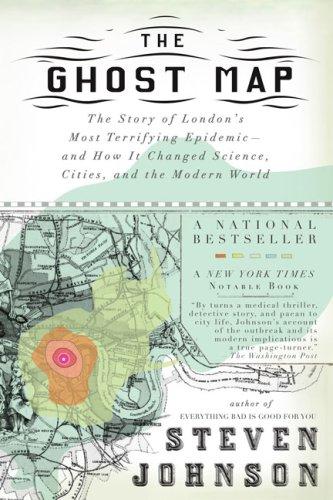
Deep Overview
The Ghost Map reconstructs the severe cholera outbreak that struck London’s Soho district in late August and early September 1854. Steven Johnson organizes much of the central narrative chronologically, following the epidemic from its first households through the investigation of the Broad Street water pump. Physician John Snow supplies the analytical framework: already skeptical of the dominant belief that cholera traveled through foul air, he gathers addresses, water-use histories, mortality patterns, and exceptions that might support or undermine a waterborne explanation. The Reverend Henry Whitehead contributes a different but complementary form of knowledge—close familiarity with neighborhood residents and the willingness to conduct extensive household inquiries. Johnson presents their eventual collaboration as an example of formal analysis strengthened by local, social intelligence. The book then widens its scale. It examines Victorian waste disposal, overcrowding, water infrastructure, municipal governance, microorganisms, disease theory, statistical evidence, and the challenges created by rapidly growing cities. Its governing method is to move repeatedly among the microscopic world of Vibrio cholerae, individual human decisions, neighborhood networks, and metropolitan systems. The map of the title is therefore both a historical object and a model of explanatory thinking: hidden relationships become visible when information is arranged spatially. Snow’s original work and modern epidemiology sources confirm the historical importance of mapping cases and comparing populations exposed to different water supplies. ([archive.cdc.gov](https://archive.cdc.gov/www_cdc_gov/csels/dsepd/ss1978/lesson1/section2.html?utm_source=openai))
Key Themes
Major themes include evidence versus inherited belief; the relationship between cities and disease; the value of maps as analytical tools; the importance of combining quantitative and local knowledge; the public consequences of infrastructure; and the difficulty of persuading institutions to revise established explanations. Johnson also explores emergence: large-scale urban patterns arise from countless small transactions, habits, pathways, and failures. Another recurring theme is scale. Cholera cannot be understood solely as a bacterium, a medical crisis, a family tragedy, or an engineering problem; the outbreak emerges from the interaction of all four. The Snow–Whitehead partnership further complicates the familiar lone-genius account of discovery by showing how scientific reasoning can depend on interviews, trust, neighborhood access, and detailed knowledge of human behavior.
Historical and Scientific Context
The central episode occurred in 1854, when London’s rapid growth had outpaced parts of its water, sewerage, housing, and waste-removal systems. Miasma theory—the idea that disease arose from poisonous or corrupted air—remained influential, while Snow argued that cholera was transmitted through contaminated water. During the Golden Square outbreak, Snow plotted deaths and pumps, investigated where victims obtained water, and connected the concentration of cases to the Broad Street pump. His broader South London comparison of households served by different water companies provided an especially important test of his theory. Modern epidemiology instruction treats his work as an early model of outbreak investigation organized around person, place, time, exposure, hypothesis testing, and public-health intervention. ([wellcomecollection.org](https://wellcomecollection.org/works/uxgfjt62?utm_source=openai)) The heroic version of the story requires qualification. The epidemic was already declining when parish authorities disabled the pump, and Snow’s map was not independently conclusive. Historical scholarship also emphasizes Whitehead’s descriptive work and the contributions of other investigators and officials. These cautions do not erase Snow’s importance; they show that scientific change was more collaborative and contested than the simplified pump-handle legend suggests. ([cdc.gov](https://www.cdc.gov/pcd/issues/2009/oct/09_0110.htm?utm_source=openai))
Intended Audience
The book is especially suitable for general readers interested in medical history, epidemics, Victorian London, cities, data visualization, scientific reasoning, or public policy. It can work well in introductory courses on epidemiology, urban studies, history of science, environmental health, or science communication because it connects a memorable case study to broader systems. Readers looking for narrative nonfiction rather than a technical epidemiology textbook are likely to find it accessible. Those seeking a narrowly documented scholarly monograph may find Johnson’s broad interpretive passages—particularly his excursions into urban theory and modern threats—less satisfactory than the historical reconstruction itself.
Reading Difficulty
The prose is intended for a general audience and uses a chronological, investigative structure that often resembles a medical detective story. Some passages introduce microbiology, epidemiological reasoning, urban systems, demographic change, and spatial analysis, but they generally explain concepts rather than assume specialist training. The principal challenge is structural rather than technical: Johnson frequently shifts from street-level events to microbial processes and then to large arguments about cities and networks. Readers should be prepared for descriptions of severe illness, death, contaminated water, cesspools, overcrowding, and Victorian waste work.
Helpful Background Knowledge
No formal preparation is necessary. It may help to know that nineteenth-century observers did not yet possess a settled germ theory of disease and that miasma explanations could appear reasonable in environments where terrible smells, poverty, and illness visibly coincided. Familiarity with the basic difference between correlation and causal evidence will sharpen the reading. Readers may also benefit from viewing Snow’s map and remembering that it represents deaths and water-pump locations rather than directly depicting the cholera organism or proving causation on its own. Snow’s 1855 account and surviving map are available through Wellcome Collection. ([wellcomecollection.org](https://wellcomecollection.org/works/uxgfjt62?utm_source=openai))
Why Read This Book
The Ghost Map offers an unusually concrete way to think about how evidence changes minds. Its central problem is not merely discovering a possible cause but connecting scattered facts—addresses, habits, water sources, institutional records, local testimony, and apparent exceptions—into an explanation capable of guiding action. The book is also valuable for understanding cities as systems whose density can amplify danger while supporting the cooperation, infrastructure, and knowledge needed to control it. Readers interested in maps will see how spatial representation can expose a pattern that is difficult to detect in a list of deaths. Readers interested in public policy will encounter the harder question of how incomplete but compelling evidence should influence decisions during a crisis.
Reader Takeaways
A careful reader may leave with a stronger appreciation for field investigation, spatial evidence, and the disciplined study of exceptions. The brewery, workhouse, distant pump users, and households served by different water companies matter because they test the waterborne hypothesis rather than merely illustrate it. The book also encourages readers to distinguish a discovery from the later story told about that discovery: Snow’s achievement was significant, but it belonged to a larger network of residents, clergy, registrars, investigators, public officials, and infrastructure workers. More broadly, the narrative shows that urban health depends on systems that are usually unnoticed until they fail—water sourcing, sanitation, waste removal, record keeping, governance, and public trust.
Strengths
The book’s strongest feature is its integration of several scales of explanation. Johnson makes the biology of cholera, the routines of Soho residents, the physical structure of wells and cesspools, and the development of modern urban governance part of one connected account. The day-by-day organization gives the historical material momentum without eliminating its scientific questions. Giving Henry Whitehead a substantial role is another strength because it demonstrates how neighborhood knowledge and interviews complemented Snow’s analytical work. A contemporary CDC review praised the book for bringing forward aspects of Snow’s life and the social setting often omitted from standard public-health accounts. ([stacks.cdc.gov](https://stacks.cdc.gov/view/cdc/16781/cdc_16781_DS1.pdf?utm_source=openai))
Limitations and Cautions
Johnson’s wide-angle conclusions about urbanization, networks, terrorism, and future threats are more interpretive than the closely reconstructed outbreak narrative. Some readers may consider these connections illuminating; others may find that they extend beyond what the 1854 case can establish. A contemporary medical review similarly observed that the excursions into cities and modern threats can distract from the historical account. ([pmc.ncbi.nlm.nih.gov](https://pmc.ncbi.nlm.nih.gov/articles/PMC1832016/?utm_source=openai)) Readers should also resist reducing the history to the claim that a map single-handedly proved the cause of cholera or that removal of the pump handle immediately ended the epidemic. The outbreak was already waning, the map required supporting testimony and analysis, and historians continue to examine the contributions of Whitehead, William Farr, parish authorities, and other investigators. ([cdc.gov](https://www.cdc.gov/pcd/issues/2009/oct/09_0110.htm?utm_source=openai)) Finally, this is narrative history for a broad readership, not a substitute for primary documents or specialist scholarship on Victorian epidemiology.
Important Concepts and Figures
John Snow: physician and anesthetist who argued that cholera was transmitted through contaminated water. Henry Whitehead: local clergyman whose household investigations and community knowledge helped clarify the outbreak’s transmission and probable source. Miasma theory: the historically influential belief that foul or corrupted air caused diseases such as cholera. Vibrio cholerae: the bacterium now known to cause cholera. Spot map: a map marking where cases or deaths occurred, used to inspect geographical patterns. Broad Street pump: the public water source associated with the Soho outbreak. Natural experiment: a comparison created by circumstances rather than researcher assignment; Snow’s comparison of populations receiving water from different companies is a classic example. Local knowledge: practical knowledge of residents, customs, routes, preferences, and exceptions that can make abstract data interpretable. Infrastructure: the water, sewerage, housing, waste, and administrative systems that shape population health. Causal inference: the process of deciding whether an observed association supports an explanation rather than coincidence.
Questions the Book Explores
How can investigators identify a cause before the underlying biological mechanism is fully visible? What makes a map evidence rather than mere illustration? Why do established explanations survive when contrary observations accumulate? How do personal habits and neighborhood networks alter disease transmission? When should public officials act on incomplete evidence? Does urban density primarily create vulnerability, or does it also make collective solutions possible? How should credit for a scientific breakthrough be divided among theorists, field investigators, local informants, record keepers, and decision-makers? What kinds of infrastructure remain invisible until a crisis exposes them?
Reading Group Guide
A group can divide the discussion into four scales: microbe, household, neighborhood, and city. For each scale, identify what information becomes visible and what remains hidden. Participants might examine a reproduction of Snow’s map before discussing Johnson’s interpretation, noting what the map itself demonstrates and what must come from interviews or other records. Another useful exercise is to list the apparent exceptions to the pump hypothesis and discuss how Snow and Whitehead used those exceptions as tests. Groups should distinguish the documented 1854 sequence from Johnson’s larger editorial claims about modern cities. For interdisciplinary groups, assign members to consider the outbreak from the perspectives of a physician, resident, clergyman, statistician, engineer, and parish official.
Discussion Questions
1. What forms of evidence prove most persuasive in the investigation, and why? 2. Does Johnson successfully balance Snow’s analytical role with Whitehead’s local knowledge? 3. How does the chronological structure influence the reader’s understanding of uncertainty? 4. Which apparent exception to the Broad Street pattern contributes most to the case? 5. Why was miasma theory resilient, and what observations appeared to support it? 6. How does a map change the meaning of information already present in addresses and mortality records? 7. Was disabling the pump justified even though the epidemic was already declining? 8. Where does the book move from documented history into broader interpretation? 9. Does the story make cities appear more dangerous, more resilient, or both? 10. How might institutional hierarchy, professional identity, and public trust affect the reception of evidence? 11. What modern infrastructure failures can be understood through Johnson’s movement between individual behavior and large systems? 12. How does the popular pump-handle story simplify the actual history of the investigation?
Sources and Verification
Book identity was checked against Penguin Random House, WorldCat, library catalog records, Google Books, Open Library, and a contemporary review in the CDC journal Emerging Infectious Diseases. The original U.S. edition’s ISBN pair and 2006 publication are well supported. The exact release date is supported by edition records and is consistent with Penguin Random House’s date for the ebook release, but the publisher’s current title page foregrounds the 2007 paperback. Page counts vary by source and counting convention: contemporary bibliographic records commonly give 299 pages, while one hardcover edition record gives 320. Historical context was checked against CDC epidemiology materials, Wellcome Collection’s copy of Snow’s 1855 work and map, and scholarly medical-history commentary. Editorial judgments about audience, strengths, limitations, and reading value are WebToTell interpretations rather than claims made by those sources.