
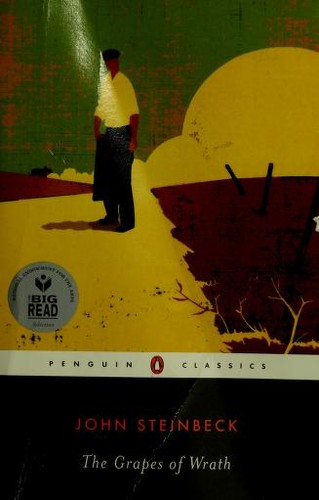
The Grapes of Wrath
John Steinbeck's 1939 novel follows the Joads, an Oklahoma tenant-farming family pushed off their land during the Dust Bowl and the Great Depression. They travel west on Route 66 toward California, hoping for work and dignity. They find low wages, hostile locals, labor camps and organized efforts to keep migrant workers divided and poor. Steinbeck alternates the family's story with wider chapters about the land, the banks, the roads and the economy. The result is both an intimate family drama and a sweeping protest against hunger amid plenty. It won the 1940 Pulitzer Prize, helped lead to Steinbeck's 1962 Nobel Prize, and remains one of the classic novels to read for anyone curious about American history and social conscience.
Where to buy or borrow
Are you selling this book? Bookstores, publishers, authors and libraries can be listed here for free. Request a listing
About this book
Deep Overview
The road west is a process of subtraction. Elderly relatives die, others drift away, money disappears and the family's old identity as independent farmers wears thin. Steinbeck uses the journey to ask what remains of a person or a family when property, routine and status are removed. His answer develops slowly. In the early chapters the Joads think mostly in terms of 'we' meaning the immediate family. By the end, the unit of loyalty has widened to include strangers in the same predicament.
California is not the promised land that handbills suggested. Growers advertise for far more workers than they need, which depresses wages. Local residents fear and demean the newcomers. Deputies and private interests suppress organizing. The migrants discover that hunger is not caused by absence of food, since the orchards and fields are full of produce, but by a system that would sooner destroy surplus than distribute it cheaply. This is the source of the title's anger, which draws on the 'Battle Hymn of the Republic' tradition of moral judgment and fruit harvested at last.
The interchapters carry much of the analysis. They describe the turtle crossing a highway, the used-car lots that prey on desperate sellers, the tractors that erase tenant households, and the banks that Steinbeck presents as institutions with no human face. They give the story a social and ecological frame so that the Joads' misfortunes read as part of a pattern rather than private bad luck.
The book also tracks a change in belief. Casy rejects conventional sin-focused religion in favor of a sense that human beings belong to one larger body and share a responsibility to one another. Tom absorbs this idea and carries it forward after Casy is gone. Ma Joad expresses it in action, holding the family together while recognizing that survival depends on people helping people. The ending, which is famously abrupt and open to argument, tests that idea in its most extreme and symbolic form.
What Steinbeck seems to be demonstrating is that a moral crisis can hide inside an economic one. Unequal ownership, fear of outsiders and the treatment of labor as disposable are shown to damage everyone involved, including those who benefit. At the same time, he insists on the dignity and practical intelligence of poor people, which is why the novel reads as testimony rather than only as polemic.
Key Themes
Collective responsibility versus private interest: Steinbeck sets cooperation among the poor against the competitive logic of ownership. The movement from 'I' to 'we' is the book's central moral arc.
Exploitation of labor and land: the same short-term thinking that wears out the soil also treats workers as an expendable resource. The interchapters link ecological damage and human suffering.
The resilience of women: Ma Joad's endurance, judgment and quiet authority reshape ideas about who holds a family together, and Rose of Sharon's arc ties private care to public generosity.
Spiritual change outside institutions: Jim Casy's reinterpretation of holiness suggests that faith is found in shared work and mutual care rather than in rigid doctrine.
Dignity under humiliation: the book keeps asking how people preserve self-respect when systems treat them as problems to be managed.
Power, fear and anger: the title points to a rising popular anger, and the novel explores how fear of organized workers shapes police, landowners and public opinion.
Historical Context
Steinbeck was not working from imagination alone. In 1936 the San Francisco News commissioned him to report on conditions in California's migrant camps, and that fieldwork shaped the novel's detail. The wider political climate also mattered. California's large-scale agriculture depended on a seasonal labor force, and organizations such as the Associated Farmers, formed in 1934, opposed union activity. After publication the Associated Farmers publicly condemned the book, and some of its critics compared its politics to Carey McWilliams's exposé Factories in the Fields. Steinbeck's role in the Committee to Aid Agricultural Organization, listed in archive material, shows how closely his writing and advocacy were connected.
The book was an immediate commercial success after its release on 14 April 1939, topping bestseller lists within weeks, and it won the 1940 Pulitzer Prize. The Nobel committee later cited it in connection with Steinbeck's 1962 prize. It entered a long argument about whether it is accurate social documentation, powerful fiction or politically charged propaganda, a debate that continues.
Intended Audience
Readers who prefer a fast, plot-first story may find the interchapters slow, and those who dislike overtly political fiction may feel the book pushes its message hard. Readers sensitive to depictions of hunger, death, violence and infant mortality should be prepared for some difficult scenes.
Reading Difficulty
The pace is steady rather than fast. The edition runs to 528 pages including DeMott's introduction and notes, so the novel itself is substantial but approachable if read in sections. No specialist knowledge is required, though the notes are helpful for period language and references. Readers who start with the story chapters and return to the notes afterward will likely find the experience smoother. The text is also widely available as an audiobook for those who prefer to hear the dialect.
Helpful Background Knowledge
Some familiarity with Christian imagery, especially the Exodus story, the idea of a promised land, and hymn language, will deepen the reading, as will knowing that Steinbeck had already written about California farm labor in earlier novels such as In Dubious Battle and Of Mice and Men. DeMott's introduction in this edition supplies publication and critical context, so it can be read first or saved until after the novel, depending on whether a reader wants spoilers.
Why Read This Book?
It is also a landmark of American public conversation. Understanding why it was praised, attacked and banned from certain conversations tells you a great deal about how the country argued over poverty and labor. For anyone building a list of classic novels to read, it offers a different emphasis than many canonical works: collective struggle rather than individual self-making. The Penguin Classics edition adds scholarly support from a leading Steinbeck editor, which is useful for study and book club preparation.
Reader Takeaways
Readers may reconsider whether a story's significance lies in outcomes or in changes of understanding, since the Joads gain little materially yet change deeply in what they believe and whom they feel responsible for. Many will also notice how language shapes status, from the labels attached to migrants to the way landowners and officials speak about the dispossessed. The book can prompt reflection on contemporary parallels in migration, food systems and precarious work, though readers should be careful not to treat the 1930s setting as identical to the present.
Strengths
The novel is grounded in observed conditions, and its historical weight remains clear because it responds to real events as they were happening. The edition adds useful scholarly material. The book's moral questions about responsibility, scarcity and solidarity remain open enough to sustain very different readings.
Limitations and Cautions
Some readers find the interchapters didactic or the ending too symbolic. The novel's attention is focused on white Dust Bowl migrants, so it does not offer a full portrait of every group in California agricultural labor. Its depiction of gender and some period language also reflect the era. Finally, the dialect and sometimes harsh content may be a barrier for younger or less experienced readers.
Important Concepts, People, and Places
Jim Casy: a former preacher whose idea of shared humanity becomes the book's spiritual core.
The Dust Bowl: the environmental and economic catastrophe on the Great Plains that, together with mechanization and foreclosure, drives the family from their land.
The Great Depression: the national economic crisis that left workers desperate and employers able to set harsh terms.
Route 66: the highway that links Oklahoma to California in the story and works as a symbolic channel of hope, hardship and community among travellers.
California's Central Valley and migrant camps: the destination, where the Joads discover surplus produce alongside deprivation, and where a federally run camp shows what cooperation and basic dignity can achieve.
'Okies': a derogatory label applied to migrants from the southern plains, illustrating how prejudice turns economic desperation into stigma.
The Associated Farmers: an agricultural employers' organization of the period that opposed labor organizing and later attacked the novel.
The Battle Hymn of the Republic: the source of the title's image, linking private suffering to moral reckoning.
Robert DeMott: the scholar who wrote this edition's introduction and notes and edited Steinbeck's journal of the novel's composition.
Questions the Book Explores
Reading Group Guide
One good starting point is to compare an interchapter with the story chapter that follows it and ask how each reframes the other. Another is to track a single object or image, such as the truck, food, the road or hands, and see how its meaning changes. Members may also want to bring a short piece of Dust Bowl history or a few Farm Security Administration images, if available, to compare documentary and fictional treatments. Since opinions on the ending vary, it can be useful to leave that conversation until the end of the session, and to invite members who disagree about the book's politics to make the strongest case for the other side. The discussion questions below are intended to support a group of any size.
Discussion Questions
2. Ma Joad's role develops across the book. Which moments best show how she leads, and what does that leadership cost her?
3. Jim Casy abandons conventional preaching but keeps a spiritual vision. How does his idea of community compare with the institutions the family encounters?
4. Steinbeck presents banks and large landowners as impersonal forces. Is that effective, or does it make responsibility too abstract?
5. What does the government camp suggest about what is possible, and how does it differ from the other places the Joads stay?
6. How does the novel handle the stigma attached to being a migrant? Where do you see similar labels used today?
7. The ending is symbolic and abrupt. What do you think it is meant to communicate, and did it feel earned?
8. Critics have disagreed about whether the book is fair, accurate or propagandistic. How should a reader approach a novel that is both art and advocacy?
9. How does the title shape your reading of anger, justice and hope in the book?
10. Which characters change most, and which seem unable to change? What separates them?
Sources and Verification
Comments
No published comments yet.
Available editions
Paperback
Penguin Classics edition with introduction and notes by Robert DeMott
- Publisher
- Penguin Classics
- ISBN-13
- 9780143039433
- Publication date
- Pages
- 528