
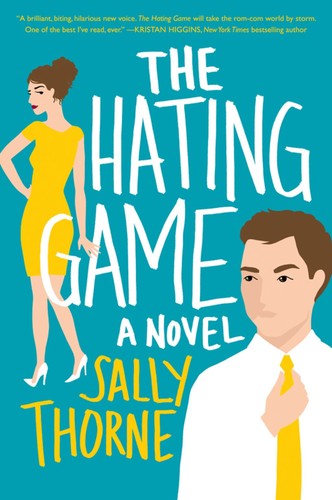
The Hating Game
A Novel
Lucy Hutton and Joshua Templeman are executive assistants at Bexley & Gamin, a publishing company created by a merger whose unresolved tensions are embodied in their shared office. Lucy is personable, colorful, and eager to be liked; Joshua is controlled, intimidating, and seemingly impossible to please. Their mutual hostility has hardened into a daily ritual of staring contests, mimicry, insults, and strategic victories. When both become candidates for the same promotion, their private contest acquires professional consequences: each refuses to work beneath the other, and losing may mean leaving the company. Yet attraction increasingly disrupts Lucy’s certainty that she understands her rival. Told through her witty, intensely subjective perspective, Sally Thorne’s debut novel turns workplace competition into an enemies-to-lovers romantic comedy about misread signals, vulnerability, ambition, and the unstable boundary between antagonism and desire.
Where to buy or borrow
Are you selling this book? Bookstores, publishers, authors and libraries can be listed here for free. Request a listing
About this book
Deep Overview
Lucy narrates the conflict as a series of games. She and Joshua stare, mirror one another, record possible human-resources violations, and search constantly for signs of weakness. These routines are funny, but they also reveal how completely each has learned the other’s habits. Their supposed indifference requires extraordinary attention. Lucy treats Joshua’s severity as proof of contempt, while Joshua’s reserve prevents her from easily testing that interpretation. Because the reader receives events through Lucy, the romance depends on recognizing how confidently she can misread what she sees.
A newly created management position raises the stakes. Lucy wants the promotion not only as professional advancement but as evidence that kindness, creativity, and accommodation do not make her weak. Joshua appears to represent the opposite theory of workplace success: discipline, intimidation, and emotional control. Their competition therefore becomes a clash between different ideas of authority as well as a battle between two ambitious individuals. Both also recognize that reporting to the winner would be intolerable, making the contest a potential turning point in their careers.
Physical attraction complicates the rivalry, but the deeper transformation comes through situations that expose life beyond the office. Illness, social encounters, family relationships, and moments of unguarded care challenge Lucy’s simplified image of Joshua. She gradually discovers that his intimidating manner coexists with insecurity, loyalty, and a long history of being measured against expectations he cannot comfortably satisfy. Joshua, meanwhile, sees that Lucy’s friendliness is not the absence of ambition. Her desire to please others can conceal both determination and fear of being underestimated.
The central “hating game” is thus a structure both characters use to avoid direct emotional risk. Competition lets them remain closely engaged without admitting how much the other matters. Their banter gives attraction a safe disguise, while the promotion supplies a plausible explanation for obsessive attention. The novel’s romantic question is less whether antagonism will become love—the genre makes that trajectory visible—than whether Lucy and Joshua can abandon interpretations that protect them from rejection. By linking professional rivalry with emotional self-defense, Thorne turns the office into a stage on which ambition, desire, pride, and vulnerability become difficult to separate.
Key Themes
**Competition as intimacy:** Lucy and Joshua’s games are adversarial, yet they require sustained attention to each other. Rivalry becomes a coded relationship long before either character can speak honestly about attachment.
**Ambition and likability:** Lucy worries that being agreeable has caused others to underestimate her. Her pursuit of promotion tests whether she can assert authority without abandoning the warmth she values in herself.
**Emotional control and vulnerability:** Joshua’s restraint initially looks like confidence and superiority. As the novel reveals more of him, composure emerges partly as protection against judgment and rejection.
**Opposites and hidden similarities:** Their clothes, manners, and working styles appear sharply opposed, but both are observant, competitive, lonely, and deeply affected by how others evaluate them.
**Workplace identity:** The merger places both characters inside an organization that is still deciding what it values. Their personal contest reflects a larger struggle between corporate cultures and definitions of success.
Literary and Cultural Context
The publishing merger is especially significant. Consolidation and competing commercial and literary priorities provide more than background decoration: they explain why Lucy and Joshua inherit rival loyalties and why a promotion can symbolize the future culture of their company. At the same time, the book reflects continuing debates around whether women can be ambitious, authoritative, and well liked without being forced to choose among those qualities.
The novel predates the widespread normalization of remote work, so its comedy depends on enforced daily proximity—shared space, visible routines, and the inability to escape a colleague’s attention. That office-centered environment is essential to both its tension and its particular snapshot of professional life.
Intended Audience
It will be less suitable for readers uncomfortable with sexual content, strong language, or romance between coworkers competing for the same position. Those who dislike relationships built around teasing, antagonism, jealousy, or uneven communication may find the central dynamic frustrating rather than playful. The Library of Congress’s accessible-format description notes strong language and explicit sexual material.
Reading Difficulty
The main interpretive challenge is the gap between Lucy’s conclusions and the evidence available to the reader. Understanding the novel involves noticing when her descriptions reveal possibilities she has not accepted. Readers should also expect an emotionally heightened style in which attraction, embarrassment, anger, and insecurity are rendered with deliberate intensity.
Helpful Background Knowledge
Readers unfamiliar with publishing need not study the industry. The contrast between Bexley’s commercially minded culture and Gamin’s literary self-image matters mainly because it reinforces the characters’ inherited loyalties and opposing work styles. Awareness that the narration remains limited to Lucy’s viewpoint will be more important than technical knowledge of the business.
Why Read It
The novel is particularly effective at making interpretation part of the entertainment. Readers can compare Lucy’s certainty about Joshua with the details she reports, often detecting emotional implications before she does. It also gives professional ambition real importance. Lucy’s career goal is not merely an obstacle delaying romance; it is connected to her struggle to distinguish kindness from passivity and approval from respect.
Reader Takeaways
Lucy’s career arc encourages reflection on the cost of making likability a central measure of self-worth. Joshua’s development, in turn, shows how competence and control can conceal insecurity. Together, their story emphasizes the need to replace performance, guessing, and strategic provocation with direct communication. It also illustrates how a romance can alter self-understanding: each character becomes a mirror in which the other must confront traits that office rivalry had made easier to caricature.
Strengths
The repeated games provide both structure and characterization. They show the pair’s competitiveness, but also how carefully they monitor one another. The workplace stakes are clear and easy to follow, and the contrast between the merged companies supports the central opposition without requiring lengthy exposition.
The book also understands that a predictable romantic destination need not produce a dull journey. It generates interest through shifting perceptions, emotional reversals, and the gradual disclosure of vulnerability rather than through uncertainty about the genre’s ultimate promise.
Limitations and Considerations
Some readers may also question the professional boundaries surrounding a romance between direct competitors or find aspects of the pair’s games immature. The heightened attention to physical appearance, body size, clothing, and conventional markers of attractiveness may feel narrow or dated to some audiences.
The resolution is intentionally neat in the manner of romantic comedy. Contemporary trade criticism was divided on whether that neatness was fully earned: Publishers Weekly praised the chemistry but considered the ending somewhat too tidy. Readers looking for a detailed examination of organizational ethics or realistic promotion procedures should approach the office setting as a romantic-comedy framework rather than a workplace case study.
Important Concepts, People, and Organizations
**Joshua Templeman:** Lucy’s officemate, rival, and fellow candidate for promotion. His formal appearance, efficiency, and guarded behavior make him difficult for Lucy to interpret. Understanding the difference between his public control and private vulnerability is crucial to the romance.
**Bexley & Gamin:** The merged publishing company where the story takes place. It represents an uneasy union of contrasting business cultures and supplies the institutional pressure behind Lucy and Joshua’s conflict.
**The promotion:** More than a plot device, the management vacancy tests both characters’ ideas about leadership, status, and self-respect. Because the loser may have to work for the winner, it makes emotional trust professionally risky.
**The office games:** The Staring Game, Mirror Game, and other recurring contests turn routine interaction into ritual. They function as warfare, flirtation, surveillance, and a substitute for honest conversation.
**Enemies-to-lovers:** The romance convention organizing the novel. Here, the pattern depends on limited perspective: apparent hatred is gradually reconsidered as Lucy gains access to contexts and motives she previously lacked.
Questions the Book Explores
How accurately can we understand another person when pride encourages the least generous interpretation?
Can someone remain kind and approachable while also pursuing authority and recognition?
What is the difference between being liked, being respected, and being truly known?
How do workplace roles and inherited corporate loyalties shape personal judgment?
Why might people choose teasing, competition, or control instead of direct emotional disclosure?
Can attraction be separated from the thrill of conflict, and how can the characters determine whether their connection will survive once the contest changes?
Reading Group Guide
Compare the former Bexley and Gamin cultures. Discuss whether Lucy and Joshua truly embody those institutions or merely use them to explain a more personal incompatibility. The promotion offers another useful angle: ask what each candidate appears to believe leadership requires and whether either person’s behavior supports that belief.
Pay attention to changes in setting. Scenes outside the shared office allow information and behavior that the workplace suppresses. Discuss why illness, family contact, and social situations alter the balance between the characters.
Finally, separate genre pleasure from real-world judgment. A productive conversation can appreciate the banter while still examining professional boundaries, indirect communication, jealousy, and the risks of treating hostility as evidence of attraction.
Discussion Questions
2. What do the office games allow Lucy and Joshua to express without saying directly?
3. How does the Bexley–Gamin merger influence the way each character views the other?
4. Does Lucy’s desire to be liked help her professionally, limit her, or do both at different moments?
5. What qualities would make Lucy or Joshua the stronger manager?
6. When does their rivalry begin to feel emotionally intimate rather than merely hostile?
7. How does Lucy’s first-person narration shape the reader’s judgment of Joshua?
8. Which revelations genuinely revise earlier events, and which simply confirm what the reader may already suspect?
9. How effectively does the novel balance romantic fantasy with the ethical complications of a workplace relationship?
10. Does the ending resolve the career and relationship conflicts equally well? Why or why not?
11. What would change most if the story included Joshua’s viewpoint?
12. Where should readers draw the line between entertaining enemies-to-lovers behavior and unhealthy communication?
Sources and Verification
Comments
No published comments yet.
Available editions
Paperback
paperback
- Publisher
- William Morrow Paperbacks
- ISBN-13
- 9780062439598
- Publication date