
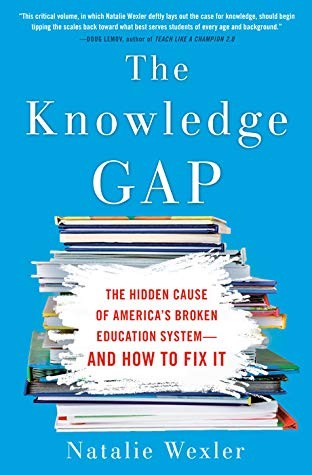
The Knowledge Gap
The Hidden Cause of America's Broken Education System—and How to Fix It
Why do many children learn to pronounce written words yet struggle to understand increasingly complex texts? Natalie Wexler argues that a major cause lies in the way American elementary schools often teach reading comprehension: as a collection of general-purpose skills, such as identifying a main idea, rather than as an ability grounded in vocabulary and knowledge of the world. Combining classroom reporting, intellectual history, cognitive-science research, and education-policy analysis, she traces how content-light literacy instruction became widespread and why it particularly disadvantages children who cannot rely on home environments to supply missing background knowledge. The book also follows educators experimenting with coherent, content-rich curricula organized around subjects such as history, science, and the arts. Wexler’s larger claim is that curriculum is an equity issue: schools cannot narrow educational disparities unless they deliberately give every child sustained acce…
Where to buy or borrow
Are you selling this book? Bookstores, publishers, authors and libraries can be listed here for free. Request a listing
About this book
Deep Overview
That distinction places background knowledge and vocabulary at the center of comprehension. Texts inevitably leave information unstated, expecting readers to supply connections from memory. Knowledge also makes unfamiliar words and concepts easier to absorb because new information can attach to an existing mental framework. Wexler therefore treats comprehension not as a freely transferable skill but as the cumulative result of learning about many connected subjects.
The consequences are unequal. Children who encounter extensive knowledge and vocabulary outside school may compensate for a thin curriculum. Children who depend more heavily on school for access to history, science, literature, and the arts cannot. The resulting disparity is not merely a difference in stored facts: it compounds as knowledgeable readers comprehend more, learn more from what they read, and become better prepared for later coursework. Wexler connects this cumulative process to the “Matthew effect,” in which early advantages and disadvantages tend to widen over time.
The middle portion asks how schools arrived at a content-light model. Wexler examines progressive and child-centered educational traditions, the spread of whole-language and balanced-literacy ideas, assumptions about what is developmentally appropriate, and the familiar early-grade social-studies progression from self and family to neighborhood and community. She also considers how testing, standards, philanthropy, teacher-quality initiatives, and school-choice debates diverted attention from the substance of curriculum. Her account does not reduce the problem to individual teachers; educators are shown working within training systems, schedules, materials, and institutional habits that encourage fragmented skill practice.
The final movement turns toward change. Wexler visits classrooms using coherent curricula that sustain a topic across multiple texts and lessons. Students may listen to material above their independent reading level, discuss demanding ideas, acquire domain-specific vocabulary, and write about what they are learning. Writing matters because constructing sentences and explanations can expose gaps in understanding while reinforcing content. These examples support the book’s central proposal: literacy instruction should be built through meaningful subject matter rather than separated from it. The ultimate measure of reform is not whether students can perform an isolated reading exercise, but whether schools steadily enlarge the intellectual resources students bring to every future text.
Key Themes
• Curriculum as an equity mechanism: A shared, content-rich curriculum can give children access to knowledge that is otherwise distributed unevenly through family and community circumstances.
• The limits of generic skills practice: Main idea, inference, and similar strategies have value, but repeated practice cannot substitute for sustained learning about specific subjects.
• Cumulative advantage: Knowledge makes additional learning easier, so early curricular differences may grow into wider academic disparities.
• Decoding versus comprehension: Accurate word reading is necessary, but it does not by itself ensure that a student understands a text.
• Institutional persistence: Teacher preparation, commercial materials, testing pressures, inherited routines, and competing reform agendas help sustain instructional practices even when their assumptions are disputed.
• Integration of reading and writing: Writing about substantive content can strengthen vocabulary, syntax, reasoning, and understanding rather than functioning as an isolated activity.
Historical Context
The late twentieth-century reading wars form another important background. Whole language emphasized immersion in meaningful text, while phonics advocates stressed explicit instruction in sound-symbol relationships. Balanced literacy attempted to combine elements of both, but Wexler argues that the public debate over decoding often obscured a separate question: how schools build the knowledge required for comprehension.
The book also addresses standards-based reform, including the Common Core State Standards, and the education-reform movement’s emphasis on testing, accountability, school choice, and teacher quality. Wexler’s historical claim is not that these concerns were irrelevant, but that reform repeatedly focused on structures and measurable skills without sufficiently addressing what students encounter in the curriculum each day.
Intended Audience
Readers seeking a neutral survey of every major literacy framework may find the book less suitable. Wexler advances a clear argument for knowledge-building instruction and evaluates competing practices from that position. It is also not a classroom manual containing daily lesson plans, although its reported examples can inform instructional and curricular decisions.
Reading Difficulty
The historical and policy chapters introduce numerous movements, organizations, reform initiatives, and educational terms, but Wexler generally explains them in context. Readers unfamiliar with American schooling may need occasional background research on the Common Core, balanced literacy, standardized testing, or elementary curriculum design. The narrative-reporting structure makes the book more approachable than a technical academic monograph.
Helpful Background Knowledge
Familiarity with phonics, whole language, and balanced literacy can clarify the reading-wars chapters, although the book supplies its own explanations. Readers may also benefit from recognizing that standardized reading tests use passages on varied topics; a student’s apparent comprehension ability may therefore partly reflect familiarity with a passage’s subject. No prior knowledge of cognitive psychology is necessary.
Why Read This Book?
The book is also valuable because it joins questions often discussed separately: reading research, curriculum design, teacher preparation, education reform, and socioeconomic inequality. Even readers who dispute parts of Wexler’s prescription will gain a sharper framework for asking what a literacy program assumes about knowledge and how those assumptions affect children with different opportunities outside school.
Reader Takeaways
It also reframes educational equity. Equal access to generic exercises is not necessarily equal access to learning; students may need common opportunities to encounter history, science, literature, art, and sophisticated vocabulary. Readers may become more attentive to the content hidden beneath labels such as “literacy block,” “student-centered learning,” or “standards aligned.” Finally, the book offers a practical evaluative question for any program: What will students know, remember, and be able to understand after completing it?
Strengths
Another strength is the attention to systems rather than simple blame. Teachers appear as professionals working within preparation programs, purchased curricula, testing expectations, schedules, and reform mandates. The book explains why well-intentioned practices persist and why replacing materials alone may not change instruction. Its equity argument is similarly concrete: it identifies a school-controlled resource, curriculum, that can either widen or narrow students’ access to shared knowledge.
Limitations and Cautions
The primary focus is American elementary education, particularly literacy and comprehension. The analysis does not provide a complete account of every factor affecting reading outcomes, including disability, multilingual development, attendance, school funding, family circumstances, or the quality of implementation across different curricula. Classroom examples are illuminating but cannot by themselves establish how a program will perform at scale. Because the book was first published in 2019, readers investigating current programs, laws, or adoption patterns should supplement it with newer evidence.
Important Concepts, People, and Institutions
• Background knowledge: Information already held by a reader. It helps the reader interpret references, fill in unstated connections, and learn from a new text.
• Reading comprehension strategies: Procedures such as summarizing, predicting, inferring, and identifying main ideas. Wexler accepts their limited usefulness but challenges treating them as content-independent abilities requiring continual practice.
• Daniel T. Willingham: A cognitive psychologist whose explanations of memory, knowledge, and comprehension help anchor the book’s research case.
• E. D. Hirsch Jr.: An education scholar associated with cultural literacy and the Core Knowledge movement. His work is central to the history of content-based curriculum and to political disputes over which knowledge schools should teach.
• Jean-Jacques Rousseau and Émile: Rousseau’s educational ideas, expressed in Émile, help Wexler trace the intellectual roots of child-centered approaches that distrust premature instruction in distant or abstract subjects.
• Whole language and balanced literacy: Influential approaches associated with learning through meaningful reading experiences. The book examines how their assumptions affected both decoding instruction and the organization of literacy lessons.
• The reading wars: The prolonged dispute, often framed as phonics versus whole language. Wexler argues that this conflict left the knowledge requirements of comprehension comparatively neglected.
• The Matthew effect: A pattern of cumulative advantage in which students who know more can understand and learn more, while students with weaker foundations may fall progressively further behind.
• Common Core State Standards: Academic standards intended in part to increase engagement with complex and informational texts. The book examines the gap between standards and the specific curriculum needed to build knowledge.
• Core Knowledge: A curriculum movement and organizational effort associated with specifying coherent content across grades. It serves as an important example in the book’s discussion of sequenced knowledge-building.
• The Writing Revolution: An instructional approach associated with Judith C. Hochman that integrates explicit writing instruction with substantive content; it illustrates how writing can support knowledge and reasoning.
• Education reform and philanthropy: The network of policymakers, foundations, advocates, and school organizations that concentrated heavily on accountability, choice, and teacher quality. Wexler argues that curriculum received insufficient attention within this agenda.
Questions the Book Explores
• How does background knowledge change what a reader notices, infers, and remembers?
• Why did history, science, and the arts lose ground during the elementary school day?
• How did progressive education, the reading wars, standards, testing, and reform philanthropy shape current classroom practice?
• Can schools reduce inequality by guaranteeing access to a coherent body of knowledge?
• What is the proper relationship among decoding, vocabulary, comprehension, speaking, and writing?
• Why do instructional methods survive when the research cited in their support is limited or misapplied?
• How much content should a common curriculum specify, and who should decide what belongs in it?
• What support do teachers need to implement demanding new materials successfully?
Reading Group Guide
Compare the reported classrooms. Notice what students read or hear, how long a class remains with one subject, what vocabulary recurs, what students write, and how teachers check understanding. Groups with educators may compare these patterns with local materials without reducing the conversation to whether one named program is “good” or “bad.”
For the historical chapters, trace how an educational idea changes as it passes from philosophy to teacher preparation, curriculum publishing, standards, and classroom routine. Discuss whether the consequences arise from the original idea, its implementation, or both.
End with the book’s equity argument. Consider which kinds of knowledge schools should guarantee, how curricula can represent varied experiences without becoming fragmented, and what evidence would demonstrate that a knowledge-building approach benefits students over several years.
Discussion Questions
2. How does the book alter your definition of what it means to be a strong reader?
3. Which of Wexler’s explanations for content-light elementary education is most convincing?
4. Is a shared curriculum necessary for educational equity, or can common goals be reached through locally chosen content?
5. How should schools decide which historical, scientific, literary, and cultural knowledge students should encounter?
6. What are the benefits and risks of specifying curriculum in detail?
7. Does the book give adequate attention to teacher expertise and adaptation, or does its emphasis on curriculum materials go too far?
8. How might a knowledge-building curriculum serve multilingual learners? What additional supports might they require?
9. Which claims in the book depend most heavily on cognitive research, and which depend on Wexler’s institutional or historical interpretation?
10. How should schools measure progress if the benefits of accumulated knowledge may take years to appear?
11. What obstacles would a school face when moving from strategy-centered literacy instruction to content-centered instruction?
12. After reading the book, what would you look for when evaluating an elementary literacy curriculum?
Sources and Verification
Comments
No published comments yet.
Available editions
Paperback
paperback
- Publisher
- Avery
- ISBN-13
- 9780735213562
- Publication date