
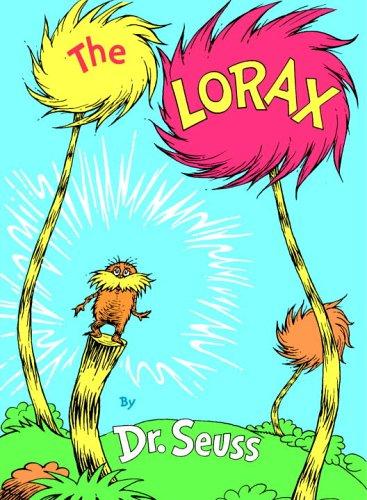
The Lorax
The Lorax is Dr. Seuss's 1971 rhymed picture book about what happens when a business grows faster than the living world can bear. A boy visits the reclusive Once-ler, who recalls how he found a valley of colorful Truffula Trees, began cutting them to make a product called the Thneed, and brushed aside a small, orange, mustached creature who spoke for the trees. As the factory expanded, the animals left, the air and water fouled, and the forest vanished. The story ends with a single seed and a direct challenge to the reader. Written at the start of the modern American environmental movement, it remains one of the best-known books for kids about ecology, consumption, and personal responsibility.
Where to buy or borrow
Are you selling this book? Bookstores, publishers, authors and libraries can be listed here for free. Request a listing
About this book
The book has a nested structure. A frame story in the present has a child seeking out the Once-ler; the longer central section is the Once-ler's confession; and the final pages return to the present with an instruction. The color palette shifts from saturated tufted trees to gray, smoggy landscapes, so the pictures carry much of the argument. Many readers meet it as one of the classic books of American children's literature, but it also works as a short, compact text for older students analyzing persuasion, tone and unreliable narration. This profile covers the 1971 Random House hardcover, which the publisher lists as part of its Classic Seuss line.
Deep Overview
The Lorax appears the moment the first tree falls. He claims to speak for the trees, and from then on the book becomes a repeated confrontation. The Lorax objects, the Once-ler offers a justification, and the operation grows. Family members arrive, the axes get faster, a machine takes over, and the Once-ler's rationalizations become more elaborate. Seuss keeps the Once-ler from being a cartoonish villain. He is energetic, inventive and responsive to demand, and the story shows how reasonable-sounding decisions can add up to a catastrophe because nobody in the system is charged with stopping.
The pollution and displacement come in stages. Smoke and sludge appear, the animals are sent away because there is not enough food, and the final tree is cut. With no raw material, the factory closes, and the Lorax lifts himself away, leaving behind a single word carved into a small pile of stones. The Once-ler lives for years with that word, and the narrative gradually reveals he has been waiting for someone to ask him about it.
The ending is the point of the entire book. The Once-ler hands the child the last Truffula seed and tells him to plant it and protect it, and the story turns from mourning to responsibility. The tone is neither triumphant nor fatalistic: the seed is real hope, but it is also fragile, and the future depends on whether the listener acts. In this sense the book does not only criticize industrial excess; it asks who gets to stop it, and it answers that a concerned individual is the necessary starting point.
A 2018 study from Dartmouth College, published in Nature Ecology & Evolution, offered a more ecological reading. Its authors argue that the Lorax is better understood as a member of the forest community than as an outside guardian, and they suggest, as a hypothesis, that Geisel drew on animals and trees he saw during a 1970 stay in Kenya. That reading is an interpretation and remains a proposal rather than settled biography, but it shows how much ecological detail readers have found in a children's story.
Key Themes
Speaking for those who cannot speak for themselves is a recurring idea. The Lorax is an advocate, and the book considers what it takes for an advocate to be heard when profit is at stake. Related to this is the way persuasion works: the Thneed is marketed as essential, and the story hints that manufactured desire is part of how destruction gets justified.
The book also treats memory and regret. The Once-ler's narration is partly confession and partly self-defense, so the reader has to decide how far to trust it. Finally, hope and agency run through the ending: change is not promised, but it becomes possible when someone cares enough to act.
Historical Context
Geisel was by this time a very successful children's author who had helped launch Random House's Beginner Books line in the late 1950s. Using a picture book to take on industry and ecology so directly gave the story a pointed, topical edge.
The book's later life is also part of its history. In 1989, a school dispute in Laytonville, California, a logging town, made national news when some parents objected to the book being required reading for second-graders because they felt it portrayed the timber industry unfairly; a school committee voted to keep it. A response book titled Truax, which took a more industry-friendly view, was published as part of the debate. The story has since been adapted into a 2012 animated feature from Illumination Entertainment and Universal Pictures and a stage adaptation that played in 2018, according to the Seussville timeline.
Intended Audience
Older students, including middle and high schoolers, can use it as a short case study in persuasion, satire and environmental rhetoric. Adults interested in the history of environmental advocacy or in Dr. Seuss's work beyond the lighter titles may also find it worth a look.
It may be less satisfying for readers who want a balanced policy analysis, detailed science, or a realistic account of how forestry, manufacturing and employment actually work. It is a moral fable, and its simplicity is deliberate.
Reading Difficulty
Conceptually, the book asks readers to follow a nested narration and to infer causes: why the animals leave, why the factory stops, and what the single word on the stones means. Those inferences are manageable for older children, and the pictures supply plenty of cues. The mood darkens in the middle, so very young or sensitive children may need conversation about the loss of the forest and the departure of the animals.
The edition profiled is a hardcover picture book of about 70 pages in a large trim size, with most pages mixing a short passage of verse with a full illustration.
Helpful Background Knowledge
For older readers, a short look at the early 1970s environmental movement, including Earth Day, adds context to the book's urgency. It is also useful to know that the book has been both widely praised and contested, so that a discussion can address why a children's story about trees drew a school-board dispute.
Why Read This Book?
It is also a rare example of a book written for the very young that points directly at commerce and manufacturing as sources of harm. The result is a text that can be reread at different ages, with children focusing on the creatures and the ending, and older readers noticing the satire and the moral argument. Its place among the classic books of children's environmental writing makes it a useful starting point for any reading list on the subject.
Reader Takeaways
They may also notice how the book uses visual change, from color to gray, to carry its argument, and how its final message avoids guaranteeing success. For adults reading with children, a practical takeaway is the value of asking what the child thinks should happen next, and what a small, real act of care might look like, such as planting a tree or reducing waste.
Strengths
Its invented animals and vocabulary make the message memorable without making it feel like a textbook, and the ending leaves room for action instead of closing the door. It has also proved flexible: classrooms, theaters and filmmakers have all found ways to adapt it, which suggests the central situation is clear enough to be reinterpreted.
Limitations and Cautions
The Dartmouth reading of the Lorax as a member of the forest ecosystem, and of Kenya as a source of inspiration, is a scholarly hypothesis rather than documented authorial intent. The mood of the middle sections may be heavy for some young listeners. Finally, because the profile follows the 1971 hardcover, readers should expect that later printings and anniversary editions may differ in packaging, extras and possibly page counts.
Important Concepts, People, and Places
The Lorax: the small, orange, mustached creature who says he speaks for the trees; he is the book's advocate and conscience, and leaves a single word behind when he departs.
The Once-ler: the narrator and industrialist whose growing business consumes the forest; his story is both explanation and confession.
Truffula Trees: the tufted trees at the center of the conflict, which supply the raw material for the Thneeds and whose disappearance destroys the habitat.
Thneed: the all-purpose knitted product that stands for manufactured demand and the wastefulness of production for its own sake.
Brown Bar-ba-loots, Swomee-Swans and Humming-Fish: the animals who depend on the forest and pond, and whose forced departure shows the wider ecological cost.
The last Truffula seed: the final symbol of hope and responsibility that is passed from the Once-ler to the child.
Earth Day, the National Environmental Policy Act and the Environmental Protection Agency: 1970 events that framed the moment in which the book was written.
Mount Kenya Safari Club: the Kenyan location where, according to Dartmouth, Geisel wrote most of the book.
Laytonville, California: the logging town where a 1989 school dispute over the book became a national story.
Random House: the publisher of the 1971 edition and later Classic Seuss printings.
Questions the Book Explores
How do people persuade themselves that growth is always good? When is a product genuinely needed, and when is the need created by marketing? Is it ever too late to repair damage, and what does repair require beyond regret?
The book also touches on how stories change the people who hear them, by asking what the child will do with what he has learned.
Reading Group Guide
Groups with children can ask them to draw the valley before and after, or to plant a seed as a follow-up. Groups with teens or adults might compare the book with its 2012 film adaptation, or read it alongside a news article about a local development decision. Because the book has been the subject of real community disagreement, it can also support a structured conversation in which participants practice presenting an opposing view fairly. Ask participants to pay attention to the illustrations as well as the words, since the color change does as much work as the rhyme.
Discussion Questions
2. At what point, if any, could the Once-ler have changed course? What would that have required?
3. How does the book portray advertising and demand? Is the Thneed something people really needed?
4. What does the single word the Lorax leaves behind suggest, and why might Seuss have chosen that way of ending his role?
5. How does the book use color and setting to shape the reader's feelings?
6. Some residents of a logging town felt the story was unfair to their industry. What would a fairer or more complete version include, and would it still work as a fable?
7. Is the ending hopeful, or does it place too much weight on one child? How would you plan to make the seed matter?
8. Whose voices are missing from the story, and what might they say?
Sources and Verification
Comments
No published comments yet.
Available editions
Hardcover
- Publisher
- Random House Books for Young Readers
- ISBN-13
- 9780394823379
- Publication date
- Pages
- 72