
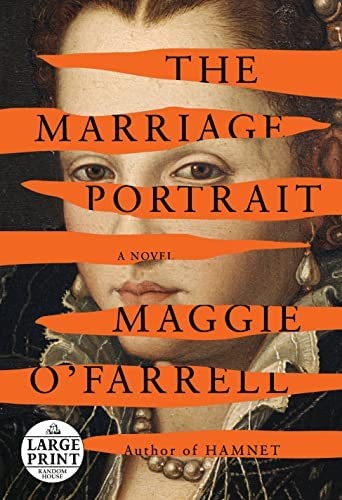
The Marriage Portrait
In Renaissance Italy, Lucrezia de’ Medici is transformed from an observant, artistically gifted Florentine girl into the adolescent wife of Alfonso II d’Este, heir to the duchy of Ferrara. Marriage removes her from her family and places her inside a court governed by ceremony, surveillance, dynastic rivalry, and the urgent demand that she produce an heir. When Lucrezia comes to believe that Alfonso intends to kill her, the novel becomes both a psychological struggle for survival and an inquiry into how powerful men control women’s bodies, images, and stories. Maggie O’Farrell draws on the historical Lucrezia, who died at sixteen, and on the cultural afterlife associated with Robert Browning’s “My Last Duchess.” Moving between Lucrezia’s endangered present and the experiences that brought her there, the book combines literary historical fiction with mounting suspense while restoring imagination, perception, and agency to a young woman largely reduced by history to a marriage and an ear…
Where to buy or borrow
Are you selling this book? Bookstores, publishers, authors and libraries can be listed here for free. Request a listing
About this book
Deep Overview
As a daughter of Cosimo I de’ Medici and Eleonora di Toledo, Lucrezia grows up in the magnificent but regulated world of Florence’s ruling family. She is imaginative, solitary, alert to animals and physical textures, and strongly drawn to making art. These qualities provide an inward freedom that court life cannot entirely suppress. Yet her aristocratic rank does not grant control over her future. After her older sister Maria dies before marrying Alfonso, Lucrezia becomes the substitute bride in a political alliance between the Medici and Este families.
Marriage carries her into a different political ecosystem. Alfonso can appear cultivated, attentive, and interested in artistic achievement, but his charm coexists with an expectation of absolute obedience. His court is shaped by succession anxieties, religious and diplomatic pressures, and competing loyalties. Lucrezia’s principal public purpose is reproductive: the marriage must produce an heir. Her body therefore becomes a dynastic resource, interpreted and managed by other people. The absence of a child steadily increases her vulnerability.
O’Farrell links this bodily control to the making of Lucrezia’s portrait. A court portrait can preserve a person’s likeness, but it can also turn the sitter into a possession, a diplomatic symbol, or an idealized surface. Lucrezia’s private artistic practice offers a counterforce. When she observes, draws, mixes colors, and imagines, she becomes the maker rather than the object of an image. The distinction between seeing and being seen runs throughout the novel: Alfonso possesses institutional authority, while Lucrezia develops the perceptiveness needed to read concealed motives and possible escape routes.
The book’s alternating chronology gradually closes the distance between the frightened duchess at the villa and the girl whose family treated marriage as policy. Suspense grows not from uncertainty about the historical Lucrezia’s early death alone, but from the tension between recorded outcome and fictional possibility. In taking imaginative liberties with that record, O’Farrell asks what historical fiction can do for people whose inner lives were never preserved. Rather than merely filling a documentary gap, the novel challenges the authority of inherited narratives—especially narratives created by courts, husbands, portraits, and later male artists.
Key Themes
**Art, ownership, and representation:** Portraiture promises remembrance while fixing its subject within another person’s design. Lucrezia’s own art reverses that relationship, giving her a way to interpret rather than merely be interpreted.
**Marriage as political machinery:** The union joins ruling houses and is judged by its ability to produce an heir. Intimacy is repeatedly subordinated to succession, diplomacy, and reputation.
**Captivity and the animal world:** Caged and hunted animals mirror Lucrezia’s condition without reducing her to helplessness. Her affinity with them emphasizes instinct, danger, and resistance.
**Perception versus performance:** Courtly life depends on ceremony and controlled appearances. Survival requires Lucrezia to distinguish attractive surfaces from the intentions behind them.
**History and imaginative restoration:** The novel questions what can be known about a girl represented mainly through lineage, marriage, portraiture, and death. Fiction becomes a means of proposing an inner life without claiming to replace the historical record.
Historical Context
Court art also carried political force. Cosimo I de’ Medici used architecture, patronage, ceremony, and portraiture to project authority, while artists such as Agnolo Bronzino helped establish the controlled visual language associated with the Medici court. A portrait could advertise lineage, wealth, chastity, fertility, and dynastic continuity even when it revealed little about the sitter’s personality.
The novel also enters a later literary tradition. Robert Browning’s nineteenth-century dramatic monologue “My Last Duchess” presents a Duke of Ferrara discussing the portrait of a dead wife in language that implies possessiveness and lethal control. O’Farrell shifts imaginative attention away from the duke’s voice and toward the young duchess whom such a speaker would reduce to an image.
Intended Audience
Readers seeking a rapid, event-driven thriller should expect a slower and more descriptive opening than that label might suggest. Those who prefer strict documentary reconstruction should also note that O’Farrell openly uses invention and alters the possibilities available to her heroine. The book includes coercive marriage, sexual violence, reproductive pressure, domestic abuse, and threatened murder, making it potentially difficult for readers sensitive to those subjects.
Reading Difficulty
No specialist knowledge is required. The greater challenge is emotional rather than technical: readers spend long periods within a young woman’s fear and constrained choices. The pacing is deliberately cumulative, with atmosphere and characterization carrying much of the early novel before the survival plot tightens.
Helpful Background Knowledge
It is also helpful to read Robert Browning’s “My Last Duchess,” either before or after the novel. The poem is not required for understanding the plot, but it clarifies the tradition O’Farrell is answering. Basic familiarity with Renaissance court portraiture can similarly enrich the novel’s contrast between a controlled public image and a concealed private self.
Why Read This Book?
It is also worth reading for its sustained inquiry into representation. Lucrezia’s marriage portrait, her own artistic work, Browning’s poem, and O’Farrell’s novel all create different versions of the same life. Comparing them makes the book an absorbing study of who controls cultural memory.
Reader Takeaways
It may also prompt reflection on the ethical possibilities and limits of historical fiction. O’Farrell cannot recover Lucrezia’s actual thoughts; instead, she demonstrates how invention can expose the silences built into official records. Lucrezia’s alertness further suggests that observation and creativity are not merely decorative talents. Under conditions of control, they can become ways of preserving identity and recognizing danger.
Strengths
The treatment of art is unusually central and coherent. Portraiture connects marriage, ownership, memory, and political propaganda, while Lucrezia’s private creativity gives the heroine a mode of thought independent of court expectations. Alfonso is also rendered as more than a simple emblem of cruelty: his cultivated surfaces and need for command make the danger less predictable and therefore more unsettling.
Limitations and Cautions
Readers may also find the symbolism of cages, prey, hunting, and portraiture emphatic rather than subtle. The descriptive style can slow momentum, particularly before the two timelines converge. Because the narrative remains closely aligned with Lucrezia’s experience, the broader political and religious world of Ferrara is present mainly as it bears upon her; readers seeking a panoramic account of Renaissance Italy will need supplementary history.
Important Concepts, People, and Places
**Alfonso II d’Este:** Lucrezia’s husband and the future Duke of Ferrara. In the novel, his refinement, political anxiety, and demand for control create the central danger.
**Cosimo I de’ Medici:** Ruler of Florence and Lucrezia’s father. He represents the fusion of paternal and political authority that determines his daughter’s marriage.
**Eleonora di Toledo:** Lucrezia’s mother and a model of the reproductive and ceremonial obligations placed on a ruling wife.
**Maria de’ Medici:** Lucrezia’s older sister and Alfonso’s intended bride before her death. Her absence makes Lucrezia the replacement in a prearranged dynastic alliance.
**The House of Medici:** Florence’s ruling dynasty, associated with political power and major artistic patronage. Lucrezia’s childhood unfolds within its carefully managed culture.
**The House of Este:** The ruling family of Ferrara. Its need for succession turns Lucrezia’s fertility into a matter of state.
**Florence and the Palazzo Vecchio:** Lucrezia’s birthplace and childhood environment, presented as both a treasury of art and a controlled dynastic household.
**Ferrara:** The seat of Alfonso’s court and Lucrezia’s marital displacement. Its unfamiliar customs intensify her isolation.
**Agnolo Bronzino:** The historical court painter closely associated with Cosimo I and Medici portraiture. His artistic world informs the novel’s interest in polished, politically charged images.
**Robert Browning and “My Last Duchess”:** Browning’s poem gives a Duke of Ferrara control over the story and painted image of his dead wife. O’Farrell’s novel effectively reverses that perspective.
**Dynastic marriage:** A union designed to secure political relationships and legitimate heirs. It explains why Lucrezia’s personal wishes carry little weight.
**Court portraiture:** A public technology of rank, lineage, and possession as well as an artistic practice. The marriage portrait embodies the struggle between Lucrezia’s living self and the identity imposed upon her.
Questions the Book Explores
Can a portrait preserve a life, or does it replace the living subject with an image useful to others?
How do charm, cultivation, and artistic patronage coexist with domination and violence?
What happens when marriage is organized around dynasty rather than mutual choice?
How can creativity function as resistance when open rebellion is impossible?
What responsibilities does a novelist assume when imagining the thoughts of a historical person who left little testimony?
Can fiction challenge an inherited ending without obscuring the violence recorded by history?
Reading Group Guide
Track images of enclosure: the palazzo, the animal menagerie, carriages, bedrooms, the portrait frame, and the country villa. Compare these with Lucrezia’s moments of imaginative or physical freedom. A second useful thread is the division between maker and subject. Notice when Lucrezia observes or creates, and when she is dressed, examined, moved, or represented by others.
Groups may also compare the novel with “My Last Duchess.” Browning’s duke controls the speech, the curtain, and the painted woman; O’Farrell changes the center of consciousness. Discuss what is gained by this reversal and what remains unknowable. Finally, separate historical record from fictional construction and consider whether the ending changes the book’s argument about memory, justice, and survival.
Discussion Questions
2. Which of Lucrezia’s childhood experiences best prepares her to understand danger later?
3. Does Alfonso’s appreciation of art complicate his character, or does it deepen the novel’s critique of possession?
4. How does Lucrezia’s artistic practice differ from the commissioned portrait made of her?
5. What do the novel’s animals reveal about captivity, instinct, and power?
6. How do Cosimo I and Eleonora di Toledo model different responses to dynastic duty?
7. In what ways is Lucrezia privileged, and in what ways is she powerless?
8. How effectively does the alternating chronology create suspense?
9. What does the novel suggest about the relationship between reproductive expectation and political authority?
10. How does reading “My Last Duchess” before or after the novel alter your response to Alfonso and Lucrezia?
11. Where should historical fiction draw the line between imaginative restoration and distortion?
12. Did the novel’s departure from the expected historical trajectory strengthen or weaken its treatment of Lucrezia?
Sources and Verification
Comments
No published comments yet.
Available editions
Hardcover
hardcover
- Publisher
- Knopf
- ISBN-13
- 9780593320624
- Publication date
- Pages
- 352