
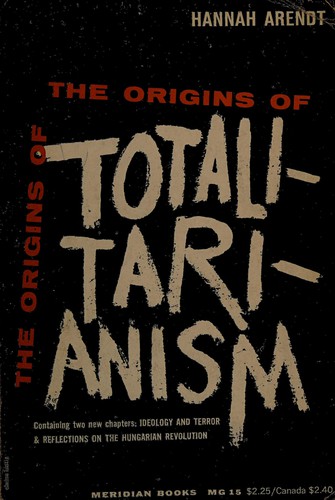
The Origins of Totalitarianism
Hannah Arendt’s The Origins of Totalitarianism investigates how unprecedented systems of domination emerged from the political and social crises of modern Europe. Organized into three major parts—Antisemitism, Imperialism, and Totalitarianism—the book traces elements that converged in Nazi Germany and Stalin’s Soviet Union without presenting their rise as the inevitable result of a single cause. Arendt examines the weakening of the nation-state, the production of stateless and rightless populations, racial ideology, colonial violence, mass political organization, propaganda, secret police, and concentration camps. Her central claim is that totalitarianism cannot be understood as ordinary dictatorship enlarged in scale. It seeks to transform reality and human beings themselves through ideology and terror, destroying spontaneity, plurality, legal protection, and the distinction between fact and fiction. The book remains influential because it joins historical inquiry to political theory…
Where to buy or borrow
We don’t list any stores or libraries for this book yet.
Are you selling this book? Bookstores, publishers, authors and libraries can be listed here for free. Request a listing
About this book
Deep Overview
The second part turns to nineteenth-century imperialism. Arendt examines overseas expansion, racial doctrines, bureaucracy, and forms of rule that escaped the legal restraints associated with citizenship inside European states. Colonial administration and racial classification become important because they demonstrate how power can treat populations as objects to be managed rather than citizens entitled to participate in a common political world. She also considers continental expansionism, pan-movements, and nationalism. These developments do not constitute a simple causal chain leading to totalitarianism, but they supply practices and ideas that totalitarian movements later radicalize.
A crucial connection between the first two parts is the decline of stable political membership. Refugees, minorities, and stateless people expose the weakness of supposedly universal human rights when no political community guarantees them. Arendt’s analysis of the loss of a place in which one’s speech and actions matter leads to the idea commonly associated with a “right to have rights”: effective rights depend on belonging to an organized public world.
The final part analyzes totalitarian movements and regimes. Arendt distinguishes the mob from the masses and describes how atomization, political homelessness, and loneliness can make individuals receptive to movements offering total consistency. Propaganda attracts and organizes adherents, but ideology does more than spread falsehoods. It claims to reveal an all-explaining law—such as a law of nature or history—and draws consequences from that premise regardless of experience.
Once in power, the totalitarian regime does not simply establish a stable authoritarian hierarchy. Competing offices, shifting authority, secret-police power, and uncertainty prevent ordinary accountability and make the ruler’s will difficult to locate or resist. Terror enforces the movement of ideology by treating human beings as carriers of predetermined historical or natural processes. For Arendt, the concentration and extermination camps are therefore not incidental excesses. They are laboratories of total domination in which individuality, legal personhood, moral choice, and spontaneity are systematically attacked. The deepest objective is not merely obedience but the reduction of human plurality to predictable, interchangeable behavior.
Key Themes
• Ideology and terror: Ideology supplies a total explanation of history or nature, while terror forces living reality to conform to that explanation.
• Statelessness and political membership: The predicament of refugees and minorities reveals that abstract rights become fragile when people lose membership in a political community.
• Imperialism, race, and bureaucracy: Colonial expansion helped normalize forms of domination unconstrained by citizenship, legal equality, or shared responsibility.
• Mass society and loneliness: Social isolation and the collapse of durable political relationships create conditions in which comprehensive movements can replace a common world of experience.
• Fact, fiction, and consistency: Totalitarian movements undermine factual reality and make loyalty to an internally consistent ideology more important than evidence.
• Human plurality and spontaneity: Total domination attacks the capacity to begin something new, act with others, and appear as a distinct person.
Historical Context
Arendt’s own historical position was directly relevant to these questions. A German Jewish émigré who fled Nazi persecution, lived in France, and later settled in the United States, she had personal experience of displacement and insecure political status. The book nevertheless should not be read as memoir. It is an ambitious interpretation of European modernity written when archives concerning both Nazi Germany and the Soviet Union were far less accessible than they are today. Its early Cold War setting, its proximity to catastrophe, and its necessarily incomplete evidence all shaped both its urgency and its limits.
Intended Audience
Reading Difficulty
Helpful Background Knowledge
Why Read This Book?
Reader Takeaways
Strengths
Limitations and Cautions
Important Concepts, People, Places, and Events
• National Socialism and Adolf Hitler: Nazi Germany provides Arendt’s most fully developed example of totalitarian domination, racial ideology, organized terror, and extermination.
• Stalinism and Joseph Stalin: The Soviet regime under Stalin forms the book’s second principal case, particularly in relation to ideology, purges, secret-police rule, and forced-labor camps.
• The Dreyfus Affair: The prosecution of French Jewish army officer Alfred Dreyfus becomes a major case study in political antisemitism, mass agitation, and the instability of republican institutions.
• European imperialism: Overseas expansion supplies examples of racial administration, bureaucracy, and power exercised beyond the legal restraints of citizenship.
• Pan-Germanism and Pan-Slavism: Continental movements that Arendt associates with expansionist nationalism and hostility toward the territorial limits of the nation-state.
• Stateless people and refugees: Populations deprived of effective citizenship reveal the institutional weakness of universal rights when no political community guarantees them.
• The nation-state: A political form strained by imperial expansion, minority conflicts, and mass displacement; its crisis is central to Arendt’s account of rightlessness.
• The masses and the mob: Distinct political groupings in Arendt’s vocabulary. The masses are isolated and politically unrepresented, while the mob emerges from social and political disintegration but retains particular interests and resentments.
• Ideology: An all-encompassing explanatory logic that claims to disclose the inevitable movement of nature or history and becomes resistant to contradictory experience.
• Terror and the secret police: Instruments that eliminate legal stability and enforce the ideological movement of the regime rather than merely suppressing conventional opponents.
• Concentration and extermination camps: For Arendt, these are central institutions of total domination, designed to attack legal identity, moral agency, individuality, and spontaneity.
• Human plurality: The condition that people are equal enough to understand one another yet distinct enough to introduce genuinely new words and actions into public life.
Questions the Book Explores
• How did antisemitism become an organized political ideology in modern Europe?
• What practices of racial and bureaucratic domination developed under imperialism?
• Why does the loss of citizenship threaten supposedly universal human rights?
• How do isolated individuals become organized into political masses?
• What happens when ideological consistency replaces attention to facts and experience?
• Why do totalitarian systems preserve institutional chaos rather than creating a simple, stable hierarchy?
• How do terror and concentration camps serve the deeper purposes of total domination?
• Can a regime eliminate spontaneity and plurality without destroying the human world itself?
Reading Group Guide
Discussion Questions
2. Which connections among antisemitism, imperialism, and totalitarianism are most convincing, and which require further evidence?
3. What does the predicament of stateless people reveal about the difference between moral rights and enforceable political rights?
4. How does Arendt distinguish loneliness from solitude and social isolation? Why is that distinction politically important?
5. In her account, why can a coherent ideological fiction become more powerful than observable reality?
6. What purpose is served by overlapping institutions and uncertain chains of command in a totalitarian system?
7. Does Arendt establish a persuasive basis for placing Nazism and Stalinism within the same political category?
8. Why does she treat the camps as central institutions rather than extreme but secondary instruments of repression?
9. How does total domination attack spontaneity, and why does spontaneity matter for political freedom?
10. Which parts of the analysis seem historically bounded to twentieth-century Europe, and which offer broader political insights?
Sources and Verification
Comments
No published comments yet.
Available editions
Hardcover
First American edition, hardcover
- Publisher
- Harcourt, Brace
- Pages
- 477