
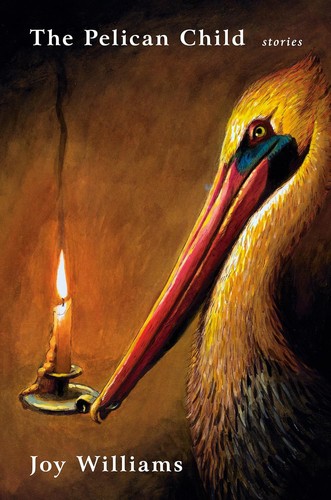
The Pelican Child
The Pelican Child is Joy Williams's seventh collection of short fiction, published by Alfred A. Knopf in November 2025. The twelve stories, most previously published in literary journals, gather Williams's signature fusion of the mundane and the mythic: talking dogs at a writers' retreat, a Slavic folkloric figure meeting John James Audubon, twin sisters plotting ecological retribution in Wyoming, and a man's mother receiving his terminal diagnosis with a koan. The collection is unified by its preoccupation with mortality, the slow unraveling of the natural world, and the uncanny quality that hides inside ordinary American life. Characters drift through a diminished landscape where care homes replace family photos with stock images, where lakes are drying, and where the boundary between the living and the dead remains stubbornly porous. The book was longlisted for the 2025 National Book Award and received broadly favorable critical attention.
Where to buy or borrow
We don’t list any stores or libraries for this book yet.
Are you selling this book? Bookstores, publishers, authors and libraries can be listed here for free. Request a listing
About this book
Deep Overview
The structural intelligence of the book lies in its layering. Each story operates in a territory that is simultaneously recognizable and arcane. The opening piece, "Flour," establishes a template: a journey with no fixed destination, narrated by a woman wealthy enough not to work, whose driver spends his nights decoding a Coptic riddle. The story's language slips between present and past tense in the space of a single line, enacting the very intractability of time it describes. This temporal instability recurs throughout: in "The Fellow," a fellowship director's assistant is corrected when she says time "goes by"—"Time never goes anywhere!"—and in "After the Haiku Period," a factotum's duties include serving "Time, the severe concept of which had always troubled him."
Myth and folklore form a second layer. Williams inserts Baba Iaga, the Slavic folkloric figure, into a story that also features the naturalist John James Audubon, whose encounter with a pelican daughter becomes a fable about humanity's ease in inflicting harm on the natural world. The ghost of Gurdjieff drifts to Tucson to visit Susan Sontag's childhood home, the chronology deliberately impossible. Odysseus's hound Argos is given a brief, devastating voice in a flash piece of fewer than three pages. These insertions are not decorative; they suggest that the mythic framework has never fully dissolved from American consciousness, even in a world of trailer parks and biker bars.
The third layer is the most politically urgent: the environmental. "After the Haiku Period" is the collection's lone new story and its most direct ecological reckoning. Twins Candida and Camilla plot against their father's record of destruction in Kansas and Wyoming, where he enthusiastically participated in the slaughter of animal life by guns and strychnine. This is not a story about a distant, catastrophic ending but about the slow, corporate erosion of ecosystems that has already occurred. The Anthropocene is not a future threat in Williams's fiction; it is the present condition, and her characters are its inheritors.
What Williams is trying to demonstrate, across these twelve stories, is that the personal and the planetary are not separable registers. A woman's indifference toward the babies in her day-care is structurally identical to a nation's indifference toward its wetlands. A man's terminal diagnosis, received by his mother with the casualness of a koan, is another small instance of the world's diminishment. The collection's power lies in refusing to choose between the intimate and the vast, insisting that a Coptic riddle, a Slavic witch, a dying reef, and a nursing home are all facets of the same question: what do we do with the world we have, and the one we are losing?
Key Themes
The intractability of time. Several stories treat time as a fixed, severe entity rather than a resource to be spent. Characters cannot "make up time"; it does not go anywhere; it simply is, and it is troubling.
Environmental diminishment and the Anthropocene. The natural world is not merely a setting but a character in slow decline. The collection's ecological consciousness ranges from corporate destruction in Wyoming to the drying of lakes and the death of coral, treated as present facts rather than speculative futures.
The uncanny embedded in the ordinary. Talking dogs, a ghost visiting a dead woman's childhood home, a child who may be a mirage—these elements do not signal genre shift but suggest that the everyday is always slightly more strange than it appears.
Indifference and its consequences. Multiple characters articulate a growing indifference toward their responsibilities—toward babies, toward the living, toward the world—and the stories track where that indifference leads.
Myth and folklore as interpretive frameworks. Williams draws on Slavic, Coptic, and Greco-Roman mythic material not as escapist ornament but as a lens for understanding the secular, diminished present.
Historical Context
The broader literary context includes the enduring American tradition of the short story as a form for capturing the uncanny within the quotidian—Lucia Berlin, Denis Johnson, and Carson McCullers are names that recur in critical responses to this book. Williams's prose, often described as lean and elliptical, situates her within a lineage that values implication over explanation.
Culturally, the collection emerges in a moment of acute environmental anxiety. The stories do not reference specific policy debates or climate reports, but their world is one in which the damage is already visible: dying reefs, drying lakes, corporate slaughter of animal populations. The Anthropocene, a term from earth science describing the current geological epoch shaped by human activity, is the unspoken backdrop. The book's 2025 publication places it in a U.S. political and social climate that several reviewers noted lends an additional layer of allegorical weight, though Williams's settings are not explicitly tied to any administration.
The collection's longlisting for the 2025 National Book Award situates it within the contemporary literary fiction conversation, alongside works that grapple with ecological grief and the persistence of myth in a secular age.
Intended Audience
The book also appeals to readers interested in environmental themes in fiction, though it handles them through indirection and character rather than through argument or exposition. Readers of Slavic folklore, Coptic literature, or classical mythology will find additional layers in the stories that draw on those traditions.
This is not a book for readers who prefer tight plot arcs, clear character arcs, or narrative resolution. The stories are deliberately open-ended, and several resist easy interpretation. Readers looking for a straightforward environmental thriller or a coming-of-age narrative will likely find the collection's restraint and strangeness off-putting. It is a book that rewards re-reading and slow savoring over quick consumption.
Reading Difficulty
The pacing is slow and meditative. There are no fast plot turns in the conventional sense; momentum comes from shifts in tone, a single striking image, or the accumulation of small, strange details. The collection as a whole reads more like a sequence of painted canvases than a novel's forward march. Readers who find pleasure in rereading a single page to catch a nuance will be well served; readers who want to finish a book in a weekend may find the experience too unhurried.
No formal prerequisites are required. The stories do not assume knowledge of academic literary theory, environmental science, or comparative mythology, though familiarity with any of these fields can add depth. The format is a standard trade paperback or hardcover collection; each story is short enough (most under fifteen pages, one under three) to be read in a single sitting, which makes the book approachable in increments.
Helpful Background Knowledge
Baba Iaga, the Slavic folkloric figure of the witch who lives in a hut on chicken legs, appears in the title story. Knowing her basic mythic role as a threshold-crosser and tester of the hero helps the story's fable-like structure land.
John James Audubon, the nineteenth-century naturalist and artist, is a character in the same story. His historical reputation as a brilliant but environmentally destructive figure is essential to the story's meaning.
Susan Sontag, the late American literary critic and essayist, is the object of a character's obsession in "George and Susan." Knowing her stature as a public intellectual gives weight to the story's premise.
George Ivanovich Gurdjieff, the early twentieth-century spiritual teacher and author, is the "ghost" in that same story. His esoteric cosmology and reputation as a self-proclaimed seeker of consciousness provide context for his behavior.
Coptic literature and riddle traditions appear in the opening story "Flour." A general sense that Coptic is an ancient Christian literary tradition from Egypt is sufficient; the story does not require scholarly knowledge.
The New Yorker and The Paris Review are the two literary journals where most of these stories previously appeared. Knowing them as venues for high-literary short fiction sets expectations for tone and audience.
Joy Williams's earlier novel Harrow (2021) and the Azrael diptych share thematic ground with this collection. Reading them first is not necessary but can make the continuities more apparent.
Why Read This Book?
It is also a book that takes the ecological crisis seriously without becoming a pamphlet about it. Williams embeds environmental grief in character, in setting, in the quiet details of a world that is losing its edges, and the result is more unsettling than a straightforward argument could be. If you have been looking for literary fiction that treats the Anthropocene as a lived reality rather than a policy topic, this is one of the most accomplished examples available.
The mythological layering adds a dimension that purely naturalistic short story collections lack. The insertion of Baba Iaga, Argos, and Gurdjieff into small-town American life is not a gimmick; it suggests that the stories we inherit shape the world we inhabit, and that the failure to tell them has consequences. For readers who are drawn to fiction book recommendations that cross between the literary and the archetypal, The Pelican Child occupies a rare and valuable space.
Finally, the book is a pleasure to read in the simplest sense. The prose is lean, the stories are vivid, and the collection moves with an internal rhythm that makes each piece feel like a different room in the same house. It is a book you can read a story of on a Tuesday evening and return to on a Thursday with fresh eyes.
Reader Takeaways
The collection invites a reconsideration of the relationship between the personal and the ecological. By the end, the woman's indifference in the day-care and the corporation's slaughter in Wyoming feel like the same act viewed at different scales, and the reader may notice that conflation more readily in their own life.
Readers may also reconsider their assumptions about time. The stories insist that time is not a resource to be managed but a fixed, severe presence, and that the narratives we tell ourselves about making up time or going backward are fictions. This is a small philosophical shift, but one that colors how one reads the stories and, perhaps, experiences a day.
Finally, the book models a form of attention. Williams's characters notice things—tinted sunglasses, a Coptic riddle, a soldier tucked in silk beside a coffin—and the act of noticing becomes a way of being alive. A reader who has completed the collection may find themselves pausing longer over the small, strange details of their own surroundings, holding them up to the light as the characters do.
Strengths
Thematic coherence without formula. Twelve stories, each distinct in plot and setting, are unified by a shared preoccupation with diminishment, mortality, and the uncanny. The collection feels like a single sustained thought rendered in different keys, which is a rare achievement in a form as diverse as the short story.
The mythological layering is handled with confidence. Williams does not explain her references to Baba Iaga, Coptic riddles, or the Odyssey; she trusts the reader to meet the allusion halfway. This creates a texture that purely naturalistic fiction rarely achieves.
The environmental dimension is integrated rather than didactic. The ecological crisis is present in the world of the stories—drying lakes, corporate slaughter, a dying reef—without the characters becoming advocates or the narratives becoming arguments. This indirection gives the environmental theme a quiet, persistent power.
The collection benefits from the compression inherent to the short story form. Each piece is a controlled experiment in tone and structure, and the variety across the twelve stories keeps the reading experience fresh without sacrificing the collection's underlying unity.
Limitations and Cautions
Eleven of the twelve stories are republished from earlier journal appearances, with only one new piece. For readers expecting an entirely new body of work, the collection functions more as a curated selection than a fresh creative burst. This is common in the literary fiction canon but worth noting.
The elliptical, implication-driven style will not suit every reader. Stories that resist explicit resolution, that leave key questions unanswered, or that shift between tenses without signaling the shift may feel deliberately frustrating to those who prefer narrative clarity.
The environmental theme, while central, is expressed through indirection and character rather than through any sustained argument or factual grounding. Readers who want the ecological dimension to be more explicit, more argued, or more politically specific may find the treatment too quiet.
Several stories depend on cultural references—Slavic folklore, Coptic literature, the Odyssey, Gurdjieff, Sontag—that are not explained. While the stories are comprehensible without this knowledge, readers from backgrounds where these references are less common may find some layers less accessible.
The collection's setting is overwhelmingly American, and its small-town and desert locales may feel parochial to readers looking for a more globally situated literary fiction.
Important Concepts, People, and Places
John James Audubon: The nineteenth-century naturalist and ornithologist, cast as a character in the title story. His historical reputation as a brilliant observer who also contributed to the extinction of species gives the story its moral weight.
Susan Sontag: The late American critic, public intellectual, and essayist. In "George and Susan," a character travels to her childhood home in Tucson, Arizona, hoping to find a clue to her genius. The story treats her as a figure whose intellectual life was a form of sacred work.
George Gurdjieff: The early twentieth-century spiritual teacher, appearing in the same story as a ghost. His esoteric cosmology and reputation as a seeker of consciousness shape the story's premise.
The Anthropocene: The current geological epoch defined by human impact on the earth's systems. It is not named explicitly in the stories but is the unspoken backdrop of the collection's environmental consciousness—the dying reefs, drying lakes, and corporate slaughter are its literary embodiments.
Alfred A. Knopf: The publisher of The Pelican Child, a long-established American literary imprint. The association signals the book's position within the literary fiction canon.
The New Yorker and The Paris Review: The two literary journals where most of the collection's stories previously appeared. Their editorial standards and readership shaped the stories' tone and length.
Wyoming, Kansas, and Tucson, Arizona: The primary American settings. Wyoming and Kansas are sites of ecological destruction in the stories; Tucson is the childhood home of Sontag and the location of Gurdjieff's visit.
The 2025 National Book Award: The collection was longlisted in the fiction category, situating it within the year's most recognized literary fiction.
The Coptic riddle tradition: Referenced in the opening story "Flour," where the driver searches for a missing word in a Coptic riddle. The reference grounds the story in a specific literary and spiritual tradition without requiring the reader to know the text.
Questions the Book Explores
Is time something we control, or something that controls us? Multiple stories treat time as a fixed, severe entity, and the characters' attempts to "make up" or "spend" it are presented as fictions.
Where does indifference end and survival begin? Characters articulate a growing detachment from their responsibilities, and the stories ask whether that detachment is a form of self-preservation, a moral failure, or both.
How do myths persist in a secular, corporate, diminished world? The insertion of Baba Iaga, Argos, and Gurdjieff into American small-town life suggests that the old stories have not been replaced but merely displaced, and that their absence has consequences.
Can a personal relationship—mother and son, woman and driver, twins and father—be a site for reckoning with ecological and moral failure? Several stories locate their ethical weight in intimate relationships rather than in public action.
What is the function of imagination when the world it imagines is disappearing? A child in one story warns, "I believe we've come to the end of our options here," and the collection asks what remains when the stories we tell ourselves can no longer keep pace with reality.
Is the boundary between the living and the dead as fixed as we assume? Talking dogs, ghosts, and characters who vanish mid-sentence suggest that the border is more porous than the living prefer to believe.
Reading Group Guide
A useful starting point is the opening story, "Flour," which establishes the collection's tonal and structural template: a journey, a driver, a riddle, a destination that feels foreign. Ask the group what the journey represents, who the "missing word" in the Coptic riddle might be, and why the narrator finds the whole enterprise "repellent." These questions open the door to the collection's larger concerns without requiring a full analysis.
The talking dogs are a natural discussion hook. They appear in at least two stories and are treated with a straight-faced matter-of-factness that is both comic and unsettling. Ask the group whether the dogs function as a comic device, a metaphor, or something else entirely, and whether their presence changes the moral weight of the stories they inhabit.
The environmental thread is best discussed after the group has finished "After the Haiku Period," the collection's most explicit ecological story. The twins' plot against their father's record of destruction in Kansas and Wyoming provides a concrete entry point for talking about how the collection treats ecological grief, and whether the personal-revenge framing is a strength or a limitation.
The title story, "Baba Iaga and The Pelican Child," is the collection's most mythologically layered piece and likely to generate the richest discussion. Ask the group what they make of Audubon's role, whether the pelican daughter's fate is a metaphor for something specific, and whether the Slavic folklore setting feels natural or forced within the collection's American context.
Finally, close with a conversation about form. The collection is a sequence of short stories, not a novel, and the group should talk about whether the cohesion comes from theme, tone, or something else. Is the collection stronger as a curated selection of previously published work, or does the grouping create meaning that the individual stories lack?
Discussion Questions
2. The talking dogs appear in at least two stories. Do they function as a comic device, a philosophical vehicle, or something else? How does their presence alter the moral weight of the stories they inhabit?
3. In the story about the man with terminal cancer, his mother responds to his news with a koan about resurrection and death. Is her casualness a form of wisdom, a failure of feeling, or both? What does the story ask of the reader who is watching this exchange?
4. "After the Haiku Period" is the collection's only new story and its most explicit ecological narrative. Does the twins' plan for revenge feel like a meaningful response to their father's destruction, or does it replicate the same logic of violence? What would a different response look like within the story's world?
5. The title story places Baba Iaga and John James Audubon in the same narrative. What is the relationship between the two figures? Does the story treat Audubon's historical environmental legacy as a given, or does it complicate it? What does the pelican daughter's fate signify?
6. Several characters in the collection are described as "still there but not alive." What does this state suggest about the collection's understanding of personhood, and does it align with or challenge your own experience of the world around you?
7. The Irish Times review notes that Williams's pessimistic environmentalism is "at the forefront." Do you agree that the environmental dimension is the collection's dominant theme, or is it one thread among several? How does the collection's treatment of ecological crisis compare to other literary fiction you have read?
8. The collection includes stories set in small-town America, a writers' retreat, a nursing home, and a desert prison-style building. What connects these settings? Is the "West" described in the Boston Globe review a specific place or a state of mind?
9. Joy Williams is the author of five novels in addition to this collection. Does the short story form suit her concerns better than the novel, or does the novel offer something the story cannot? What do you think is gained and lost in the move from the Azrael diptych to these shorter pieces?
10. The collection was longlisted for the 2025 National Book Award. What does a short story collection's nomination for a prize traditionally associated with novels suggest about the current state of the form?
Sources and Verification
Comments
No published comments yet.
Available editions
Other format
- Publisher
- Alfred A. Knopf
- Publication date