
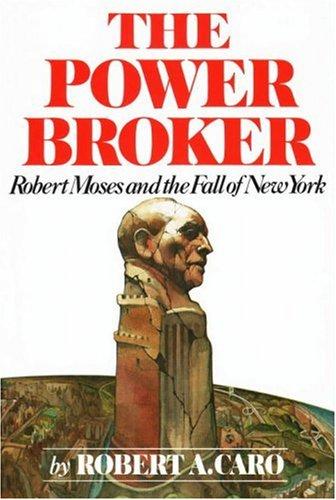
The Power Broker
Robert Moses and the Fall of New York
Robert A. Caro’s monumental biography examines how Robert Moses transformed New York’s physical landscape while building a political empire largely insulated from voters. Following Moses from idealistic reformer to dominant public official, Caro shows how command of legislation, public authorities, patronage, toll revenue, and overlapping appointments enabled one unelected man to influence parks, highways, bridges, housing, and urban renewal for decades. The book gives substantial attention to the achievements associated with that power, including beaches, parkways, playgrounds, and major infrastructure. Its central concern, however, is the human and democratic cost: displaced neighborhoods, weakened institutions, racial and class inequalities, and a transportation system oriented toward automobiles rather than mass transit. More than a biography, The Power Broker is an investigation of how power is acquired, concealed, exercised, and eventually lost—and of how governmental machinery…
Where to buy or borrow
Are you selling this book? Bookstores, publishers, authors and libraries can be listed here for free. Request a listing
About this book
Deep Overview
The early Moses emerges from Progressive-era reform culture. Educated, ambitious, and hostile to machine politics, he initially appears committed to replacing patronage with competence and rational administration. His work with Governor Alfred E. Smith becomes crucial. Smith possesses electoral legitimacy and political instinct; Moses supplies technical command, relentless energy, and an exceptional ability to draft laws. Caro traces how this alliance helped Moses convert reform expertise into durable authority.
Parks and parkways form the first great arena of achievement. Moses expands recreational access and realizes large projects at a speed that inspires admiration. Jones Beach becomes a particularly important example of his capacity to join design, engineering, finance, public relations, and political pressure. Yet Caro argues that success changed both Moses’s methods and aims. Institutions created to accomplish public purposes also became platforms from which he could resist mayors, governors, legislators, and ordinary administrative oversight.
The Triborough Bridge and Tunnel Authority is central to this transformation. Toll income and bond obligations gave the authority a continuing financial base, while carefully designed legal arrangements limited outside interference. Moses could use one completed project to help sustain the next, enlarging both his construction program and his independence. Caro’s larger point is that infrastructure finance is never merely technical: control over revenue can become control over policy.
As the narrative turns toward New York City, it follows the effects of expressways, clearance programs, and large redevelopment schemes on neighborhoods. The Cross-Bronx Expressway serves as one of the book’s most consequential cases. Caro emphasizes that route selection and administrative procedure were moral and political choices, not inevitable products of engineering. Families and communities paid the price for decisions made within institutions they had little power to challenge.
The later chapters chart conflicts with mayors, governors, reformers, and rival planners. Figures such as Fiorello La Guardia, Nelson Rockefeller, and John Lindsay reveal the difficulty of controlling a public official whose authority had accumulated across multiple agencies. Moses’s eventual decline does not erase his influence: roads, bridges, parks, residential patterns, and administrative precedents survive him. Caro ultimately presents the built city as a record of political decisions, asking readers to see concrete, parkland, toll plazas, and displaced blocks as evidence of who possessed power and whose interests counted.
Key Themes
**Ends, means, and accountability:** Caro repeatedly tests whether desirable public works can justify secrecy, coercion, displaced communities, or the weakening of democratic checks.
**Infrastructure as politics:** Roads, bridges, parks, and housing projects distribute access, inconvenience, wealth, and opportunity. Their locations and designs embody political priorities.
**Reform becoming domination:** Moses begins as an opponent of machine government, yet develops his own durable network of loyalists, favors, institutional leverage, and controlled resources.
**Automobility and metropolitan inequality:** The preference for highways and automobile access shapes suburban growth, public-transit choices, and the burdens imposed on poorer urban neighborhoods.
**The human cost of administrative abstraction:** Official terms such as clearance, relocation, and arterial improvement obscure the experiences of residents whose homes, businesses, and social ties are destroyed.
Historical Context
Moses’s rise coincided with expanding automobile ownership, metropolitan suburbanization, and government investment in parks, roads, bridges, housing, and large civic projects. During the New Deal and after World War II, federal money and urban-renewal policy strengthened the capacity of local officials to clear land and rebuild at enormous scale. Public authorities also became important vehicles for issuing bonds and operating revenue-producing infrastructure beyond ordinary departmental structures.
Caro wrote amid growing criticism of top-down urban renewal and highway construction. By the 1960s and 1970s, neighborhood preservation, environmental concerns, and opposition to expressway projects had altered public debate. The book belongs to that reassessment, although its biographical scope reaches back to the institutional origins of the system under criticism.
Intended Audience
Readers seeking a short introduction to Robert Moses may find its scale excessive. Those primarily interested in technical planning methods should also know that Caro’s emphasis is political and moral rather than instructional. The book is best approached by readers willing to follow complex institutional struggles and to remain with a sustained argument over many chapters.
Reading Difficulty
The principal challenge is cumulative rather than technical. Caro explains institutions as they become important, but the reader must remember how offices, statutes, revenues, and political alliances connect across decades. Chapters often function as extended demonstrations, building toward a conclusion through numerous incidents and witnesses. Reading in regular sections—and keeping a list of agencies and public officials—can make the structure more manageable.
Helpful Background Knowledge
Familiarity with three governmental ideas also helps: public authorities can possess powers and revenues distinct from ordinary agencies; municipal bonds finance projects through promised future repayment; and urban renewal often involved government acquisition and clearance of areas officially designated as blighted. A general understanding of Progressive reform, Tammany Hall, the New Deal, suburbanization, and postwar highway expansion will clarify the larger stakes.
Why Read It
It also teaches readers to interpret the built environment historically. A bridge or expressway is not simply an object on a map; it is the outcome of conflicts over money, mobility, property, public priorities, and whose objections can be ignored. That perspective remains useful far beyond New York.
Finally, the book joins large-scale institutional analysis to the experiences of individuals and neighborhoods. It demonstrates why public accomplishments and public harms must be evaluated together rather than placed in separate stories.
Reader Takeaways
Readers may become more attentive to the distributional effects of infrastructure: who gains speed, recreation, land value, or access, and who receives demolition, noise, separation, or displacement. The narrative also complicates familiar contrasts between reformers and machines, expertise and politics, or efficiency and corruption. An institution can be productive and still be unaccountable; a reformer can defeat one political organization while constructing another form of concentrated power.
Most broadly, the book shows that political decisions can harden into landscapes. Once built, roads, bridges, and neighborhood divisions can guide behavior and constrain later choices for generations.
Strengths
The narrative also humanizes policy consequences. Testimony from residents and officials prevents public works from appearing only as statistics or engineering accomplishments. Caro is particularly effective at converting complicated administrative matters into scenes with clear stakes without abandoning the underlying institutional detail.
Its research foundation is another major asset. Caro drew on extensive interviews and documentary investigation, and his surviving archive offers evidence of the depth of that process. The book’s organization gives coherence to a vast subject by treating the acquisition and use of power as its governing problem.
Limitations and Cautions
Its biographical concentration can also magnify the agency of one man. Federal policy, automobile culture, real-estate interests, racial segregation, suburban demand, engineering professions, and broader metropolitan politics cannot always be reduced to Moses’s decisions, even when he was exceptionally influential.
Because the book appeared in 1974, it cannot assess later changes in New York, later archival discoveries, or the long-term evolution of projects discussed. Its size is a practical limitation as well: repetition reinforces the argument but may test readers who already accept its central claims.
Important Concepts, People, Places, and Institutions
**Robert A. Caro:** The biographer and investigative historian whose focus is not only Moses’s personality but the means by which power is accumulated and exercised.
**Alfred E. Smith:** New York governor and major early patron of Moses. Their partnership joins political legitimacy to administrative skill and helps launch Moses’s state-level authority.
**Fiorello H. La Guardia:** Mayor of New York City during a major phase of Moses’s urban expansion. Their relationship illustrates both cooperation and conflict between an elected mayor and an entrenched builder.
**Nelson A. Rockefeller:** Governor of New York during Moses’s later career and an important figure in the eventual reduction of Moses’s institutional independence.
**John V. Lindsay:** New York City mayor associated with the final period of Moses’s decline in city affairs.
**Public authorities:** Government-created bodies able to finance and operate projects with varying degrees of independence. They are essential to Caro’s explanation of Moses’s durability.
**Triborough Bridge and Tunnel Authority:** A crucial institutional base whose toll revenues and bond structure helped provide Moses with continuing financial and political leverage.
**Jones Beach State Park:** A signature recreational achievement that demonstrates Moses’s capacity to realize ambitious public projects while also revealing the values embedded in access and design choices.
**Cross-Bronx Expressway:** A central case in Caro’s account of neighborhood destruction, route selection, and the social consequences of highway-centered planning.
**Tammany Hall:** New York’s famous Democratic political organization. Moses’s early opposition to machine politics forms an important contrast with the power system he later creates.
**Urban renewal:** Government-backed clearance and redevelopment, presented as a process whose official goals must be measured against displacement and community loss.
**Bond financing and toll revenue:** Financial instruments that do more than pay for construction; in Caro’s analysis, they can give institutions autonomy and make power self-reinforcing.
Questions the Book Explores
What institutional arrangements allow public power to escape ordinary oversight?
When, if ever, do the achievements of large public works justify coercive methods or concentrated authority?
How do legal drafting, bond covenants, tolls, appointments, and agency jurisdiction become political weapons?
Whose needs are prioritized when governments choose highways, parks, housing, and redevelopment projects?
How should public achievement be weighed against displacement, segregation, weakened transit, and destroyed communities?
Can a reform movement reproduce the very concentration of power it originally opposed?
What remains of a political regime after its leader loses office but its physical projects endure?
Reading Group Guide
Trace one mechanism of power across the book, such as bill drafting, public relations, toll revenue, patronage, or overlapping appointments. This prevents discussion from reducing Moses’s authority to personality alone.
Choose one major project and examine it from several positions: Moses, an elected official, a motorist, a transit rider, a displaced resident, a contractor, and a bondholder. Discuss how changing perspective alters the definition of public benefit.
Groups may also compare Caro’s portraits of institutions with his portraits of individuals. Consider where narrative drama clarifies the political analysis and where it may encourage a more personalized explanation than the evidence warrants.
Discussion Questions
2. Does the book establish a meaningful distinction between authority, influence, and power?
3. Which of Moses’s accomplishments poses the hardest challenge to Caro’s critical judgment?
4. How does expertise become a source of legitimacy, and when does that legitimacy become dangerous?
5. What democratic safeguards might have limited Moses without making large public projects impossible?
6. How does Caro make financial and legal structures narratively compelling?
7. In what ways does the book complicate the idea of political corruption?
8. How should historians evaluate decisions whose costs and benefits are distributed unevenly across generations?
9. Does concentrating on Moses illuminate New York’s transformation, or obscure the responsibility of other institutions and social forces?
10. Which parts of the physical environment in your own community might reveal similar histories of hidden political choice?
11. How does the book’s treatment of displaced residents affect its argument about public purpose?
12. What would a persuasive reassessment of Moses need to retain, revise, or reject from Caro’s account?
Sources and Verification
Comments
No published comments yet.
Available editions
Hardcover
hardcover
- Publisher
- Alfred A. Knopf
- ISBN-13
- 9780394480763
- Publication date
- Pages
- 1296