
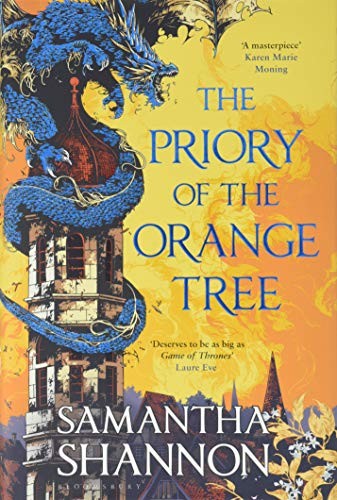
The Priory of the Orange Tree
Samantha Shannon’s expansive epic fantasy follows four people whose divided societies must confront the return of an ancient draconic enemy. In Inys, Queen Sabran Berethnet faces pressure to preserve a royal line believed to protect the world, while Ead Duryan secretly guards her on behalf of the hidden Priory of the Orange Tree. Across the sea, Tané trains to become a dragonrider in a culture that reveres water-linked dragons, and the exiled alchemist Niclays Roos searches for a route back to influence. Their stories expose incompatible accounts of a foundational dragon-slaying legend—and the political and religious structures built upon those accounts. Combining court intrigue, a sapphic central romance, competing faiths, magical artifacts, sea voyages, and large-scale conflict, the novel reworks heroic fantasy around women who act as rulers, warriors, scholars, and makers of history.
Where to buy or borrow
Are you selling this book? Bookstores, publishers, authors and libraries can be listed here for free. Request a listing
About this book
Deep Overview
Eadaz du Zāla—known at court as Ead Duryan—occupies a dangerous position near the queen. She serves as a lady-in-waiting while secretly answering to the Priory of the Orange Tree, a southern order of women who preserve a competing account of the world’s foundational conflict. Ead’s concealed magic allows her to protect Sabran from assassins, but closeness creates divided loyalties. Her relationship with the queen moves from suspicion and guarded service toward intimacy, forcing both women to reconsider the institutions that shaped their identities.
Far to the east, Tané has dedicated her life to becoming a dragonrider. Her society reveres celestial, water-associated dragons rather than viewing every dragon as monstrous. A desperate choice made before her initiation threatens her vocation and entangles her with Niclays Roos, a disgraced western alchemist living in exile. Niclays’s longing to recover what he has lost repeatedly pushes him toward betrayal and ethically compromised bargains. Through these eastern and maritime storylines, the novel widens beyond Inysh court politics to explore trade, quarantine, piracy, scholarship, and the costs of isolation.
The principal crisis is the anticipated return of the Nameless One and his fire-breathing servants. Yet military preparation is obstructed by religious hostility and historical misinformation. Different civilizations possess incomplete pieces of the truth: the West has preserved a saintly national myth, the Priory guards another lineage of memory, and the East understands dragons through a separate cosmology. Victory therefore depends on more than finding weapons. Characters must compare evidence, surrender cherished certainties, and cooperate across borders.
Shannon uses a familiar epic structure—an awakening evil, hidden magic, ancient relics, a divided world, and a culminating battle—but rearranges who receives authority within it. Queens, women warriors, scholars, healers, and dragonriders stand at the center. The deeper struggle concerns interpretation: whether societies will continue defending useful legends or reconstruct a shared past adequate to the danger before them.
Key Themes
**Faith and doubt:** Several characters discover that questioning an inherited belief need not mean abandoning every value associated with it. Doubt becomes a path toward moral responsibility rather than a simple rejection of religion.
**East-West estrangement:** Geographic separation and opposing dragon traditions produce prejudice, fear, and strategic weakness. Cooperation requires more than diplomacy; it requires learning why each culture interprets the world as it does.
**Women and authority:** Women rule kingdoms, preserve knowledge, fight, practice magic, and ride dragons. Their conflicts arise from competing duties and ambitions rather than from a single, universal system of gender exclusion.
**Love versus prescribed duty:** Sabran and Ead’s relationship challenges obligations imposed by throne, ancestry, secrecy, and religious service. Other relationships similarly test whether loyalty to institutions should outweigh loyalty to particular people.
**Loss and the temptation to undo it:** Niclays’s choices show how grief can harden into obsession. His pursuit of restoration raises questions about what people owe the living when they cannot release the dead.
Literary and Mythic Context
The book also responds to conventions of twentieth- and twenty-first-century epic fantasy: the dark power returning after centuries, the relic needed to defeat it, the secret magical order, and the alliance of divided peoples. It retains the scale and adventure of those conventions while placing a greater emphasis on female political agency and queer love. Its contrasting dragons draw on broad cultural differences in dragon symbolism. European traditions frequently cast the dragon as a destructive adversary, while many East Asian traditions associate dragons with water, rain, authority, or good fortune. The fictional cultures are not direct replicas of real societies, but this symbolic contrast structures the novel’s religious and diplomatic divide.
Intended Audience
Readers who prefer compact casts, rapid beginnings, limited invented terminology, or romance as the sole narrative focus may find the novel demanding. Although the central relationship is significant, the book remains primarily an ensemble epic with substantial attention to politics, mythology, travel, and war.
Reading Difficulty
Maps help with the geographic structure, and the narratives become easier to follow as their connections emerge. The pacing alternates between deliberative court scenes, travel, investigation, romance, and bursts of action. At 848 pages in the verified U.S. hardcover edition, it rewards sustained reading and some comfort with long-form epic fantasy.
Helpful Background Knowledge
Readers may want to note unfamiliar names, institutions, and artifacts during the opening sections. It is particularly helpful to distinguish the Inysh religion of the Virtudom, the southern Priory, and the eastern traditions surrounding celestial dragons. These belief systems are central to the mystery of what happened a thousand years earlier.
Why Read It?
Its most distinctive feature is the connection between mythology and state power. The question of who defeated the ancient enemy affects succession, diplomacy, religious authority, and personal identity in the present. The book also gives its women varied forms of agency: Sabran governs, Ead protects and investigates, Tané pursues mastery, and the women of the Priory preserve a suppressed historical tradition. The result is not merely a reversal of a damsel-in-distress tale, but an examination of why that tale was preserved in the first place.
Reader Takeaways
It also invites readers to distinguish faith from certainty, leadership from inherited legitimacy, and reconciliation from simple agreement. Cooperation becomes possible only when characters admit the limits of their own knowledge. On a more personal level, the book examines how duty can provide purpose while also becoming an excuse to avoid difficult moral choices. Its central relationships suggest that trust requires disclosure, accountability, and a willingness to revise the story one tells about oneself.
Strengths
Shannon also handles scale effectively. Personal decisions have political consequences, while large historical questions remain connected to grief, love, ambition, and fear. The central romance develops within genuine conflicts of office and belief rather than existing apart from the wider plot. Finally, the self-contained structure provides substantial closure without requiring readers to continue into another volume.
Limitations and Considerations
Some major revelations and alliances accumulate rapidly in the final portion, making the conclusion feel more compressed than the extensive setup. Readers seeking a romance-forward fantasy should also know that the relationship between Ead and Sabran shares space with several other plots. The book questions religious institutions and inherited orthodoxy, but it does so through invented traditions rather than offering a detailed analogue of any single historical religion.
Important Concepts, People, and Places
**Queen Sabran Berethnet IX:** The ruler of Inys and latest member of a dynasty believed to keep the Nameless One imprisoned. Her body, marriage, and succession have been made into instruments of state theology.
**Tané:** An eastern aspirant dragonrider whose discipline is threatened by one consequential decision. Her story introduces the reverence for celestial dragons and the costs of pursuing an idealized vocation.
**Niclays Roos:** An exiled alchemist whose grief and desire for restoration make him vulnerable to manipulation. He links western scholarship, eastern exile, and maritime conflict.
**The Priory of the Orange Tree:** A secretive southern order of mages and warriors. It preserves knowledge and a lineage of power that contradict the official Inysh account of salvation.
**Inys and the House of Berethnet:** The queendom and dynasty at the center of western politics. Their legitimacy depends on the story of Sir Galian Berethnet and his victory over the Nameless One.
**The Virtudom:** The western religious order built around Galian’s saintly reputation and the sacred role of the Berethnet line. Its teachings influence diplomacy and attitudes toward magic and dragons.
**The Nameless One:** An ancient fire-breathing enemy whose possible return drives the military crisis. He represents both physical destruction and the consequences of misunderstanding the past.
**Wyrms and celestial dragons:** Two categories associated with opposing magical forces and moral traditions. Treating all dragons as identical is one of the world’s most consequential errors.
**The Grief of Ages:** The earlier catastrophe involving the Nameless One. Conflicting memories of this event form the foundation of the novel’s religious and historical mystery.
Questions the Book Explores
Can religious belief survive the discovery that its foundational narrative is incomplete or distorted?
When does loyalty to a nation, dynasty, or order become complicity in its errors?
How can societies cooperate when the symbols one culture reveres are objects of terror to another?
Does political leadership require preserving reassuring myths, or exposing dangerous truths?
What is the difference between honoring the dead and allowing grief to govern the living?
How do love and friendship alter duties that once seemed absolute?
Reading Group Guide
Trace references to the ancient dragon conflict as they appear in different regions. A group might keep a shared list of what each culture believes, what evidence supports it, and what each institution stands to lose if its version is disproved.
Niclays offers a productive counterpoint to the more conventionally heroic characters. Discuss whether grief explains his betrayals, whether it mitigates them, and what meaningful accountability would require.
It may also be useful to compare the narrative functions of fire and water, isolation and exchange, lineage and chosen loyalty. Finally, examine the ending as both military resolution and historical correction: does defeating the enemy also repair the structures that allowed division to persist?
Discussion Questions
2. How does the expectation that Sabran produce an heir affect her understanding of power, intimacy, and her own body?
3. In what ways does Ead’s secrecy protect Sabran, and in what ways does it deny Sabran agency?
4. Why are the competing accounts of the Grief of Ages so durable?
5. How does the novel distinguish celestial dragons from wyrms beyond their physical characteristics?
6. What does Tané’s training reveal about excellence, discipline, shame, and institutional belonging?
7. To what extent is Niclays responsible for choices made under the pressure of grief and exile?
8. Does the novel portray faith itself as dangerous, or does it focus its criticism on certainty and institutional power?
9. How successfully do the separate viewpoint narratives converge?
10. What elements of the traditional dragon-slayer story does Shannon preserve, and which does she overturn?
11. Does the central romance change the political world, or mainly the people within it?
12. After the final conflict, which divisions seem genuinely healed and which are likely to remain?
Sources and Verification
Comments
No published comments yet.
Available editions
Hardcover
hardcover
- Publisher
- Bloomsbury Publishing
- ISBN-13
- 9781635570298
- Publication date