
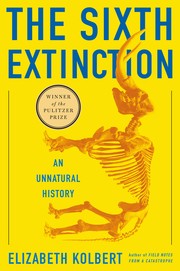
The Sixth Extinction
An Unnatural History
The Sixth Extinction investigates the proposition that human activity is producing a biological crisis comparable in scale—though not necessarily identical in mechanism or duration—to the five major mass extinctions identified in the fossil record. Kolbert develops this case through thirteen chapters, each organized around an emblematic species, extinction mechanism, scientific discovery, or conservation problem. The sequence moves between deep time and contemporary field sites rather than presenting a conventional textbook survey. The early chapters reconstruct the intellectual history of extinction. Georges Cuvier’s study of fossil remains helped establish that species could disappear permanently, overturning assumptions that nature’s inventory was fixed. The great auk illustrates how direct exploitation can eliminate an abundant species, while ammonites and the end-Cretaceous catastrophe introduce sudden planetary disruption and the scientific struggle to recognize it. The book the…
Where to buy or borrow
Are you selling this book? Bookstores, publishers, authors and libraries can be listed here for free. Request a listing
About this book
The early chapters reconstruct the intellectual history of extinction. Georges Cuvier’s study of fossil remains helped establish that species could disappear permanently, overturning assumptions that nature’s inventory was fixed. The great auk illustrates how direct exploitation can eliminate an abundant species, while ammonites and the end-Cretaceous catastrophe introduce sudden planetary disruption and the scientific struggle to recognize it.
The book then turns increasingly toward present-day processes. Amphibian losses reveal the destructive reach of chytrid fungus; ocean acidification demonstrates how carbon emissions alter seawater chemistry; warming forces organisms to shift their ranges; habitat fragmentation leaves forest remnants functioning like ecological islands; global trade transports organisms beyond their evolutionary boundaries; and hunting, reproduction problems, and restricted habitat imperil large mammals such as the Sumatran rhinoceros. A chapter on Neanderthals expands the inquiry to humanity’s encounters with other hominin populations.
Kolbert’s central method is cumulative rather than narrowly argumentative. Field reporting, encounters with scientists, portraits of threatened organisms, paleontological history, and explanations of ecological mechanisms gradually show Homo sapiens acting as a geological and biological force. The resulting account is not only about individual species disappearing. It is about the destabilization of relationships among climate, chemistry, geography, organisms, and evolutionary time. ([us.macmillan.com](https://us.macmillan.com/books/9780805099799/thesixthextinction/))
Deep Overview
The early chapters reconstruct the intellectual history of extinction. Georges Cuvier’s study of fossil remains helped establish that species could disappear permanently, overturning assumptions that nature’s inventory was fixed. The great auk illustrates how direct exploitation can eliminate an abundant species, while ammonites and the end-Cretaceous catastrophe introduce sudden planetary disruption and the scientific struggle to recognize it.
The book then turns increasingly toward present-day processes. Amphibian losses reveal the destructive reach of chytrid fungus; ocean acidification demonstrates how carbon emissions alter seawater chemistry; warming forces organisms to shift their ranges; habitat fragmentation leaves forest remnants functioning like ecological islands; global trade transports organisms beyond their evolutionary boundaries; and hunting, reproduction problems, and restricted habitat imperil large mammals such as the Sumatran rhinoceros. A chapter on Neanderthals expands the inquiry to humanity’s encounters with other hominin populations.
Kolbert’s central method is cumulative rather than narrowly argumentative. Field reporting, encounters with scientists, portraits of threatened organisms, paleontological history, and explanations of ecological mechanisms gradually show Homo sapiens acting as a geological and biological force. The resulting account is not only about individual species disappearing. It is about the destabilization of relationships among climate, chemistry, geography, organisms, and evolutionary time. ([us.macmillan.com](https://us.macmillan.com/books/9780805099799/thesixthextinction/))
Key Themes
• Extinction as both event and idea: Kolbert examines how scientists learned to recognize extinction, catastrophes, and the discontinuities visible in the fossil record.
• Evolutionary adaptation versus rapid change: Species can adapt to environmental change, but the speed, scale, and combination of contemporary pressures may exceed their capacity to respond.
• Global connection and biological homogenization: Modern travel and commerce unite ecosystems that evolved separately, allowing pathogens and invasive organisms to cross former barriers.
• The value of biological diversity: Rather than reducing biodiversity to a list of useful resources, the book repeatedly confronts readers with the singularity of species and the irreversible character of their loss.
• Scientific knowledge and delayed recognition: Evidence is often assembled while the destructive process is already underway. The book explores both the power of scientific investigation and the limits of acting only after certainty becomes overwhelming.
• Conservation under emergency conditions: Captive breeding, assisted reproduction, specimen preservation, and habitat management appear as necessary but incomplete responses to threats operating at planetary scale.
Historical and Intellectual Context
Kolbert places the modern biodiversity crisis within two intersecting histories. One is geological: the recognition of the “Big Five” mass extinctions and the development of theories explaining catastrophic change. The other is intellectual: the shift from viewing species as permanent elements of creation to understanding them as evolutionary populations that arise, change, and disappear.
The narrative revisits debates associated with figures such as Georges Cuvier, Charles Lyell, Charles Darwin, and Luis and Walter Alvarez. These episodes show that scientific understanding does not always advance smoothly. Ideas once dismissed as excessively catastrophic can later become persuasive when multiple forms of evidence converge.
The Sixth Extinction received the 2015 Pulitzer Prize for General Nonfiction. The Pulitzer citation characterized it as an exploration of nature that confronts the threat human behavior poses to biological diversity. ([pulitzer.org](https://www.pulitzer.org/files/2015/2015_pulitzer_presskit_042015.pdf?utm_source=openai))
Intended Audience
It can work well in undergraduate environmental studies, biology, journalism, history of science, and ethics courses because it connects scientific mechanisms with questions of evidence, responsibility, and public understanding. Reading groups willing to discuss morally difficult nonfiction should also find substantial material.
Readers seeking a detailed policy program, a technical monograph, or an optimistic catalogue of conservation solutions may find the book less directly satisfying. Its primary work is diagnosis and interpretation, not legislative design or step-by-step activism. The many accounts of disappearance and ecological danger may also be emotionally difficult for readers sensitive to animal suffering or environmental loss.
Reading Difficulty
The main difficulty is conceptual breadth. Readers move across hundreds of millions of years, numerous branches of biology and geology, and field sites on several continents. Scientific names and unfamiliar species may slow some readers, although each chapter’s emblematic organism provides a useful anchor.
The pacing is episodic rather than plot-driven. Individual chapters can often be read separately, but the book’s force depends on recognizing the cumulative pattern across them. Readers may benefit from keeping a simple list of the species, locations, extinction mechanisms, and historical scientists encountered in each chapter.
Helpful Background Knowledge
Useful concepts to review include the geological time scale; the end-Permian and end-Cretaceous extinction events; adaptation and ecological specialization; habitat fragmentation; invasive species; ocean acidification; and the difference between a species being rare, endangered, extinct in the wild, and globally extinct.
Readers should also remember that the book reports scientific knowledge and field conditions from the period leading up to its 2014 publication. Present conservation status, population estimates, taxonomic classifications, and research conclusions should be checked against current scientific and conservation sources.
Why Read This Book?
The book is also valuable as a history of scientific perception. It demonstrates how difficult it was for earlier naturalists to accept extinction, how evidence for catastrophic events accumulated, and how conceptual assumptions shape what investigators are prepared to see.
Its strongest reason for being read is the scale of perspective it provides. Human history usually measures time in decades or centuries; Kolbert sets industrial society against hundreds of millions of years of biological change. That comparison makes contemporary environmental disruption more legible without requiring the reader to master a specialist literature.
The book’s 2015 Pulitzer Prize confirms its recognized significance as general nonfiction, but its reader value lies chiefly in its combination of lucid explanation, firsthand reporting, intellectual history, and close attention to particular organisms. ([pulitzer.org](https://www.pulitzer.org/files/2015/2015_pulitzer_presskit_042015.pdf?utm_source=openai))
Reader Takeaways
The book also clarifies why human influence cannot be reduced to climate change alone. Climate disruption is central, but the broader crisis includes habitat conversion, overexploitation, pathogen movement, invasive species, pollution, and the rearrangement of formerly separate biological communities.
Readers may reconsider familiar notions of resilience. Life as a planetary phenomenon has survived previous catastrophes, but that does not mean particular species, ecosystems, or evolutionary lineages will survive current change. “Life will continue” is therefore not an adequate answer to the loss the book documents.
Another likely takeaway is that knowledge creates responsibility without guaranteeing control. Scientists can identify decline, preserve genetic material, breed rare animals, and model future changes, yet the causes may be too widespread for isolated technical interventions to solve.
Finally, the book encourages readers to view ordinary infrastructure, consumption, travel, and land use as ecological forces. The sixth extinction is presented not as a distant disaster occurring outside society, but as an outcome embedded in normal human systems.
Strengths
• Integration of disciplines: The book connects paleontology, evolutionary biology, ecology, geology, chemistry, anthropology, and conservation practice while retaining a coherent central inquiry.
• Field-based reporting: Encounters with researchers and threatened organisms give institutional and emotional texture to processes that might otherwise remain statistical abstractions.
• History of ideas: Kolbert does not present scientific concepts as timeless facts. She shows how extinction and catastrophe became thinkable through argument, error, evidence, and revision.
• Controlled tone: The implications are severe, but the book generally allows evidence, juxtaposition, and accumulated examples to carry the warning rather than relying on sustained polemic.
• Ethical reach: By combining large-scale patterns with individual species, the narrative asks readers to consider both ecosystem function and the irretrievable loss of unique forms of life.
Limitations and Cautions
Because the first edition appeared in 2014, some species statuses, population figures, projections, and scientific debates may have changed. Readers using it for current research should consult recent peer-reviewed literature and authoritative conservation databases.
The book devotes more attention to diagnosing the crisis than to comparing policy pathways, economic reforms, Indigenous conservation practices, environmental justice perspectives, or large-scale restoration strategies. Readers looking for a practical program will need companion works.
Its focus on extinction can also obscure other serious forms of biological decline, such as population collapse, reduced abundance, lost ecological interactions, and diminished genetic diversity that occur before formal extinction.
Finally, “sixth mass extinction” can be used in scientific and public discussion with different thresholds, time scales, and degrees of precision. Kolbert builds a forceful case for an unfolding anthropogenic extinction crisis, but readers should distinguish that broad conclusion from narrower technical questions about when an event qualifies as equivalent to the fossil record’s Big Five.
Important Concepts, Figures, and Cases
• Background extinction rate: The lower, ordinary rate at which species disappear outside mass-extinction intervals.
• Anthropocene: A proposed framework for an interval in which human activity has become a major influence on Earth systems.
• Georges Cuvier: The naturalist whose study of fossils helped establish extinction as a scientific reality.
• Charles Lyell and gradualism: Associated with explanations emphasizing slow, continuous geological processes; important to the book’s history of resistance to catastrophic interpretations.
• Charles Darwin: Central to understanding species as evolving populations rather than fixed creations, though evolutionary adaptation does not guarantee survival under abrupt change.
• Alvarez impact hypothesis: The evidence linking an asteroid impact to the end-Cretaceous extinction illustrates how a once-controversial catastrophic explanation gained acceptance.
• Chytridiomycosis and Bd: A fungal disease central to catastrophic amphibian declines and to the book’s opening investigation of Panamanian golden frogs.
• Ocean acidification: The chemical consequences of seawater absorbing atmospheric carbon dioxide, with implications for corals and other organisms that build calcium-carbonate structures.
• Habitat fragmentation and island biogeography: The division of continuous habitat into isolated patches, reducing viable populations and changing extinction risk.
• New Pangaea: Kolbert’s metaphor for the human-driven mixing of organisms that evolved on separate continents and islands.
• Neanderthals and Homo sapiens: A case through which the book considers humanity’s history of replacing or absorbing other human populations.
• Conservation dependence: The condition in which a species survives only through sustained human intervention such as captive breeding, reproductive assistance, or intensive habitat management.
Questions the Book Explores
• How did scientists learn that extinction was possible, and why was the idea initially difficult to accept?
• In what ways does the current crisis resemble earlier mass extinctions, and in what ways is it unprecedented?
• Can evolutionary processes keep pace with changes generated by industrial society and global commerce?
• How does humanity transform ecosystems indirectly, even when no one intends to destroy a species?
• What happens when organisms, pathogens, and predators cross geographic barriers that once kept ecosystems separate?
• What can zoos, laboratories, seed banks, and captive-breeding programs preserve—and what ecological relationships remain beyond their reach?
• Does humanity’s capacity to understand extinction create a special moral obligation to prevent it?
• What does the fate of other hominins suggest about the ecological character of Homo sapiens?
• Is technological ingenuity a sufficient answer to a crisis partly created by previous human ingenuity?
Reading Group Guide
At each meeting, choose one species as a case study. Identify the immediate threat, the deeper human system behind it, the scientific evidence used to understand it, and the attempted conservation response. This prevents discussion from remaining at the level of general alarm.
Groups may also create a two-column timeline pairing discoveries in the history of extinction science with examples of biological decline. This highlights the book’s double narrative: humanity is learning to understand extinction while simultaneously accelerating it.
For a contemporary extension, participants can check the current status of one featured species through an authoritative conservation source. Any differences from the 2014 account should be treated as an update, not retroactively attributed to the book.
Because the subject can produce despair, conclude by distinguishing individual, community, institutional, and international forms of responsibility. The purpose need not be to force consensus, but to clarify which responses match the scale and causes of the problem.
Discussion Questions
2. How does the history of Georges Cuvier and the discovery of extinction shape the reader’s understanding of present-day scientific warnings?
3. Which extinction mechanism in the book—direct killing, habitat loss, climate change, acidification, disease, fragmentation, or invasive species—most changed your understanding of human influence?
4. What is gained by comparing the current biodiversity crisis with the Big Five mass extinctions? What misunderstandings might the comparison encourage?
5. Does the book treat Homo sapiens primarily as a morally responsible agent, an unusually successful invasive species, a geological force, or some combination of these?
6. Several organisms survive only through intensive management. Is survival in captivity an adequate form of conservation? What has already been lost when a species becomes extinct in the wild?
7. How does the “New Pangaea” idea change the way we might think about travel, trade, gardening, agriculture, and the movement of animals?
8. Why include Neanderthals in a book about extinction? How does that chapter alter the scale or ethical meaning of the argument?
9. The book combines fascination with grief. Does scientific curiosity help readers confront environmental loss, or can it create emotional distance?
10. Where should responsibility lie when extinction results from millions of ordinary actions rather than one deliberate decision?
11. What important perspectives or solutions receive too little attention in the book?
12. After checking current information about one featured species, how has its situation changed since the book was published in 2014?
Sources and Verification
The publisher now lists multiple editions, including a tenth-anniversary edition with a new epilogue. This profile is tied specifically to the 2014 first U.S. hardcover and does not describe later material as part of that edition. Current claims about species populations, conservation classifications, or the state of scientific debates require separate verification from up-to-date scientific sources. Editorial assessments of audience, difficulty, strengths, limitations, and discussion value are WebToTell guidance rather than claims made by the publisher or author.
Comments
No published comments yet.
Available editions
Hardcover
First U.S. edition, hardcover
- Publisher
- Henry Holt and Company
- ISBN-13
- 9780805092998
- Publication date
- Pages
- 319