
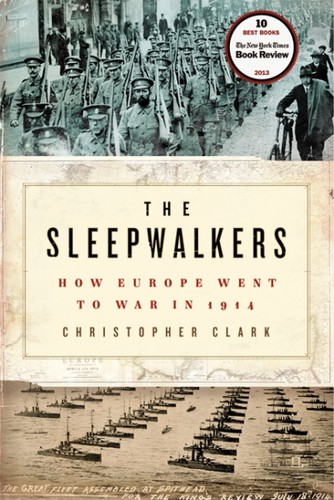
The Sleepwalkers
How Europe Went to War in 1914
Christopher Clark reconstructs the political and diplomatic decisions that transformed the assassination of Archduke Franz Ferdinand in Sarajevo into a European war. Rather than treating the catastrophe as the execution of a single power’s settled plan, he follows decision-makers in Serbia, Austria-Hungary, Germany, Russia, France, and Britain as they responded to threats, allies, domestic pressures, incomplete information, and rapidly narrowing choices. The account reaches back beyond the July Crisis to Serbian politics, Balkan nationalism, imperial rivalry, shifting alliances, and earlier confrontations that shaped how leaders interpreted events in 1914. Its central significance lies in replacing a simple search for one guilty state with an international study of interacting agency. Clark does not present the war as automatic: he emphasizes choices, misjudgments, and calculated risks. The result is both a detailed narrative of escalation and a major intervention in the long-running…
Where to buy or borrow
Are you selling this book? Bookstores, publishers, authors and libraries can be listed here for free. Request a listing
About this book
Deep Overview
Clark then widens the frame to Austria-Hungary and the European alliance system. The Habsburg monarchy is portrayed as troubled but not merely moribund. Its leaders face a strategic problem: Serbian expansion and South Slav nationalism appear capable of weakening the empire from within. Elsewhere, the Franco-Russian alliance, Britain’s understandings with France and Russia, Germany’s relative isolation, colonial disputes, naval rivalry, and the Balkan Wars alter expectations about which states will support one another. Yet alliances do not operate like automatic machinery. Their meaning depends on repeated interpretation by monarchs, ministers, diplomats, ambassadors, military planners, journalists, and officials whose authority often overlaps.
This institutional complexity is one of the book’s central analytical strengths. Foreign policy does not emerge from a single national mind. In Berlin, Vienna, Paris, St. Petersburg, London, and Belgrade, different actors possess different information and pursue partly conflicting priorities. Decisions are therefore shaped by internal rivalries as well as international pressure. Clark shows how messages could be softened, delayed, misunderstood, or read through assumptions formed during previous crises.
After Franz Ferdinand and Sophie Chotek are killed on June 28, 1914, the narrative becomes increasingly compressed. Austria-Hungary seeks German support and receives the assurance commonly called the “blank check.” Vienna prepares an ultimatum designed to impose a severe reckoning on Serbia. Serbia accepts much of it but not every demand; Austria-Hungary declares war. Russian leaders move toward mobilization in support of Serbia and in defense of Russia’s standing as a great power. France affirms its alliance with Russia, while Britain’s initially uncertain position becomes clearer as the crisis expands and Germany violates Belgian neutrality.
Clark’s emphasis is on the interaction of these choices. Leaders repeatedly believe that firmness will preserve credibility, deter opponents, satisfy allies, or improve their position in an apparently unavoidable conflict. The metaphor of sleepwalking does not mean that they are literally unconscious or innocent. It captures a disjunction between alert tactical calculation and inadequate comprehension of the disaster their combined actions are producing. War emerges as contingent but intelligible: not inevitable, not accidental in a trivial sense, and not reducible to one decision-maker or one capital.
Key Themes
**Contingency rather than inevitability:** Alliances, nationalism, arms competition, and military plans created danger, but they did not by themselves compel war. Particular decisions during the crisis still mattered.
**The Balkans as a political center:** Serbian ambitions, Habsburg insecurity, South Slav nationalism, and the legacy of the Balkan Wars are integral to the European story rather than peripheral complications.
**Fragmented government:** Cabinets, courts, foreign ministries, armies, intelligence networks, and informal groups compete within states. The book challenges the convenient fiction that each nation acted as a unified person.
**Risk, deterrence, and credibility:** Leaders repeatedly choose firmness because retreat seems likely to weaken alliances or national standing. Measures intended to deter adversaries instead intensify their fears.
**Perception and miscommunication:** Decision-makers interpret new information through inherited assumptions. Uncertainty does not necessarily produce caution; it can encourage worst-case reasoning.
**Nationalism and imperial vulnerability:** Serbia’s national project and Austria-Hungary’s multinational structure collide in a struggle involving sovereignty, security, and the political future of the South Slavs.
Historical Context
A particularly important reference point is the debate associated with German historian Fritz Fischer, whose work emphasized Germany’s expansionist aims and major responsibility. Clark does not simply invert that interpretation by substituting another single culprit. He internationalizes the inquiry and places greater weight on Serbia, Austria-Hungary, Russia, France, and Britain alongside Germany. This approach helped renew scholarly and public debate around the war’s centenary. It has been influential precisely because it changes the governing question from a courtroom-style search for guilt to an examination of how interacting decisions produced escalation. Critics, however, have argued that this redistribution can understate evidence concerning German and Austro-Hungarian responsibility. The book is therefore best understood as a major intervention in an unresolved historiographical dispute, not as the final consensus.
Intended Audience
It is less suitable as a first introduction to the entire First World War because it concentrates on the road to conflict rather than combat, civilian life during the war, or the postwar settlement. Readers wanting a short overview may also find its large cast and diplomatic detail demanding.
Reading Difficulty
Maps, notes, and an index assist navigation. The three-part organization provides a clear large-scale structure, although the middle section’s comparative treatment of foreign-policy systems may feel slower than the opening Serbian narrative or the final account of the July Crisis. No specialist training is required, but familiarity with Europe’s pre-1914 geography and major powers will reduce the cognitive load.
Helpful Background Knowledge
A simple map of the Balkans can clarify the positions of Serbia, Bosnia and Herzegovina, Montenegro, Albania, Bulgaria, the Ottoman Empire, and the Adriatic. Brief familiarity with the Bosnian annexation crisis, the Italo-Turkish War, the Balkan Wars, and the Franco-Prussian War will make recurring fears and diplomatic memories easier to follow. Readers need not master these subjects in advance; the goal is orientation rather than prior expertise.
Why Read This Book?
The book also offers a valuable case study in historical method. It asks readers to hold structure and agency together: long-term pressures define the danger, yet individuals still choose among alternatives. Whether or not one accepts Clark’s allocation of responsibility, the argument provides a rigorous basis for comparing rival interpretations of 1914.
Reader Takeaways
Readers may also become more attentive to the internal plurality hidden by phrases such as “Russia decided” or “Germany wanted.” Governments contain competing offices, factions, and time horizons. Finally, the account illustrates a broader lesson about crisis management: leaders who believe they are defending credibility can collectively destroy the order that gives credibility its value. Contingency does not eliminate responsibility; it makes the examination of choices more important.
Strengths
Clark is also effective at reconstructing foreign policy as an institutional process. Rival officials, unclear chains of command, informal channels, and unstable coalitions make the narrative more realistic than accounts built around coherent national intentions. The final crisis is presented with enough detail to reveal both alternatives and cumulative momentum. Throughout, the author combines archival scholarship, comparative analysis, and sharply drawn political personalities without reducing events to personality alone.
Limitations and Cautions
Its interpretation of responsibility remains contested. Some historians argue that Clark’s welcome attention to Serbia, Russia, and France is accompanied by comparatively limited treatment of evidence supporting stronger conclusions about German and Austro-Hungarian agency. Others question whether the sleepwalking metaphor risks making purposeful risk-taking sound less conscious than the narrative itself demonstrates.
The close focus on complexity can also diffuse moral and political judgment. Readers should distinguish the persuasive claim that many actors contributed to escalation from the stronger and more debatable claim that their contributions were equivalent. Pairing the book with scholarship that emphasizes German planning, Austro-Hungarian initiative, or alternative national perspectives will provide a fuller historiographical picture.
Important Concepts, People, Places, and Institutions
**Archduke Franz Ferdinand and Sophie Chotek:** Their assassination in Sarajevo on June 28, 1914, triggers the crisis. Franz Ferdinand’s position as heir to the Habsburg throne gives the attack exceptional political weight.
**Gavrilo Princip:** The Bosnian Serb assassin whose act connects revolutionary nationalism to great-power diplomacy.
**Dragutin Dimitrijević, known as Apis:** A Serbian intelligence officer and leading conspiratorial figure whose networks link elements of the Serbian military establishment to the assassination plot.
**Nikola Pašić:** Serbia’s prime minister, caught between state policy, nationalist ambitions, and forces within Serbia that his civilian government did not fully control.
**Austria-Hungary:** The multinational Habsburg monarchy that treats the assassination and Serbian nationalism as threats to imperial survival.
**Serbia:** A growing Balkan kingdom whose national aspirations and regional influence challenge Habsburg authority, especially over South Slav populations.
**Sarajevo:** The Bosnian city where the assassination occurs; it is the point at which local nationalist conflict becomes a European diplomatic emergency.
**The Black Hand:** The name commonly associated with the clandestine Serbian nationalist network linked to Apis; its relationship to formal state authority is essential to the book’s treatment of fragmented sovereignty.
**Kaiser Wilhelm II and German decision-makers:** Germany’s leadership gives Austria-Hungary strong backing, creating the diplomatic assurance known as the blank check.
**Count Leopold Berchtold:** Austria-Hungary’s foreign minister during the July Crisis and a central participant in the decision to confront Serbia.
**Sergei Sazonov:** Russia’s foreign minister, important to Russian support for Serbia and the movement toward mobilization.
**Raymond Poincaré:** President of France and an important figure in maintaining the Franco-Russian alliance during the crisis.
**Sir Edward Grey:** Britain’s foreign secretary, whose diplomacy and the uncertainty surrounding British intervention affect calculations in several capitals.
**The July Crisis:** The chain of diplomatic and military decisions between the Sarajevo assassination and general European war.
**The blank check:** Germany’s assurance of support to Austria-Hungary, which strengthens Vienna’s willingness to take severe action against Serbia.
**Mobilization:** More than a technical military measure, mobilization becomes a political signal and escalation mechanism because war plans depend on speed and sequencing.
**Alliance polarization:** The division of Europe into connected blocs that expands a bilateral confrontation while still leaving governments room for choice.
**Contingency:** The principle that war resulted from decisions made under particular circumstances and was not mechanically predetermined by long-term conditions.
Questions the Book Explores
Why did Serbia and Austria-Hungary view each other as threats to political survival?
How did earlier Balkan conflicts reshape the calculations of Russia, Austria-Hungary, and the other powers?
Were European alliances automatic war machines, or did leaders continually reinterpret their obligations?
Who actually made foreign policy inside each state when authority was divided among monarchs, ministers, diplomats, and military leaders?
Why did actions intended to deter opponents instead accelerate escalation?
How should historians assign responsibility when several actors make consequential choices but possess unequal power and freedom of action?
What is gained—and what may be obscured—by asking how war began rather than who caused it?
Reading Group Guide
Compare the book’s three scales of explanation: Balkan political history, the broader alliance system, and the day-by-day July Crisis. Discuss which scale carries the greatest explanatory force and whether the answer changes by the end.
Pay attention to Clark’s treatment of states as collections of competing actors. Choose one capital—Belgrade, Vienna, Berlin, St. Petersburg, Paris, or London—and map who possessed formal authority, useful information, and practical influence.
Examine the sleepwalking metaphor against the evidence. Mark episodes showing blindness or confusion, then contrast them with moments of deliberate risk-taking. This creates a productive test of whether the title clarifies or distorts the argument.
Finally, compare the treatment of Serbia and Austria-Hungary with the attention given to Germany. Ask whether changing the center of the story necessarily changes the distribution of responsibility.
Discussion Questions
2. Which decision during the July Crisis appears most consequential, and what plausible alternatives existed at that moment?
3. How does beginning the story with Serbia’s 1903 regicide shape the reader’s interpretation of 1914?
4. Does Clark successfully distinguish shared responsibility from equal responsibility?
5. To what extent did Austria-Hungary face a genuine security crisis, and when did its response exceed defensive aims?
6. How did fragmented authority within Serbia affect the distinction between state action and clandestine violence?
7. Were alliances primarily restraints, sources of security, or mechanisms of escalation?
8. How did mobilization timetables narrow diplomatic choice without entirely eliminating political agency?
9. What role did uncertainty about Britain’s position play in the calculations of other governments?
10. Does the book give comparable scrutiny to decision-making in every major power?
11. How should historians balance structural causes with the choices of individuals during a short crisis?
12. What contemporary lessons, if any, can responsibly be drawn from the book without forcing modern conflicts into the pattern of 1914?
Sources and Verification
Comments
No published comments yet.
Available editions
Hardcover
hardcover
- Publisher
- Allen Lane
- ISBN-13
- 9780718192952