
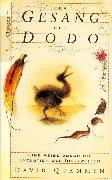
The Song of the Dodo
Island Biogeography in an Age of Extinctions
David Quammen uses islands—both literal and ecological—to explain how species originate, spread, persist, and disappear. Moving between evolutionary history, field reporting, scientific biography, and conservation debates, he traces island biogeography from the observations of nineteenth-century naturalists to the mathematical theories and reserve-design controversies of the twentieth century. Alfred Russel Wallace occupies a central place in this history, while later figures such as Robert MacArthur, Edward O. Wilson, Daniel Simberloff, and Jared Diamond show how island patterns became a framework for modern ecology. The book’s crucial shift is from oceanic islands to fragmented continents: forests, parks, and reserves surrounded by altered land can function as ecological islands. Their isolated populations become vulnerable to genetic decline, demographic accidents, invasive species, and habitat disruption. Expansive and cautionary, the book connects the intellectual history of evol…
Where to buy or borrow
Are you selling this book? Bookstores, publishers, authors and libraries can be listed here for free. Request a listing
About this book
Deep Overview
Quammen develops this double character of islands through the history of evolutionary thought. Charles Darwin is important, but the book gives unusual prominence to Alfred Russel Wallace, the naturalist whose work in the Malay Archipelago independently led him toward natural selection. Wallace’s observations of sharply changing animal distributions helped establish biogeography as evidence that species have histories tied to place. The boundary later called the Wallace Line becomes more than a mark on a map: it demonstrates that nearby regions can possess radically different faunas because of geological history, dispersal barriers, and evolution.
The narrative then moves toward twentieth-century efforts to turn island patterns into predictive theory. Robert MacArthur and Edward O. Wilson proposed that the number of species on an island could be understood through a changing balance between immigration and extinction. Larger islands generally support more species and larger populations; remote islands receive fewer colonists; and species composition can change even when total richness appears relatively stable. Quammen explains why this equilibrium theory became influential while also following experiments, objections, and arguments over how far its abstractions could be applied.
The conservation implications emerge when ecological isolation is no longer confined to land surrounded by water. Logging, agriculture, roads, settlement, and other transformations divide continuous habitats into remnants. A forest patch surrounded by farms or development may function like an island, with populations too small or disconnected to remain secure indefinitely. Quammen examines the problems associated with such fragmentation, including local extinction, inbreeding, disrupted ecological relationships, and the difficulty of recolonization.
This leads into debates about wildlife-reserve design, including whether conservation is better served by one large protected area or several smaller ones. The book does not reduce this dispute to a universal formula. Instead, it shows how scientific models, species-specific needs, political constraints, and incomplete evidence complicate apparently straightforward decisions.
Across accounts of the dodo, Komodo dragons, Madagascar’s distinctive fauna, island birds, primates, and threatened mainland populations, Quammen presents extinction as a process rather than merely a final event. A species may continue to exist while already trapped in a downward trajectory caused by small population size and ecological disconnection. The book’s broad argument is therefore about connectedness: protecting individual organisms or isolated parcels is often insufficient unless the larger relationships sustaining biological communities are also preserved.
Key Themes
• **Extinction as a gradual process:** Disappearance is often preceded by shrinking habitat, demographic instability, genetic problems, and the loss of ecological relationships.
• **The geography of evolution:** The distribution of organisms carries evidence about ancestry, dispersal, barriers, and geological history.
• **From islands to fragments:** Human alteration can transform continental habitats into isolated ecological patches that reproduce many vulnerabilities of oceanic islands.
• **Science as argument and revision:** Theories in the book emerge through travel, observation, mathematical modeling, experiments, rivalry, criticism, and correction.
• **Scale in conservation:** Decisions that seem effective for one species, reserve, or time horizon may fail when examined across a larger landscape or over many generations.
Historical and Scientific Context
Published in 1996, the book appeared when habitat fragmentation, minimum viable populations, reserve design, and biodiversity loss had become central conservation concerns. Its historical importance lies partly in showing general readers how a theory developed from oceanic islands could inform the management of forests, parks, and other habitat remnants.
Intended Audience
Readers seeking a brief introduction, a current technical survey, or a tightly linear argument may find the book’s length and digressive structure demanding. It is best approached as an extended intellectual journey rather than a concise handbook.
Reading Difficulty
Helpful Background Knowledge
Why Read This Book?
Reader Takeaways
Strengths
Limitations and Cautions
The narrative’s breadth also produces digressions and uneven pacing. Some readers may want more systematic comparison among theories than a travel-and-biography structure provides. Finally, island-biogeographic principles do not yield one automatic solution for every reserve or fragmented landscape; the needs of particular organisms and ecosystems remain decisive.
Important Concepts, People, Places, and Species
• **Alfred Russel Wallace:** A nineteenth-century naturalist and co-discoverer of natural selection whose fieldwork in the Malay Archipelago is central to the book’s history of biogeography.
• **Charles Darwin:** The naturalist whose theory of evolution by natural selection provides an essential intellectual foundation and a point of comparison with Wallace.
• **The Wallace Line:** A biogeographical boundary in the Indonesian region marking a striking transition between major animal communities; it illustrates the lasting effects of geological and dispersal barriers.
• **Robert H. MacArthur and Edward O. Wilson:** The scientists who formulated the equilibrium theory of island biogeography, relating species richness to immigration, extinction, area, and isolation.
• **Equilibrium theory:** A model proposing that an island’s number of species tends toward a dynamic balance, even though individual species may continue to arrive and disappear.
• **Species-area relationship:** The recurring pattern in which larger areas generally contain more species, with major implications for habitat loss and reserve design.
• **Habitat fragmentation:** The division of continuous habitat into smaller, separated patches, often producing ecological islands within altered landscapes.
• **Daniel Simberloff:** An ecologist associated with experimental tests of island-biogeographic theory and later debates about its conservation applications.
• **Jared Diamond:** A scientist whose work on island bird communities and reserve design forms part of the book’s discussion of applying biogeographical ideas to conservation.
• **SLOSS debate:** The dispute over whether one large reserve or several small reserves better protect biodiversity; Quammen uses it to expose the limits of universal design rules.
• **Mauritius and the dodo:** The island and extinct bird that symbolize the vulnerability of endemic species confronted by human disturbance and introduced organisms.
• **Madagascar:** A major example of prolonged isolation producing exceptional endemic diversity alongside severe conservation pressures.
• **Komodo dragon:** A distinctive island species used to explore survival, distribution, and the evolutionary consequences of isolation.
• **Extinction vortex:** A reinforcing sequence in which small populations become increasingly vulnerable to demographic accidents, genetic decline, and environmental disturbance.
• **Conservation corridors:** Connections among habitat patches that may permit movement, gene flow, and recolonization, reducing some dangers of isolation.
Questions the Book Explores
• What can the present distribution of organisms reveal about evolutionary and geological history?
• How do island size and distance from a source population affect species richness?
• When does a mainland habitat fragment begin to function like an island?
• Can mathematical models developed from islands guide the design of protected areas?
• How small can a population become before its continued existence is precarious?
• What is lost when conservation protects acreage without preserving ecological connections?
• How do personality, rivalry, field experience, and institutional authority influence scientific debate?
• What responsibilities follow from recognizing that human activity creates the conditions for extinction?
Reading Group Guide
Consider keeping two parallel timelines: one for the development of evolutionary and ecological ideas, and another for the species declines and conservation interventions described. This reveals the distance that can exist between scientific recognition and practical action.
Groups may also compare Wallace’s role with Darwin’s, examine the advantages and risks of explaining science through individual personalities, and map the movement from descriptive natural history to mathematical modeling. For the conservation sections, avoid treating the large-versus-small-reserve debate as a simple contest. Ask what information decision-makers would need about particular species, boundaries, corridors, and surrounding land uses before choosing a strategy.
Discussion Questions
2. What does the book gain by placing Alfred Russel Wallace near the center of its evolutionary history?
3. Which species account most effectively illustrates the relationship between rarity and extinction risk?
4. Does the equilibrium theory clarify ecological reality, oversimplify it, or do both at once?
5. How does the book distinguish a species that is rare but secure from one that is entering an extinction process?
6. When should conservationists rely on general theory, and when should species-specific evidence take priority?
7. What does the SLOSS debate reveal about the relationship between science and public policy?
8. How does Quammen’s presence as a traveling narrator affect the authority and accessibility of the science?
9. Which forms of habitat fragmentation are most visible in the places where group members live?
10. How might climate change alter the book’s account of islands, corridors, and protected areas?
11. Does the book ultimately offer hope, warning, or a mixture of the two?
12. What would a scientifically updated edition need to add or reconsider?
Sources and Verification
Comments
No published comments yet.
Available editions
Paperback
First Touchstone edition; paperback
- Publisher
- Scribner
- ISBN-13
- 9780684827124
- Publication date
- Pages
- 704