
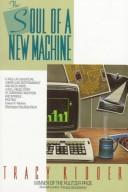
The Soul of a New Machine
Tracy Kidder’s The Soul of a New Machine follows a team of Data General engineers as they race to design and debug a new 32-bit minicomputer under intense competitive and organizational pressure. Rather than treating computer development as an abstract sequence of inventions, Kidder presents it as collective human labor shaped by ambition, rivalry, improvisation, exhaustion, management decisions, and technical judgment. The resulting work is both a history of the Eclipse MV/8000 and an enduring study of how demanding technological projects acquire momentum—and what they ask of the people who complete them.
Where to buy or borrow
Are you selling this book? Bookstores, publishers, authors and libraries can be listed here for free. Request a listing
About this book
The book occupies an important place in literary journalism because it makes highly specialized work intelligible without reducing engineering to a collection of simple breakthroughs. Its central drama comes from prolonged design, testing, debugging, and coordination rather than from a single moment of invention. Tom West, the project’s leader, emerges as a pivotal figure, but the narrative continually returns to the distributed nature of technical achievement: managers define constraints, senior engineers divide the architecture into workable problems, and less experienced team members undertake exacting implementation and diagnostic work.
The Soul of a New Machine also captures a transitional period in American computing. Data General had risen through the minicomputer market, beginning with the Nova, and faced pressure to move from 16-bit systems toward more powerful 32-bit machines. The book therefore connects a single development project to broader questions about corporate competition, compatibility, technological obsolescence, workplace culture, and the personal meaning engineers attach to difficult work.
Building Data General’s Eclipse MV/8000
Kidder structures this development process as a sustained human drama. Readers see the machine divided into components and problems, translated into logic, assembled, tested, and repeatedly diagnosed. Debugging is especially important because it reveals both the computer’s behavior and the team’s methods of thought. Failures are not merely obstacles in the plot: they are evidence that engineers must interpret.
The book’s subject is consequently larger than the physical computer. It investigates how a temporary community forms around a difficult goal, how leaders motivate people without always offering conventional rewards, and how technical workers come to regard completion itself as a source of meaning. The finished Eclipse MV/8000 matters, but Kidder gives equal attention to the culture that makes its construction possible.
Ambition, Engineering Culture, and the Cost of Innovation
The book also examines leadership through Tom West’s management of the Eagle project. West creates direction partly through distance, selective communication, competition, and a strong sense that the team is engaged in consequential work. His approach raises questions about the boundary between inspiration and manipulation.
Other recurring concerns include corporate rivalry, the tension between individual recognition and collective achievement, the invisibility of technical labor, and the rapid obsolescence of advanced products. A computer may be new when development begins and commercially vulnerable by the time it is finished. That pressure shapes both the design and the lives of the people creating it.
Data General and the Minicomputer Industry of the 1970s
By the late 1970s, computer manufacturers faced growing demand for more capable 32-bit systems. Data General needed a machine that could compete at a higher level while protecting customers’ investments in earlier software. Eagle, formally introduced as the Eclipse MV/8000 in 1980, emerged from that commercial and architectural problem.
The book appeared in 1981, the same year the IBM Personal Computer entered the market. Kidder’s story concerns minicomputers rather than the emerging personal-computer industry, but the timing makes the book a valuable record of a computing world organized around departmental systems, terminals, proprietary architectures, and corporate hardware families. It preserves a culture that would soon be transformed by personal computing, standardized platforms, networking, and new software businesses.
Who Should Read The Soul of a New Machine
No professional computing background is required. Kidder explains enough of the technical environment for general readers to understand why the problems matter, while keeping the narrative focused on people and decisions. Readers seeking a detailed technical manual for the Eclipse MV/8000, a comprehensive corporate history of Data General, or a broad history of the computer industry will find the scope narrower than those purposes require.
Technical Detail Without a Computer-Science Prerequisite
The larger challenge may be organizational rather than technical. The story moves among managers, architects, hardware designers, and diagnostic specialists, so keeping track of roles can require attention. The pacing alternates between contextual explanation, character study, workplace observation, and the incremental progress of the machine.
Useful Context Before Reading
It is also useful to understand that a minicomputer was not necessarily physically small by modern standards. The term identified a class of machines less costly and often more compact than mainframes, commonly used by businesses, laboratories, universities, and industrial organizations. Compatibility mattered because customers depended on existing programs and operational procedures; a new machine that could run older software offered commercial advantages.
Readers may also benefit from recognizing that debugging hardware resembles experimental investigation. Engineers create controlled tests, observe failures, form hypotheses, and progressively isolate defects. This process supplies much of the book’s suspense.
Why This Computing Classic Still Matters
The book is also valuable as a study of work. It asks why intelligent people accept exhausting conditions, how institutions benefit from professional devotion, and whether the satisfaction of solving a difficult problem compensates for limited control or recognition. These questions remain relevant in software development, scientific research, startups, aerospace, and other project-based fields.
Finally, Kidder shows how to write about technology without allowing machinery to displace human complexity. The computer remains technically consequential, yet the emotional center of the story lies in the team’s relationships with the project and with one another.
What Readers May Take Away from the Eagle Project
The book also encourages skepticism toward simple stories of heroic innovation. Tom West’s leadership matters, but so do the many engineers who translate broad objectives into functioning circuitry. Achievement is collective even when institutions and histories prefer a few recognizable protagonists.
Readers may further reconsider the relationship between motivation and exploitation. Meaningful work can inspire extraordinary effort, yet the promise of challenge and belonging can also encourage workers to accept conditions they would reject elsewhere. Kidder leaves that tension open rather than resolving it into a single moral judgment.
The Strength of Tracy Kidder’s Immersive Reporting
Its structure also creates suspense from a process whose outcome is historically known. The drama comes from uncertainty at the level of daily work: whether a defect can be isolated, whether separate components will function together, whether the schedule can be met, and whether the organization will continue to support the project.
Another strength is the balance between explanation and characterization. The book supplies enough technical information to establish real stakes while remaining attentive to ambition, humor, fatigue, rivalry, and professional identity. Its 1982 Pulitzer Prize for General Nonfiction reflects its standing as a major work of reported nonfiction, not merely as a specialist history of one computer.
Scope Boundaries and Perspectives to Keep in Mind
Its workplace is also socially narrow. The principal figures belong to a technical culture shaped by the demographics and employment structures of the American computer industry in the late 1970s. Readers interested in gender, race, labor policy, or the wider social consequences of computing will need supplementary histories.
The technical environment is historically specific. Minicomputer architecture and corporate computing markets have changed dramatically, so the book should not be treated as a guide to contemporary hardware development. Its enduring value lies more in its treatment of teams, organizations, and technical problem-solving than in the current applicability of particular technologies.
Tom West, Data General, Eagle, and Other Important Entities
**Tom West** leads the Eagle project and serves as the book’s most prominent managerial figure. His decisions shape the team’s organization, sense of urgency, and relationship to the larger company.
**Eagle** is the development code name for the computer that became the **Data General Eclipse MV/8000**. The project seeks to create a 32-bit system capable of competing in a changing market while maintaining compatibility with earlier Eclipse software.
**The Eclipse MV/8000** is the completed commercial machine at the center of the narrative. It belongs to Data General’s progression from the Nova through the Eclipse and MV product families.
**Digital Equipment Corporation**, commonly known as DEC, is an essential competitive presence in the historical background. Data General’s origins were connected to former DEC personnel, and competition in the minicomputer market helped shape the urgency surrounding new system development.
**Microcode** is a low-level control mechanism used to implement processor instructions. In the book, work at this level helps connect abstract architectural plans with the computer’s actual electronic behavior.
**Debugging** is the systematic process of identifying and correcting defects. Kidder treats it as both a technical practice and a way of thinking: engineers interpret symptoms, design tests, and narrow uncertainty until a failure becomes understandable.
**Backward compatibility** allows a newer computer to retain a useful relationship with programs written for an older system. For Data General, compatibility was not merely a design preference; it was tied to customer investment and commercial survival.
Questions About Leadership, Labor, and Technological Progress
The book also asks who deserves credit for a complex invention. Is a computer principally the achievement of the leader who defines the project, the architects who determine its structure, or the engineers who implement and debug its components? How should recognition be distributed when no single participant understands or constructs the entire system?
At the organizational level, Kidder raises questions about whether innovation thrives because of corporate structures or in spite of them. Internal rivalry can supply urgency, but it can also waste resources and isolate teams. The Eagle project invites readers to consider whether competition is a productive design tool, a managerial strategy, or an avoidable source of stress.
A Reading-Group Approach to The Soul of a New Machine
During the middle chapters, readers can track moments when the team’s commitment deepens. Discuss whether motivation comes from the work itself, peer loyalty, competition, managerial pressure, or fear of failure. Groups with members from technical workplaces may compare the book’s culture with contemporary experiences while avoiding the assumption that all engineering organizations operate alike.
After finishing, return to the title. Consider where the machine’s metaphorical “soul” resides: in its architecture, in the accumulated labor of its builders, in the culture surrounding the project, or in the story Kidder constructs from their work. A companion session on the history of minicomputers and the rise of personal computing can help place the project in a larger technological transition.
Discussion Questions
2. What does Tom West understand about motivation, and where might his leadership methods become ethically troubling?
3. Why do the engineers accept the project’s demands? Which motivations appear intrinsic, and which are produced by the organization?
4. Does the book treat the Eagle team as heroic, exploited, or both? What evidence supports each interpretation?
5. How does internal competition within Data General help the project, and how does it obstruct rational decision-making?
6. What does debugging reveal about the relationship between creativity and disciplined procedure?
7. How does backward compatibility connect technical architecture to business strategy and customer dependence?
8. Whose work receives the most attention in the narrative, and whose contribution remains peripheral or invisible?
9. In what ways does the minicomputer workplace resemble modern software companies, research laboratories, or startups? Where does the comparison break down?
10. What is the “soul” of the new machine, and does the book ultimately locate it in the computer or in its builders?
Sources and Edition Verification
The first edition is consistently recorded as a 1981 Little, Brown hardcover of 293 pages, issued as an Atlantic Monthly Press book. Some secondary records specify July 1981, but the profile retains the year alone because a precise day was not established through the strongest edition-level sources consulted.
Comments
No published comments yet.
Available editions
Hardcover
First edition, hardcover
- Publisher
- Little, Brown and Company
- ISBN-13
- 9780316491709
- Pages
- 293