
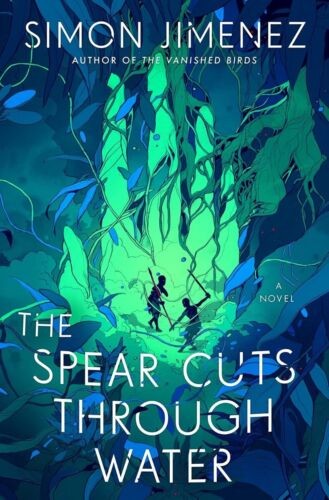
The Spear Cuts Through Water
A Novel
In a country ruled by the Moon Throne, divine power has become an instrument of dynastic terror. Jun, a prince and former enforcer burdened by what he has done, helps the imprisoned Moon goddess escape. Their flight joins him with Keema, a one-armed warrior bound by an oath to carry out a dead man’s mission. Together, the two men must escort the dying goddess across a ravaged landscape while the emperor’s fearsome sons pursue them. The five-day journey supplies the momentum of an epic quest, but Simon Jimenez places it inside a more unusual structure: an unnamed descendant dreams himself into the Inverted Theater, where ancestral history is performed by dancers and interrupted by the voices of the dead. The resulting novel is simultaneously an adventure, a love story, and an inquiry into inherited violence, migration, cultural memory, and the power of retelling the past.
Where to buy or borrow
Are you selling this book? Bookstores, publishers, authors and libraries can be listed here for free. Request a listing
About this book
The book’s form is inseparable from its subject. A descendant raised on a grandmother’s stories encounters the old country as both inherited memory and staged performance, so history is never presented as a neutral record. The narrative instead asks who is remembered, who gets reduced to scenery, and how a community carries its past after displacement. Jimenez described the work as a self-contained epic rather than the opening of a series. Its combination of mythic scale, queer romance, theatrical framing, and typographical experimentation distinguishes it from more conventionally narrated quest fantasy.
Deep Overview
Jun occupies the most compromised position in this order. He is both a victim of his father, the First Terror, and a former participant in the regime’s atrocities. Freeing the goddess begins a rebellion, but it cannot erase his history. His journey therefore involves more than switching allegiances. He must face guilt, learned brutality, and the fear that violence has become his deepest inheritance.
Keema enters the quest from outside the royal family. A one-armed fighter regarded as unfortunate by others, he has promised to complete a fallen companion’s mission. His oath links personal loyalty to the wider struggle against the empire. He also provides a counterweight to Jun: where Jun knows the ruling house from within, Keema understands exclusion and precarity. Their uneasy partnership gradually becomes intimate, making tenderness an active challenge to the masculine and dynastic violence surrounding them.
The dying goddess they escort is neither a simple prize nor an uncomplicated moral authority. She is a mother fleeing the descendants who have confined and consumed her power, but she also belongs to an ancient cycle of desire, parenthood, grievance, and punishment. Gods, rulers, and ordinary people remain entangled in the consequences of choices made generations earlier. The quest toward the sea thus carries several meanings at once: escape, burial, restoration, revolution, and the attempted repair of a broken relationship between Moon, Water, and land.
A second-person frame transforms this adventure into an inherited story. An unnamed descendant, whose family left the old country, dreams of entering the Inverted Theater. There, an otherworldly performance presents Jun and Keema’s journey. Voices from the dead interrupt the main account, granting momentary presence to people whom a heroic chronicle might otherwise ignore. These shifts make the reader experience history as collective testimony rather than a clean sequence controlled by one narrator.
The novel ultimately joins political liberation to the preservation and transformation of memory. Overthrowing tyrants matters, but so does determining what survives after the battle: an heirloom, a family story, a dance, a wound, or a version of love that later generations can recognize. The epic’s emotional force arises from this connection between enormous mythic events and the intimate act of listening to an elder recount a lost homeland.
Key Themes
**Cycles of power and violence:** Divine gifts pass through a royal bloodline alongside abuse, fear, and entitlement. Jun’s dilemma is whether inheritance determines conduct or can be interrupted through accountability and choice.
**Love against possession:** The novel contrasts care, oath, and mutual recognition with relationships based on captivity, domination, and ownership. Romance does not stand outside political violence; it develops in resistance to its habits.
**The many voices of history:** Soldiers, servants, victims, spirits, and bystanders intrude upon the central narrative. Their presence resists the tendency of epics to turn ordinary deaths into anonymous background.
**Exile and belonging:** The old country survives through memories, heirlooms, language, and ritual. The descendant’s connection to it is emotionally real even though it is indirect and partly reconstructed.
**Mortality and divinity:** Gods possess extraordinary power but remain vulnerable to grief, confinement, bodily decline, and familial conflict. Divinity enlarges human dilemmas rather than resolving them.
Literary and Cultural Context
The interventions of dead and minor characters resemble a dramatic chorus: collective voices comment on events, reveal unseen costs, and challenge the idea that history belongs exclusively to rulers and heroes. The second-person descendant and the grandmother’s stories add the perspective of diaspora, in which a homeland is encountered through recollection, family ritual, and inherited objects. These elements place the book within contemporary literary fantasy that revises epic forms by centering displaced families, queer attachment, damaged heroes, and the people traditional chronicles leave unnamed.
Intended Audience
It is less suitable for anyone seeking transparent prose, a single stable point of view, a lightly violent adventure, or an encyclopedic explanation of the world’s magic and politics. The romance is important, but the book is not structured primarily around romance conventions. Readers should also expect graphic cruelty, bodily harm, warfare, parental abuse, captivity, grief, and trauma.
Reading Difficulty
Early disorientation is intentional. A reader may need time to understand who “you” are, how the theater relates to Jun and Keema’s journey, and why apparently peripheral voices interrupt a scene. The action can be fast and visceral, yet reflective passages slow the pace to consider memory, grief, and intimacy. The print or ebook edition may make the visual organization easier to track than audio alone, although an audiobook edition is available.
Helpful Background Knowledge
Readers do not need specialist knowledge of mythology or Asian history. More useful preparation is an awareness of how oral stories change across generations and how migrant families may preserve a homeland through family anecdotes, keepsakes, names, and ceremonies. Keeping track of the Moon, Water, the emperor, the Three Terrors, Jun, Keema, and the descendant in the theater is sufficient for the opening sections.
Why Read This Book?
Its most distinctive achievement is the way a private family inheritance becomes part of a civilization’s founding legend. Readers willing to accept temporary uncertainty are rewarded with accumulating connections among the spear, the theater, the old country, and the love developing between two men trained to survive violence.
Reader Takeaways
The book also encourages reflection on inheritance. A person can receive trauma, privilege, shame, duty, culture, and love from the same family or homeland. What is inherited matters, but so does what is refused, repaired, or passed onward in altered form. Finally, Jun and Keema’s relationship presents tenderness as a demanding ethical practice: love requires seeing another person beyond usefulness, lineage, reputation, or guilt.
Strengths
Jimenez also balances large-scale fantasy with intimate characterization. The conflict includes gods, imperial succession, ecological imbalance, and rebellion, yet its emotional center remains two wounded young men learning trust. Minor figures often receive enough interior presence to prevent violence from becoming faceless spectacle. The self-contained design gives the work the scope of an epic without withholding its central resolution for later volumes.
Limitations and Reader Considerations
The novel is also intensely violent. Its insistence on acknowledging the experience of victims gives many deaths moral weight, but the cumulative brutality may feel overwhelming or repetitive. The lyrical and reflective passages can interrupt the momentum of the chase, while the rapid five-day plot leaves certain places and supporting characters less fully developed than the central relationship and narrative frame.
Important Concepts, People, Places, and Powers
**Keema:** A one-armed warrior undertaking another man’s unfinished mission. His oath draws him into the goddess’s pilgrimage, and his developing bond with Jun becomes the story’s human center.
**The Moon goddess:** The imprisoned source of the dynasty’s supernatural inheritance. Her escape destabilizes both the empire and the damaged cosmic relationship between Moon and Water.
**The Water:** The Moon’s divine counterpart, whose grief has consequences for the land. Water represents love on a scale that can nourish, punish, remember, and overwhelm.
**The emperor and the Three Terrors:** The ruling family’s central instruments of oppression. Their god-gifts convert private family dysfunction into public catastrophe.
**The Moon Throne:** Both the imperial dynasty and the political order built from captive sacred power. It links monarchy, inherited authority, and exploitation.
**The Inverted Theater:** A dreamlike venue where people across time encounter consequential stories as performance. It connects ancestral legend to the descendant who receives it.
**The unnamed descendant and Lola:** The second-person descendant experiences the old country largely through stories told by a grandmother, Lola. Their relationship shows how memory crosses migration and generational distance.
**The voices of the dead:** Brief testimonies that interrupt the heroic narrative. They restore individuality to people who might otherwise appear only as casualties or background figures.
**The spear:** An oath-bearing weapon, family heirloom, and bridge between narrative levels. Its changing significance reveals how material objects can carry cultural memory.
Questions the Novel Explores
When does family inheritance become destiny, and what is required to break that pattern?
Who owns a story once it has passed through witnesses, performers, migrants, and descendants?
Can love remain protective without becoming possessive?
What does an epic lose when it remembers heroes but not the people who died around them?
How do displaced families maintain a meaningful relationship with a homeland transformed by time and retelling?
Can political liberation repair damage that is also familial, spiritual, and ecological?
Reading Group Guide
Track three forms of inheritance: the royal family’s god-gifts, Jun’s legacy of violence, and the descendant’s spear and family stories. Comparing them opens a discussion about inheritance as burden, privilege, responsibility, and creative possibility.
Groups may also compare the Moon–Water relationship with Jun and Keema’s bond. Both connect love to separation and sacrifice, but they differ sharply in scale and power. Finally, select several interruptions by minor or dead characters and consider what each one contributes that the main viewpoint could not.
Discussion Questions
2. What obligations does Jun retain toward the victims of the regime after he turns against it?
3. How does Keema’s oath change in meaning as the journey proceeds?
4. Why does the novel give momentary narrative authority to witnesses, victims, and minor figures?
5. Where does the book draw the line between love and possession?
6. How do disability, exile, and social exclusion shape Keema without wholly defining him?
7. What does the Moon’s captivity suggest about political systems that claim sacred authority?
8. How does the five-day time frame affect the development of Jun and Keema’s relationship?
9. What is gained by addressing the descendant—and indirectly the reader—as “you”?
10. Which forms of inheritance are rejected, and which are deliberately preserved?
11. How does the spear’s significance change across the book’s narrative layers?
12. Does the novel ultimately treat storytelling as preservation, transformation, intervention, or all three?
Sources and Verification
Comments
No published comments yet.
Available editions
Hardcover
First U.S. edition; hardcover
- Publisher
- Del Rey
- ISBN-13
- 9780593156599
- Publication date
- Pages
- 522