
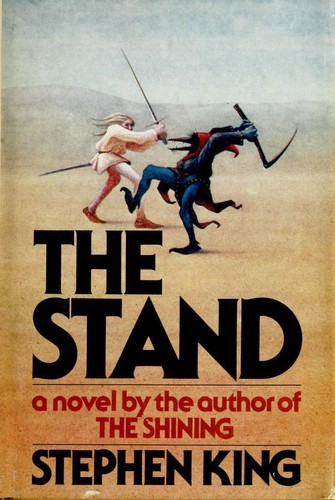
The Stand
After a lethal, laboratory-created influenza escapes military containment, the United States collapses with terrifying speed. The scattered survivors must first endure bereavement, isolation, and the hazards of an abandoned country; then shared dreams begin drawing them toward rival communities. In Boulder, Mother Abagail inspires an uncertain experiment in cooperation. In Las Vegas, Randall Flagg builds an authoritarian order based on fear and force. Following characters such as Stu Redman, Frannie Goldsmith, Larry Underwood, Nick Andros, and Harold Lauder, Stephen King combines plague narrative, road novel, social reconstruction, and supernatural conflict. The result is an expansive examination of what remains when institutions disappear—and how ordinary choices can become moral commitments.
Where to buy or borrow
Are you selling this book? Bookstores, publishers, authors and libraries can be listed here for free. Request a listing
About this book
The profiled Signet edition contains the original published version of the novel. Readers should distinguish it from The Stand: The Complete & Uncut Edition, issued in 1990, which restored substantial material and revised the story's period setting. The earlier text is comparatively compressed, although still lengthy. What distinguishes the book within disaster fiction is its refusal to stop at survival: the central drama becomes the moral and political character of whatever replaces the fallen world.
Deep Overview
The immune survivors inherit more than empty cities. They carry guilt, habits, resentments, ambitions, and unresolved identities from the former world. Stuart “Stu” Redman becomes a practical center of steadiness. Frannie Goldsmith faces pregnancy, grief, and the need to define a future rather than merely endure the present. Larry Underwood struggles against his history of selfishness. Nick Andros, deaf and unable to speak, develops into an observant organizer. Harold Lauder possesses intelligence and useful skills but interprets humiliation as an injury the world owes him repayment for. Their journeys make the catastrophe a test of character without reducing anyone to a simple moral label.
Dreams gradually divide the survivors. Some are drawn toward Mother Abagail, an elderly spiritual figure associated with humility, community, and an uneasy sense of divine purpose. Others gravitate toward Randall Flagg, whose charisma, supernatural menace, and command of fear promise discipline and power. These attractions lead to two contrasting settlements: the Boulder Free Zone and Flagg's Las Vegas regime.
Boulder is not presented as effortless goodness. Its members must restore electricity, bury the dead, create committees, negotiate authority, and decide how much of the former United States they should reproduce. The practical work matters because King treats democracy as an activity, not a label. Las Vegas, by contrast, becomes efficient through surveillance, punishment, hierarchy, and shared fear. Flagg offers people a clear place within a system, but that clarity depends upon obedience.
The later conflict therefore concerns more than defeating a villain. It asks whether decent institutions can be built by damaged people, whether sacrifice has meaning without certainty, and whether evil's apparent strength conceals instability. The supernatural framework gives these questions biblical weight, while the ensemble storytelling keeps them grounded in jealousy, friendship, work, love, and fear. This Signet edition presents that design in its original published, more compressed form rather than the expanded 1990 text.
Key Themes
- **Freedom versus authoritarian efficiency:** Boulder struggles through argument and imperfect participation; Las Vegas achieves coordination by making fear the basis of government.
- **Moral choice under pressure:** The survivors are shaped less by immunity than by what they do with survival. Courage, resentment, loyalty, and self-deception accumulate through decisions.
- **Community and belonging:** Both camps answer loneliness. The novel asks why people accept particular leaders and what they will surrender to feel useful or protected.
- **Faith, doubt, and providence:** Dreams and apparent supernatural interventions suggest a spiritual design, yet characters must act without complete explanations.
- **The persistence of the old world:** Prejudice, status anxiety, bureaucracy, weapons, and personal grievance survive the plague even when formal institutions do not.
- **Redemption and corruption:** Several arcs examine whether people can outgrow earlier failures, while others show grievance hardening into betrayal.
Historical Context
The book also belongs to a long tradition of plague and last-people narratives, but its geography and cultural vocabulary are distinctly American. Highways, small towns, consumer goods, popular music, and mass communication become the remains through which survivors move. Its opposing settlements reflect a recurring political tension of the period: participatory government may be slow and disorderly, while authoritarian rule can advertise itself as decisive and efficient.
The profiled 1980 paperback preserves the original published text. In 1990 King issued a Complete and Uncut Edition that restored extensive material and updated the time setting. Readers comparing copies should therefore expect meaningful differences in length, characterization, episodes, and period references.
Intended Audience
It is less suitable for anyone seeking a brief thriller, a strictly realistic pandemic narrative, or consistently subtle symbolism. Readers sensitive to epidemic death, mass casualties, cruelty, sexual coercion, racism, ableist treatment, animal peril, or religiously framed conflict should approach with care. Those wanting King's fullest authorized version should choose the 1990 Complete and Uncut Edition rather than this ISBN.
Reading Difficulty
No specialist knowledge is required. The main challenge is scale rather than vocabulary. The supernatural imagery is accessible, though its biblical and political resonances reward slower reading. The mass-market format of this edition may also be physically demanding because a very long narrative is set in a compact paperback.
Helpful Background Knowledge
A basic familiarity with Cold War concerns—biological weapons, nuclear arsenals, classified military programs, and distrust of federal authority—clarifies the novel's anxieties. General knowledge of biblical apocalypse, prophetic dreams, temptation, pilgrimage, and sacrifice can enrich interpretation, but it is not necessary for following the story. It also helps to approach the plague as a fictional mechanism for social and moral inquiry rather than as a scientifically rigorous model of epidemiology.
Why Read This Book?
The book is particularly valuable for the way it links private character development to public life. Rebuilding electricity or forming a committee becomes as revealing as confronting supernatural danger. King's wide cast also permits unusual comparisons: leadership rooted in service versus leadership rooted in fear, repentance versus grievance, and democratic frustration versus imposed order. Few disaster novels devote this much attention to the question that begins after immediate survival: what kind of society should come next?
Reader Takeaways
Readers may also reconsider heroism as something cumulative. Many important choices involve accepting responsibility, doing necessary work, telling an unwelcome truth, or moving forward without assurance of success. Finally, the novel suggests that rebuilding does not erase the moral failures of the previous order; survivors must decide which habits and institutions deserve restoration and which should end with the ruined world.
Strengths
- **Convincing collapse through detail:** The opening gains force from its attention to transmission, rumor, failed containment, and the disappearance of ordinary services.
- **Integration of character and politics:** Personal flaws have institutional consequences; public systems, in turn, intensify or redirect private conflicts.
- **Strong geographical movement:** Cross-country travel gives the novel physical breadth and turns the American landscape into both graveyard and possibility.
- **Sustained moral contrast:** Boulder and Las Vegas provide a clear structure for examining leadership, consent, responsibility, and fear.
- **Readable narrative voice:** Despite the scale, King's accessible prose and scene-level suspense keep the story moving.
Limitations and Cautions
The epidemiology and logistics should not be treated as technical forecasting. The novel favors narrative speed and moral symbolism over scientific precision. Its treatment of women and sexuality is uneven, and certain plot developments involve coercion or reduce characters to functions within male-centered conflicts.
Readers should also note an edition limitation: this paperback contains the original shortened publication text. It lacks episodes and characterization restored in 1990. Conversely, some readers may prefer its tighter pace. Content cautions include graphic mass death, illness, suicide, murder, sexual violence or coercion, racism, ableism, and harm involving animals.
Important Concepts, People, and Places
- **Project Blue:** The concealed biological-warfare program associated with the plague's creation and failed containment.
- **Stuart “Stu” Redman:** A pragmatic, emotionally steady survivor whose leadership grows from reliability rather than a desire for command.
- **Frances “Frannie” Goldsmith:** A pregnant young woman whose future-oriented decisions connect personal continuity with the larger question of human renewal.
- **Larry Underwood:** A musician forced to confront his selfishness; his arc makes moral growth an ongoing practice rather than a sudden conversion.
- **Nick Andros:** A deaf, nonspeaking survivor and gifted observer who becomes central to the organization of the emerging community.
- **Harold Lauder:** An intelligent but embittered outsider whose craving for recognition demonstrates how grievance can be cultivated into treachery.
- **Mother Abagail Freemantle:** The spiritual center drawing survivors toward communal responsibility, humility, and Boulder.
- **Randall Flagg:** The supernatural “Dark Man” who attracts frightened or power-seeking survivors and converts their needs into authoritarian loyalty.
- **Tom Cullen:** A cognitively disabled survivor whose loyalty and underestimated capacities become important to the community.
- **Glen Bateman:** A sociologist whose reflections help the survivors interpret the collapse and the political forms replacing it.
- **Trashcan Man:** A destructive figure obsessed with fire and weapons; his devotion reveals both the appeal and instability of Flagg's order.
- **Boulder Free Zone:** The Colorado settlement where survivors attempt democratic reconstruction through practical work and civic institutions.
- **Las Vegas:** Flagg's western stronghold, organized through discipline, surveillance, punishment, and preparations for conflict.
- **Shared dreams:** The supernatural summons that reorganizes scattered survival into a choice between rival moral and political communities.
Questions the Book Explores
- Why might frightened people prefer authoritarian certainty to democratic disagreement?
- Can people escape identities and failures formed before catastrophe?
- When does resentment become a moral choice rather than an involuntary wound?
- Is leadership best understood as charisma, competence, service, spiritual authority, or control?
- How can a community defend itself without reproducing the coercion it opposes?
- What does faith demand when providence remains uncertain and suffering appears arbitrary?
- Are good and evil external powers, patterns within human behavior, or both?
- Which institutions from a destroyed civilization deserve to be rebuilt?
- Can sacrifice retain meaning when those making it cannot know the outcome?
Reading Group Guide
Compare the two settlements using concrete categories: labor, law, punishment, leadership, communication, dissent, and treatment of vulnerable people. This keeps the discussion from reducing them to abstract “good” and “evil.” Groups can also map moments when old-world assumptions return even though old institutions have vanished.
Because editions differ, confirm that everyone is reading the original text or agree that comparisons with the Complete and Uncut Edition are welcome. If both versions are represented, focus on how restored material changes pacing or characterization rather than treating differences as errors. Content-heavy meetings may benefit from agreeing in advance how to discuss race, disability, sexual coercion, and religious symbolism respectfully.
Discussion Questions
2. How does King distinguish surviving physically from becoming worthy of survival?
3. Which character changes most convincingly, and what makes that change believable?
4. Why do the dreams succeed in giving direction to people who otherwise share little?
5. What does Boulder's committee work reveal about the burdens of democratic government?
6. Why is Flagg's Las Vegas attractive to some survivors beyond simple fear or wickedness?
7. At what points might Harold have chosen a different path?
8. How does Frannie's pregnancy shape the novel's treatment of hope, obligation, and the future?
9. Does the supernatural conflict deepen the social themes or simplify them?
10. How does the book portray the relationship between competence and moral character?
11. Which features of the former United States do the survivors restore too readily?
12. How should contemporary readers assess Mother Abagail's symbolic role and racial representation?
13. Where does the story locate evil: in individuals, institutions, supernatural forces, or group behavior?
14. Does the ending support faith in human renewal, or does it leave renewal fundamentally uncertain?
15. How might reading the shorter original edition alter one's judgment of the novel's pace and emphasis?
Sources and Verification
The sources disagree substantially about pagination for this ISBN, so no page count is asserted. Available records provide only the year 1980 rather than a reliable exact day, and the publication-date field therefore remains blank. The profile distinguishes this original shortened text from the separately published Complete and Uncut Edition of 1990. The interpretive sections are original editorial analysis based on the novel's established characters, settings, structure, and historical position.
Comments
No published comments yet.
Available editions
Paperback
1980 Signet mass-market paperback; original abridged text
- Publisher
- Signet
- ISBN-13
- 9780451139719