
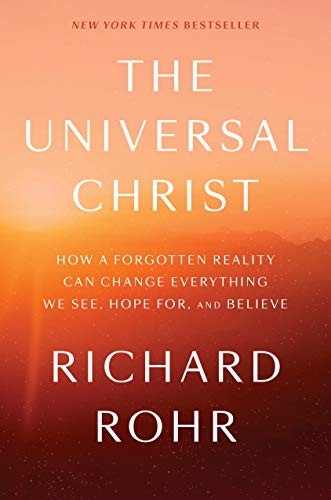
The Universal Christ
How a Forgotten Reality Can Change Everything We See, Hope For, and Believe
In The Universal Christ, Franciscan teacher Richard Rohr distinguishes Jesus of Nazareth, a historical person, from “Christ,” which he understands as God's presence disclosed throughout creation. Jesus does not become less important in this account; rather, Rohr presents him as the concrete, personal revelation of a divine reality that precedes and exceeds one life in history. Drawing on biblical texts, Christian mysticism, Franciscan spirituality, theology, psychology, and reflections on nature and suffering, the book asks readers to recognize the sacred in matter, other people, and ordinary experience. Rohr connects this incarnational vision with contemplation, compassion, inclusion, and a less punitive understanding of salvation. The result is an accessible work of constructive Christian theology that challenges sharply divided categories such as sacred and secular, spirit and matter, insider and outsider. Its interpretation is intentionally expansive and differs from some conventi…
Where to buy or borrow
Are you selling this book? Bookstores, publishers, authors and libraries can be listed here for free. Request a listing
About this book
Deep Overview
This distinction supports the book's larger claim that incarnation is not an isolated divine intervention in an otherwise godless universe. Creation itself is already revelatory. Matter can bear divine presence, and the particular can disclose the universal. Rohr therefore treats the life of Jesus as the decisive manifestation of a pattern that has always been active: divine self-giving expressed through embodiment, vulnerability, suffering, death, and transformation. Resurrection, in this framework, reveals that this pattern cannot finally be defeated by death.
The argument draws especially on New Testament passages associated with Paul and the Gospel of John, where Christ is described in cosmic terms. Rohr places these texts beside sacramental Christianity, early Christian reflection, Franciscan spirituality, and the testimony of mystics. Saint Francis of Assisi and the Franciscan theological tradition matter because they support an affirmative view of creation rather than treating the physical world merely as an obstacle to spiritual life. Rohr also invokes modern contemplatives and thinkers—including Thomas Merton, Caryll Houselander, Etty Hillesum, Carl Jung, and Pierre Teilhard de Chardin—to illustrate ways people have perceived unity, sacred presence, and transformation amid ordinary life or suffering.
The theological vision carries ethical consequences. If divine presence is not restricted to approved people and places, contempt becomes harder to justify. Rohr links the Universal Christ with solidarity across religious, social, racial, and ecological divisions. Contemplation is thus not presented as withdrawal but as training in how to see: the reader is asked to encounter people, animals, the earth, pain, and even personal failure without immediately dividing reality into worthy and unworthy parts.
The later movement of the book reconsiders salvation and atonement. Rohr resists accounts centered primarily on appeasing an offended God through punishment. He emphasizes restoration, participation, forgiveness, and awakening to a union that divine love has already made possible. This is among the book's most consequential and disputed moves. The Universal Christ ultimately proposes that Christian belief should produce a transformed way of perceiving and inhabiting the world, not merely agreement with propositions about Jesus.
Key Themes
• **Incarnation as an ongoing reality:** Divine presence is understood as permeating creation rather than appearing only at one moment in human history.
• **The sacredness of matter:** Bodies, nature, ordinary objects, and physical existence can communicate grace; spirit is not presented as the enemy of matter.
• **Nondual perception:** The book challenges reflexive either-or thinking, especially divisions between sacred and secular, divine and human, or insider and outsider.
• **Love as participation:** Faith is measured less by boundary maintenance than by growing participation in a divine pattern of self-giving love.
• **Suffering and transformation:** The cross and resurrection express a recurring movement through loss toward renewed life, without treating suffering itself as desirable.
• **Restorative salvation:** Rohr favors healing, reconciliation, and transformation over a primarily punitive account of divine justice.
• **Contemplation and action:** Spiritual practice is meant to reshape perception and thereby alter relationships, community, and engagement with the world.
Historical and Theological Context
Rohr's specifically Franciscan inheritance is equally important. Saint Francis of Assisi is associated with reverence for creation, while later Franciscan theology—especially that of John Duns Scotus—gave the incarnation a central place in God's purpose for creation, not merely as an emergency response to human sin. Rohr combines this inheritance with modern Christian mysticism and contemplative thought. His approach also belongs to contemporary efforts to address ecological crisis, religious exclusion, and dissatisfaction with punitive presentations of Christianity through a more creation-affirming theology.
Intended Audience
Readers seeking a systematic academic Christology, close historical-critical exegesis, or a detailed defense of every theological step may find the method too associative. Christians committed to penal substitution, strict exclusivism, or sharply defined traditional formulations should expect substantial disagreement. Non-Christian readers can follow the central argument, but its vocabulary, scriptural framework, and principal conversation remain Christian.
Reading Difficulty
Rohr moves quickly among scripture, theology, psychology, mystical testimony, and personal reflection. This makes the book inviting but also requires readers to distinguish illustrative parallels from sustained historical or textual arguments. A slow pace, occasional rereading, and brief notes on changing definitions will be more useful than trying to absorb the book as a linear textbook.
Helpful Background Knowledge
A basic awareness of Franciscan spirituality can clarify Rohr's positive approach to creation. Knowing that “Christology” means theological reflection on the identity and significance of Jesus Christ will also make it easier to locate the book within a larger Christian conversation.
Why Read This Book?
It is also useful as an introduction to a prominent stream of contemporary contemplative Christianity. Whether readers accept Rohr's conclusions or challenge them, the book provides a clear occasion to examine assumptions about who belongs, where God may be encountered, and whether salvation is principally legal acquittal, moral improvement, restored relationship, awakened perception, or participation in divine life.
Reader Takeaways
Readers may also acquire a vocabulary for comparing punitive and restorative accounts of salvation, individual and communal approaches to faith, and dualistic and nondual habits of perception. Even where Rohr does not persuade, he makes visible the interpretive choices hidden inside familiar Christian language.
Strengths
The work is particularly strong at showing how doctrine shapes perception. Ideas about incarnation become questions about how readers regard matter, difference, suffering, and belonging. Rohr also draws together biblical motifs and the Christian mystical tradition in language accessible to nonspecialists. The reflective structure and available companion material make the book well suited to deliberate group discussion rather than passive consumption.
Limitations and Cautions
Its key terms can also be elastic. “Christ,” “incarnation,” “nonduality,” and “salvation” sometimes function across several theological and experiential registers, which creates resonance but can reduce precision. The book's critique of punitive atonement and religious exclusivism is central rather than incidental, and some readers will judge these revisions incompatible with their traditions. Conversely, readers wanting a fully developed interreligious theology may find that the book remains strongly Christian even while making universal claims.
Important Concepts and People
• **The Universal or Cosmic Christ:** Rohr's name for the eternal divine presence and pattern manifested in creation and decisively revealed in Jesus.
• **Incarnation:** More than a single event in Rohr's account; it is the divine self-expression in material reality, culminating personally in Jesus.
• **Nondual consciousness:** A contemplative way of perceiving that can hold distinction without turning difference into absolute separation or opposition.
• **Panentheism:** The view that everything exists in God while God is more than everything. It helps distinguish Rohr's position from pantheism, which identifies God and the universe without remainder.
• **Saint Francis of Assisi:** The founder of the Franciscan movement and an important model for Rohr's reverence toward creation, poverty, and embodied discipleship.
• **John Duns Scotus:** A medieval Franciscan theologian whose incarnation-centered theology helps frame creation as intended for union with God, not merely repaired after sin.
• **Paul the Apostle:** A major scriptural source for the book's language of Christ's cosmic scope and the communal “body of Christ.”
• **The Gospel of John:** Its Logos theology gives Rohr a biblical framework for divine presence active from the beginning of creation.
• **Thomas Merton:** A twentieth-century Trappist writer whose contemplative spirituality and insight into shared human belonging align with Rohr's project.
• **Caryll Houselander:** An English Catholic mystic whose perception of Christ in ordinary people illustrates the transformation of vision that Rohr advocates.
• **Pierre Teilhard de Chardin:** A Jesuit thinker who related Christian theology to evolution and cosmic development; his vision belongs to the modern background of cosmic Christology.
• **Carl Gustav Jung:** A psychologist whose language of archetype, wholeness, and integration supplies Rohr with interpretive parallels, though the book is not a work of clinical psychology.
• **Center for Action and Contemplation:** The educational nonprofit founded by Rohr, whose teaching mission joins contemplative transformation with compassionate engagement.
Questions the Book Explores
• Can the incarnation be understood as revealing something about all creation rather than only one exceptional event?
• How can Jesus remain uniquely important within a theology that recognizes divine presence everywhere?
• What happens to Christian ethics when matter, bodies, animals, and ecosystems are treated as capable of bearing sacred presence?
• Does salvation primarily concern punishment and acquittal, or healing, participation, and restored relationship?
• How do dualistic habits of thought sustain exclusion, contempt, and religious tribalism?
• Can contemplation change social behavior by changing how people perceive one another?
• How should Christianity speak universally without erasing the historical particularity and Jewish identity of Jesus?
Reading Group Guide
Track four recurring lines of inquiry: creation and matter; suffering and resurrection; salvation and atonement; contemplation and ethical action. Groups can assign members to follow one thread and report how it develops. Give special attention to places where Rohr moves from a scriptural claim to a spiritual or social implication: is the connection compelling, suggestive, or insufficiently argued?
Discussion will be more productive if participants distinguish three responses: what they find spiritually resonant, what they consider historically or theologically persuasive, and what they might practice. Compare Rohr's claims with relevant biblical passages rather than debating them only from memory. End each session with a concrete observation exercise—identifying where the group found dignity, beauty, suffering, or connection in ordinary life—so that the discussion tests the book's concern with perception as well as ideas.
Discussion Questions
2. Does Rohr successfully preserve the importance of Jesus while extending Christ's presence throughout creation?
3. Which biblical passages seem to support his cosmic Christology most strongly? Which passages complicate it?
4. How does the book alter, confirm, or challenge your understanding of incarnation?
5. What practical consequences follow from regarding matter and creation as bearers of divine presence?
6. When does nondual thinking deepen moral discernment, and when might clear either-or judgments remain necessary?
7. How does Rohr's account of salvation differ from the one you previously knew?
8. Is his criticism of punitive atonement persuasive? Why or why not?
9. Which person or tradition cited by Rohr most effectively illuminates his argument?
10. Where does the book rely more on evocative association than demonstrated argument?
11. How might the Universal Christ vision influence responses to religious difference, social exclusion, or ecological harm?
12. What practice, relationship, or institution would look different if the book's central claim were taken seriously?
Sources and Verification
Comments
No published comments yet.
Available editions
Hardcover
First U.S. edition; hardcover
- Publisher
- Convergent Books
- ISBN-13
- 9781524762094
- Publication date
- Pages
- 272