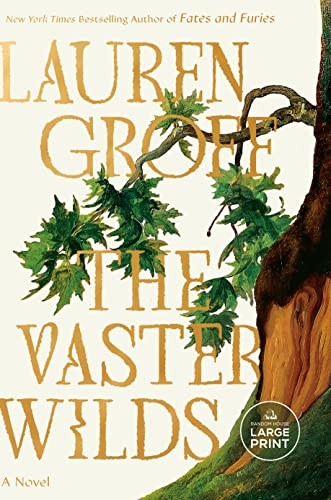
Deep Overview
The Vaster Wilds is a historical survival novel centered on a young English servant who escapes a devastated colonial settlement during the winter of 1609–1610. Although the settlement is not immediately named, the historical circumstances identify it with Jamestown during the catastrophic period remembered as the Starving Time. The girl’s flight into the forests of Virginia supplies the book’s forward momentum: she must find food, water, warmth, shelter, and a route toward a place she imagines may offer safety. Memories gradually disclose the conditions that formed her, the household she served, the Atlantic crossing, the colony’s breakdown, and her reason for fleeing. The novel consequently operates on several levels at once—as a physically exacting survival narrative, a psychological portrait of a socially powerless person, a critique of colonial assumptions, and a spiritual inquiry into humanity’s place within nature. Rather than treating the landscape as an empty stage awaiting European possession, the novel repeatedly exposes the limitations of the protagonist’s inherited language, theology, prejudices, and ideas of dominion.
Key Themes
Major themes include bodily survival, solitude, colonial violence, class and gender vulnerability, religious belief, ecological interdependence, and the instability of supposedly civilized identity. Hunger and exhaustion reduce life to immediate physical necessities, yet the protagonist’s ordeal also expands her awareness of the living world around her. The novel contrasts European claims of religious and cultural superiority with the cruelty, deprivation, and disorder produced inside the colony. It also examines how fear and prejudice distort the girl’s understanding of Indigenous people, even as experience begins to unsettle what she has been taught. Freedom remains deliberately complicated: escape releases her from direct human domination but exposes her to cold, injury, illness, starvation, and profound isolation.
Historical Context
The story is grounded in the early years of Jamestown, established in 1607 on land within the Powhatan world. Its immediate background is the winter of 1609–1610, known as the Starving Time. According to the National Park Service, deteriorating relations with the Powhatan peoples, drought, disease, unsafe water, food shortages, and the colonists’ fear of leaving the fort contributed to mass death; contemporary estimates reported that roughly 80 to 90 percent of the settlers died. Groff has stated that her research included Jamestown settlers’ primary documents, modern contextual studies, Elizabethan literature, the King James Bible, survival accounts, and material concerning bodies under extreme stress. The protagonist is fictional, and the novel should not be treated as a documentary reconstruction. Its historical setting instead creates a lens through which to examine colonial ideology, religious authority, and lives—especially those of poor women and servants—that formal records frequently preserve only incompletely.
Intended Audience
This book is well suited to readers of literary historical fiction, wilderness narratives, ecological fiction, and psychologically intense stories about endurance. It may especially appeal to readers interested in early colonial America, women excluded from conventional heroic histories, or fiction that brings spiritual and environmental questions into close contact with bodily experience. Readers seeking a broad social panorama, extensive political explanation, frequent dialogue, romance, or a conventional action-adventure structure may find it less suitable. The focus remains tightly attached to one isolated consciousness for much of the novel.
Reading Difficulty
The novel is relatively short but stylistically demanding. Its long, rhythmically shaped sentences, period-inflected vocabulary, biblical echoes, interior movement, and shifts between present danger and remembered experience require attentive reading. The physical detail is intentionally visceral, including hunger, illness, injury, bodily waste, violence, and the effects of exposure. The plot has strong momentum, but readers who prefer rapid external developments may experience the sustained walking, foraging, and observation as repetitive. No specialist historical knowledge is required, although familiarity with Jamestown makes the setting’s implications clearer.
Helpful Background Knowledge
Before reading, it is useful to know that Jamestown was an English commercial colony rather than an unoccupied beginning point for American history. The colony stood within an Indigenous political and ecological landscape associated with the Powhatan chiefdom. The Starving Time was not simply a natural disaster: environmental pressures interacted with colonial planning failures, conflict, dependence on outside supplies, and deteriorating relations with neighboring peoples. Some familiarity with early modern Christianity, providential interpretations of suffering, the biblical language of wilderness and dominion, and the limited legal and social power of servants and poor women will also enrich the reading.
Why Read This Book?
The novel offers an unusual reversal of the traditional colonial adventure. Its central figure is not a celebrated explorer, military leader, or landowning settler but a young servant whose labor and suffering would ordinarily remain at the edge of the historical record. The wilderness is not presented as property waiting to be claimed, nor is survival equated with conquest. Readers may choose the book for its intense sensory writing, its sustained portrayal of a mind under extreme pressure, and its interrogation of the stories Europeans told about civilization, faith, race, gender, and the natural world. It also provides a productive literary counterpart to triumphalist accounts of colonial origins.
Reader Takeaways
A careful reader may leave with a sharper understanding of how quickly social identities and inherited certainties can fracture under extreme conditions. The book encourages reconsideration of the boundary between humanity and nature: the protagonist survives not by standing outside the environment but by becoming increasingly attentive to its patterns and recognizing her dependence upon other forms of life. It also demonstrates how prejudice can persist inside a vulnerable person who is herself oppressed. More broadly, the novel asks whether freedom is best understood as independence, escape from domination, spiritual transformation, participation in ecological systems, or some difficult combination of these.
Strengths
The novel’s strongest feature is the close integration of language, physical action, and intellectual inquiry. Survival procedures are not decorative research details; they become the means through which the protagonist’s beliefs change. The restricted perspective creates immediacy while allowing memories to disclose her past gradually. Groff’s historically inflected prose evokes biblical and Elizabethan rhythms without presenting the book as a simulated seventeenth-century document. The natural environment has agency and complexity rather than serving merely as an antagonist or scenic background. The book also resists replacing one simple historical myth with another: the girl is vulnerable and courageous, but she retains assumptions inherited from her society.
Limitations and Reader Cautions
The tight focus on a lone English protagonist necessarily limits direct representation of the Powhatan peoples whose homelands surround the action. Much of what the girl believes about Indigenous communities reaches her through colonial rumor and fear; the novel critically frames those beliefs, but readers should not mistake her perspective for Indigenous history. The narrative’s deliberate repetition of walking, cold, hunger, concealment, and foraging may feel exhausting by design. Its religious and ecological dimensions are suggestive rather than organized into a single explicit argument. Readers sensitive to starvation, cannibalism, sexual exploitation, child abuse, violence, animal death, or graphic bodily suffering should approach with care.
Important Concepts
Important reference points include Jamestown; the Starving Time of 1609–1610; the Powhatan political and cultural world; the Virginia Company; indenture and domestic service; colonial ideas of possession and dominion; providence; original sin; wilderness as both material environment and religious symbol; ecological dependence; and captivity or survival narratives. The contrast between civilization and wildness is especially important because the book repeatedly questions which spaces, practices, and people deserve either label.
Questions the Book Explores
What remains of a person when social rank, possessions, community, and physical security are removed? Can someone escape a violent society without carrying its prejudices and theology into the new life? Does survival justify every act committed in its name? Is nature an enemy, a divine creation, an indifferent system, or a larger community to which humans belong? How do colonial stories convert inhabited land into imagined emptiness? Can physical vulnerability become a source of knowledge? What forms of freedom are possible for a poor young woman whose society regards her primarily as labor and property?
Reading Group Guide
Groups may wish to divide discussion into three connected strands: the survival plot, the historical setting, and the protagonist’s spiritual transformation. Begin by tracing what she believes about God, civilization, Indigenous people, and nature when she leaves the settlement; then identify experiences that reinforce or destabilize those beliefs. A map of the Chesapeake region and a short, reputable history of the Starving Time can help distinguish the novel’s fictional journey from documented history. Because the ending reshapes earlier material, groups should reserve part of the meeting for reconsidering the opening after the entire book has been read. Discussion should also distinguish between the protagonist’s historically conditioned viewpoint and the novel’s larger critical perspective.
Discussion Questions
1. How does the novel revise the traditional structure of an exploration or wilderness-conquest story? 2. What does the protagonist initially mean by freedom, and how does that meaning change? 3. When does practical attention to nature become spiritual or philosophical understanding? 4. How do hunger, illness, and exhaustion affect the reliability of perception? 5. What is gained by centering a servant rather than a documented colonial leader? 6. How does the novel expose prejudice without making its protagonist implausibly free of her period’s assumptions? 7. Is the colonial settlement more accurately described as civilized or wild? What standards does the book invite readers to use? 8. How do memories interrupt, explain, or complicate the forward survival narrative? 9. Does solitude liberate the protagonist, erase her, or transform her into a different kind of self? 10. How should readers interpret the relationship among faith, suffering, and ecological belonging? 11. Where does the novel draw a boundary between endurance and moral compromise? 12. How does the conclusion alter the significance of the protagonist’s journey?
Sources and Verification
Bibliographic identity and hardcover publication details were checked against Penguin Random House’s official Riverhead Books page and a public-library catalog record. WorldCat independently confirms a 2023 Riverhead edition in English. Historical context was checked against National Park Service material on Jamestown, the Starving Time, and relations between the English colony and Powhatan peoples. Statements about Groff’s research process and intentions are based on her September 2023 interview with the American Booksellers Association. Interpretive comments in this profile are original editorial analysis rather than attributed claims. The publisher and one library record disagree on page count, so the publisher’s 272-page figure has been preferred.