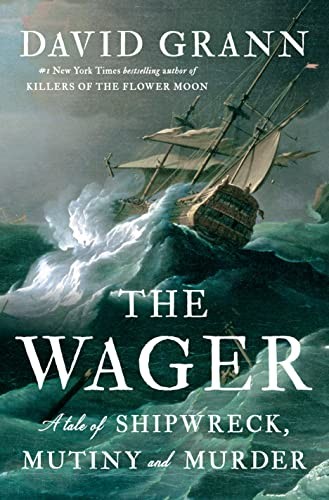
About this book
The Wager reconstructs the disastrous voyage of HMS Wager, a British warship sent into the Pacific as part of Commodore George Anson’s expedition during the War of Jenkins’ Ear. After disease, storms, navigational hazards, and separation from the squadron, the ship was wrecked off the coast of Chilean Patagonia in 1741. The survivors then faced hunger, exposure, internal division, collapsing discipline, disputed authority, violence, and an eventual break with Captain David Cheap. Grann follows the castaways’ rival escape attempts and their extraordinary returns to civilization, where competing factions published incompatible accounts and accused one another of mutiny and other crimes. The closing movement shifts from survival narrative toward legal and historical inquiry: what could the Admiralty acknowledge, what might it prefer to suppress, and whose testimony would become accepted history? Grann builds the account from logbooks, correspondence, diaries, published narratives, court-martial evidence, and Admiralty and government records. The book therefore operates simultaneously as maritime history, disaster narrative, investigation of military leadership, and study of how self-interested witnesses manufacture public versions of the past.
Deep Overview
The Wager reconstructs the disastrous voyage of HMS Wager, a British warship sent into the Pacific as part of Commodore George Anson’s expedition during the War of Jenkins’ Ear. After disease, storms, navigational hazards, and separation from the squadron, the ship was wrecked off the coast of Chilean Patagonia in 1741. The survivors then faced hunger, exposure, internal division, collapsing discipline, disputed authority, violence, and an eventual break with Captain David Cheap. Grann follows the castaways’ rival escape attempts and their extraordinary returns to civilization, where competing factions published incompatible accounts and accused one another of mutiny and other crimes. The closing movement shifts from survival narrative toward legal and historical inquiry: what could the Admiralty acknowledge, what might it prefer to suppress, and whose testimony would become accepted history? Grann builds the account from logbooks, correspondence, diaries, published narratives, court-martial evidence, and Admiralty and government records. The book therefore operates simultaneously as maritime history, disaster narrative, investigation of military leadership, and study of how self-interested witnesses manufacture public versions of the past.
Key Themes
Major themes include survival under extreme deprivation; the legitimacy and limits of command; mutiny as both a legal category and a struggle over language; loyalty, self-preservation, and group fracture; the brutality concealed by imperial ambition; and the power of written testimony to determine historical memory. The book repeatedly tests the difference between formal authority and earned authority. Captain Cheap possesses rank, but John Bulkeley gains influence through technical competence and the confidence of many sailors. Another central concern is narrative control: survivors do not merely recount events but shape accounts capable of protecting their lives, reputations, and legal positions. The absence or marginalization of certain voices also matters, reminding readers that an archive records unequal access to literacy, publication, and institutional power.
Historical Context
The expedition took place during the War of Jenkins’ Ear, an Anglo-Spanish conflict that began in 1739 and later merged into the wider War of the Austrian Succession. British strategy sought to attack Spanish commerce and imperial possessions, including the valuable Pacific trade. Anson’s squadron sailed in 1740, but inadequate preparation, disease, difficult weather, and the hazards of rounding Cape Horn devastated its manpower. Grann places the Wager disaster within an eighteenth-century naval system dependent on rigid hierarchy, corporal punishment, impressment, and enormous human expenditure. He also connects the voyage to European colonial rivalry, global commerce, and systems of coerced labor and enslavement. The story’s later battle over testimony belongs to the period’s expanding print culture, in which voyage narratives could become commercially successful interventions in legal and political disputes.
Intended Audience
The book is well suited to readers of narrative nonfiction, maritime and military history, survival stories, historical investigations, and true crime. It should also appeal to readers interested in leadership failures, institutional self-protection, disputed evidence, or the construction of historical memory. No specialist naval knowledge is required. Readers looking for a comprehensive history of the War of Jenkins’ Ear or the entire Anson expedition should recognize that the Wager disaster and its aftermath remain the principal focus. The detailed treatment of disease, starvation, injury, violence, and death may be difficult for sensitive readers.
Reading Difficulty
The prose is designed for a general audience and uses suspense, sharply drawn participants, and a largely chronological structure to manage a complicated historical record. Specialized nautical ranks, shipboard practices, geography, and legal distinctions create occasional difficulty, but these elements are generally introduced through the action rather than presented as a technical manual. The larger challenge is interpretive: readers must compare partial, contradictory, and self-protective accounts without expecting every dispute to receive a definitive answer. Maps, notes, and the list of principal characters are useful aids in keeping track of routes, factions, and changing circumstances.
Helpful Background Knowledge
Readers may benefit from a basic understanding of the rivalry between Britain and Spain, the dangers of eighteenth-century ocean travel, and the authority structure of the Royal Navy. Useful terms include impressment, court-martial, mutiny, prize, squadron, gunner, boatswain, midshipman, and commodore. Familiarity with scurvy is also helpful: long voyages without reliable access to fresh provisions could produce mass illness and death. None of this preparation is essential, because the book supplies enough context for a general reader.
Why Read This Book?
The Wager offers more than a sequence of maritime calamities. Its unusual strength lies in showing how a physical struggle for survival became a struggle over evidence and memory. The rival survivors must persuade officials and the public that their own conduct was lawful or necessary, making the aftermath as consequential as the wreck. Readers can approach the book as an adventure, a leadership case study, a courtroom puzzle, or an inquiry into how archives are created. It is particularly valuable for readers who want accessible history that still leaves room for uncertainty and conflicting interpretations.
Reader Takeaways
A careful reader may leave with a clearer sense of the extraordinary dangers of eighteenth-century naval service and of the human cost behind imperial projects. The book demonstrates that hierarchy can deteriorate quickly when institutions can no longer provide food, safety, or a credible plan. It also shows that survival decisions cannot be separated neatly from status, expertise, fear, and access to resources. Most importantly, it encourages skepticism toward apparently settled historical narratives: testimony can preserve indispensable evidence while also functioning as advocacy, accusation, self-defense, and propaganda.
Strengths
The book’s principal editorial strength is its integration of archival research with a controlled narrative structure. Grann turns numerous participants, locations, technical details, and conflicting testimonies into an intelligible sequence without eliminating moral ambiguity. The movement from voyage to wreck, factional conflict, escape, captivity, publication, and court-martial gives the book several distinct kinds of tension. Its treatment of material conditions—ships, provisions, disease, weather, navigation, and labor—helps explain behavior that might otherwise appear irrational. The competing accounts also allow the book to examine historical truth from within the story rather than attaching an abstract discussion to it.
Limitations and Cautions
The narrative is centered primarily on the British sailors whose experiences generated surviving written and institutional records. Indigenous people, enslaved people, and others encountered within the imperial world appear within the account, but the archive does not preserve their perspectives on equal terms. Readers should therefore distinguish between the breadth of the book’s historical awareness and the limits imposed by its source base. Its thriller-like pacing can also lead readers to concentrate on individual conflict while giving less attention to the wider war and global economic structures. Finally, the surviving principals wrote with strong legal and reputational incentives, so some motives and disputed actions cannot be established with certainty.
Important Concepts and Figures
HMS Wager was one vessel in George Anson’s squadron, dispatched to attack Spanish interests in the Pacific. David Cheap became the Wager’s captain and attempted to preserve naval authority after the wreck. Gunner John Bulkeley emerged as a capable organizer and central opponent of Cheap’s command. Midshipman John Byron, later known as a naval officer and as the grandfather of the poet Lord Byron, supplied another important account. The War of Jenkins’ Ear provides the immediate strategic setting. Other essential concepts include impressment, naval hierarchy, scurvy, mutiny, competing survivor narratives, court-martial procedure, imperial censorship or silence, and the relationship between published testimony and public credibility.
Questions the Book Explores
When does obedience cease to be a duty and become a threat to survival? Can command remain legitimate after the material foundations of naval order have collapsed? Where is the boundary between mutiny, desertion, necessity, and resistance to failed leadership? How should historians evaluate witnesses who are indispensable but deeply interested in the outcome? Why might an institution avoid resolving the most explosive accusations placed before it? What do missing or marginalized voices reveal about the unequal construction of archives? Can a story be factually grounded while its ultimate moral judgment remains unsettled?
Reading Group Guide
A group may divide the discussion into four stages: the expedition and its imperial purpose; the wreck and breakdown of authority; the rival journeys toward safety; and the publication and court-martial battles. Ask participants to track when their sympathies shift between Cheap, Bulkeley, Byron, and other survivors. It can be useful to separate three standards of judgment: eighteenth-century naval law, practical survival, and modern ethical evaluation. Groups can also list which kinds of evidence survive—official records, journals, published narratives, correspondence, and testimony—and identify the people least able to leave comparable records. A map of Cape Horn, Wager Island, the Strait of Magellan, Brazil, and Chile will clarify the scale of the survivors’ movements.
Discussion Questions
1. At what point, if any, does resistance to Captain Cheap become justified? 2. Which qualities allow Bulkeley to acquire authority, and how do they differ from the qualities associated with rank? 3. How do starvation, illness, and isolation complicate moral judgment? 4. Which survivor seems most credible, and what standards are you using to decide? 5. When does a firsthand account become an argument rather than a record? 6. How does the expedition’s imperial purpose affect your interpretation of the sailors’ suffering? 7. What responsibilities did officers owe to impressed or unwilling sailors? 8. Why might the Admiralty have preferred a narrow legal resolution to a complete public reckoning? 9. Which missing voices would most significantly alter the history if their accounts had survived? 10. Does Grann’s suspenseful structure clarify the evidence, or can it make uncertainty feel more settled than it is? 11. How does the book distinguish endurance from heroism? 12. What modern institutions face comparable conflicts between truth-seeking and reputation protection?
Sources and Verification
Bibliographic details were cross-checked against publisher-associated Penguin Random House material and Kirkus Reviews, while the author’s official website confirms the title, subtitle, subject, and archival basis. Penguin Random House’s official reading guide supports the book’s emphasis on rival accounts, imperial priorities, missing voices, and the construction of history. A professional article published by Army University Press was consulted for the voyage’s military context and the book’s relevance to leadership analysis. Interpretive sections above are original editorial assessments grounded in those verified features rather than copied promotional language. Verification needed for any claim tied to a different national, paperback, ebook, or audiobook edition.