
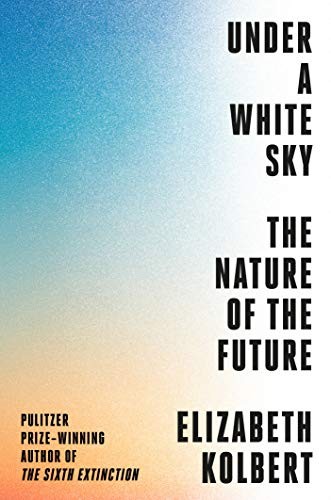
Under a White Sky
The Nature of the Future
Human beings have altered rivers, coastlines, climates, and ecosystems on such a scale that further intervention can appear to be the only way to contain the damage. In Under a White Sky, environmental journalist Elizabeth Kolbert investigates this unsettling predicament through visits to laboratories, waterways, endangered-species habitats, and experimental climate projects. Her subjects include efforts to block invasive carp from the Great Lakes, sustain the exceptionally vulnerable Devils Hole pupfish, help corals survive warmer oceans, remove carbon dioxide from the atmosphere, and reduce global temperatures through solar geoengineering. These projects display remarkable scientific ingenuity, but they also expose the risks of treating complex natural systems as manageable machinery. Rather than offering a simple case for or against technology, Kolbert examines the recurring cycle in which one attempted solution creates conditions demanding another. The result is a concise explorat…
Where to buy or borrow
Are you selling this book? Bookstores, publishers, authors and libraries can be listed here for free. Request a listing
About this book
Deep Overview
The book then turns south to the Mississippi River and coastal Louisiana. Levees and navigation works have made settlement and commerce possible while preventing the river from regularly depositing sediment across its delta. Combined with canals, subsidence, storms, and rising seas, this disruption contributes to the disappearance of wetlands that once buffered communities from the Gulf of Mexico. Proposed sediment diversions would restore part of the river’s land-building function, but doing so would also rearrange existing fisheries and livelihoods. Here, restoration cannot mean returning to a pristine baseline; it requires choosing among altered futures.
Conservation produces similarly difficult choices. The Devils Hole pupfish survives naturally in a tiny geothermal pool in the Mojave Desert. Protecting it has required legal action, close monitoring, and the creation of a costly refuge population. The species exemplifies conservation reliance: once human activity has pushed a population toward extinction, keeping it alive may demand continuing human management. In Australia, researchers investigate whether selective breeding and other forms of assisted evolution might help corals tolerate warmer conditions. Genetic techniques are also considered in relation to destructive introduced species such as cane toads. These projects blur familiar distinctions between preserving nature and redesigning it.
The final movement expands from local ecosystems to the atmosphere. Kolbert visits Icelandic projects associated with Climeworks and Carbfix, where carbon dioxide is captured and injected underground so that it can mineralize in basalt. Carbon removal may be necessary because accumulated emissions remain in the climate system, yet the scale and cost of removal underscore how much easier prevention would have been. Solar geoengineering represents an even more consequential possibility: reflecting a portion of incoming sunlight could lower global temperatures without eliminating atmospheric carbon dioxide or repairing effects such as ocean acidification. It would also create questions about international authority, unequal regional consequences, and what might happen if the intervention were suddenly stopped.
Across these cases, Kolbert resists both technological triumphalism and fantasies of human withdrawal. Humanity already exercises planetary influence, whether deliberately or not. The central dilemma is therefore not whether people will shape nature, but how openly, responsibly, and equitably they will confront the choices embedded in that power.
Key Themes
Kolbert repeatedly tests faith in technological solutions. Scientific ingenuity is real and sometimes indispensable, but technical capability does not automatically supply ethical legitimacy, political agreement, or protection against unintended consequences. A related theme is responsibility across time. Present societies inherit benefits and damage from earlier decisions while making choices that will constrain future generations.
The book also explores the mismatch between planetary problems and fragmented governance. Climate interventions could affect every country, yet there is no straightforward global authority empowered to decide whether, when, or how they should be used.
Historical and Intellectual Context
Many of the book’s cases originate in the modern history of large-scale engineering. The reversal of the Chicago River, the control of the Mississippi, wetland alteration, introduced species, and fossil-fuel development arose from projects intended to improve sanitation, transportation, agriculture, settlement, or economic production. Their ecological consequences were often delayed, displaced, or poorly understood.
The climate chapters reflect a newer debate over carbon removal and solar geoengineering. These approaches gained attention as governments struggled to reduce emissions rapidly enough to meet international temperature goals. Kolbert places them within a longer pattern: societies first alter a system for immediate advantage and later seek another intervention to manage the accumulated effects.
Intended Audience
Readers who appreciate reported nonfiction built around travel, interviews, and encounters with working scientists are likely to respond to Kolbert’s approach. Those looking for a comprehensive climate-policy program, a detailed guide to individual action, or an explicitly optimistic solutions manual may find it less satisfying. The book’s purpose is primarily diagnostic and exploratory: it clarifies dilemmas rather than resolving them.
Reading Difficulty
The larger challenge is conceptual rather than linguistic. The book moves among distinct ecosystems and technologies, so readers must track how separate cases support a common argument about intervention and unintended consequences. Its concise chapters and journalistic pacing make it considerably less demanding than an academic monograph.
Helpful Background Knowledge
Readers do not need prior knowledge of the Chicago River, the Mississippi Delta, Devils Hole, coral reproduction, CRISPR, or Icelandic basalt; Kolbert supplies the necessary orientation. It may be helpful, however, to begin with the recognition that environmental decisions involve public health, commerce, law, cultural values, and competing livelihoods as well as biology.
Why Read This Book?
The book is particularly valuable for readers dissatisfied with a choice between uncritical technological optimism and a demand to leave nature entirely alone. Its cases demonstrate why some interventions may be necessary while preserving serious questions about scale, risk, authority, and justice. It offers a disciplined way to think about environmental choices for which every available option may carry costs.
Reader Takeaways
The book also encourages greater scrutiny of the word “solution.” A project can solve a defined technical problem while shifting costs elsewhere, postponing consequences, or creating dependence on continued management. Readers may become more attentive to who defines success, who accepts the risk, and who receives the benefits of environmental intervention.
Finally, the book reinforces the importance of emissions reduction even when discussing carbon removal or geoengineering. Remedial technologies change the available choices, but they do not erase the need to limit the damage being produced.
Strengths
Her controlled use of irony is another strength. The contradictions of environmental management emerge without exaggerated rhetoric or simplistic villains. The book also gives scientific ingenuity its due while maintaining skepticism about overconfidence. This balance makes it productive for discussion among readers who may disagree about technological risk.
Limitations and Scope
Its emphasis falls largely on scientists, engineers, and technical projects. Questions of Indigenous knowledge, environmental justice, labor, colonial history, and unequal vulnerability are relevant to the dilemmas presented but receive less sustained treatment than the scientific and engineering dimensions.
Because several chapters examine rapidly developing research, the technical status, cost, and scale of individual projects may have changed since the first edition appeared in February 2021. The book remains valuable as an account of the underlying dilemmas, but it should not be treated as a current directory of available technologies.
Important Concepts, People, and Places
The Chicago River and Chicago Sanitary and Ship Canal illustrate how an engineering success can reorganize an ecosystem. The Great Lakes and Mississippi River basin become connected parts of the invasive-carp problem. Coastal Louisiana demonstrates how levees, canals, sediment loss, subsidence, sea-level rise, and storms interact rather than producing a single isolated crisis.
The Devils Hole pupfish is central to the discussion of conservation-reliant species—organisms whose continued survival may depend on indefinite monitoring and intervention. Devils Hole, within the Mojave Desert region, matters because its tiny, unusual habitat leaves the fish exceptionally vulnerable.
Ruth Gates, a marine biologist associated with the Hawaiʻi Institute of Marine Biology, matters to the book’s exploration of assisted evolution in corals. Her work sought ways to strengthen coral resilience under warming conditions. The Great Barrier Reef provides the larger ecological setting for research into heat-tolerant corals.
CRISPR is a gene-editing technology considered in connection with genetic interventions in wildlife. Cane toads in Australia exemplify the destructive potential of introducing a species for biological control and the controversial possibility of using biotechnology to manage the resulting population.
Climeworks is a company developing direct air capture, which removes carbon dioxide from ambient air. Carbfix is associated with storing carbon underground through mineralization in Icelandic basalt. These projects distinguish carbon removal from conventional emissions reduction.
Solar geoengineering refers to proposed interventions intended to reflect a portion of sunlight and cool Earth. Mount Tambora’s 1815 eruption provides a historical example of how particles in the atmosphere can lower temperatures. Camp Century and Greenland ice cores matter because ice preserves evidence of past atmospheric and climatic conditions, revealing both long-term change and episodes of abrupt instability.
Questions the Book Explores
When does restoration become redesign, and is that distinction still useful in heavily altered environments?
How should societies judge an intervention that addresses an immediate crisis but may generate delayed or geographically distant harm?
Can carbon removal reach a meaningful scale without distracting from emissions reduction?
Who would have the authority to deploy a technology capable of altering global temperatures?
How should benefits, risks, and responsibility be distributed when environmental interventions cross national borders?
What does humility mean when refusing to intervene may itself permit preventable destruction?
Reading Group Guide
Discuss whether the pupfish refuge and assisted coral evolution feel like preservation, artificial life support, or the creation of something new. Groups may find it useful to identify what assumptions about “naturalness” underlie their reactions.
When reaching the climate chapters, distinguish emissions reduction, adaptation, carbon removal, and solar geoengineering. They address different aspects of the crisis and should not be treated as interchangeable solutions. Consider making a table comparing speed, scale, reversibility, cost, governance, and potential unintended consequences.
Finally, pay attention to Kolbert’s tone. Her irony often communicates judgment indirectly. Discuss whether that restraint strengthens the book’s argument or leaves important political and moral conclusions insufficiently explicit.
Discussion Questions
2. Does the idea of an untouched natural world remain useful in the Anthropocene, or can it obstruct realistic conservation decisions?
3. What obligations do people have to preserve a species whose survival requires continuous and expensive intervention?
4. How should decision-makers balance ecological restoration against the livelihoods that have developed within an already altered environment?
5. Does assisted evolution represent responsible adaptation or excessive confidence in human control?
6. How should society distinguish a necessary technological intervention from technological solutionism?
7. Could large-scale carbon removal create an incentive to delay emissions cuts? How might that risk be reduced?
8. Under what circumstances, if any, would research into solar geoengineering be justified?
9. Who should participate in decisions about technologies that could change climate conditions across national borders?
10. Where does Kolbert locate hope, if anywhere, and how does her version of hope differ from optimism?
Sources and Verification
Comments
No published comments yet.
Available editions
Hardcover
hardcover
- Publisher
- Crown
- ISBN-13
- 9780593136270
- Publication date
- Pages
- 256