
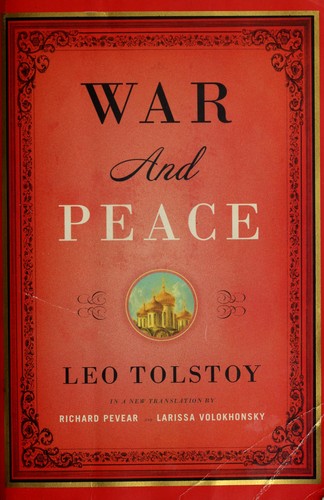
War and Peace
Leo Tolstoy's War and Peace is a vast work of historical fiction. It follows several aristocratic Russian families through the Napoleonic era, from the campaign of 1805 to the French invasion of Russia in 1812 and the years after. Its three central figures are Pierre Bezukhov, Prince Andrei Bolkonsky and Natasha Rostova. Their private searches for love, purpose and meaning unfold beside battles, court politics and the burning of Moscow. Tolstoy also steps back to argue about how history works and whether individual leaders really control events. The result is a landmark of Russian literature that combines a family chronicle, a war novel and a philosophical inquiry. This edition presents the book in the Pevear and Volokhonsky English translation.
Where to buy or borrow
Are you selling this book? Bookstores, publishers, authors and libraries can be listed here for free. Request a listing
About this book
Deep Overview
The novel alternates between peace and war, and the two are not cleanly separated. The campaign of 1805 ends at Austerlitz, where Prince Andrei is wounded and loses his faith in glory. Pierre drifts into a disastrous marriage and then into Freemasonry and a search for a moral system. Natasha grows from a girl into a young woman and falls into a humiliating crisis of her own. Tolstoy treats these private episodes as seriously as the public ones, and he often suggests that the same forces of impulse, vanity and chance run through both.
The 1812 invasion shifts the book's centre of gravity. Moscow is abandoned, the battle of Borodino is shown as confusion more than strategy, and the city burns. Pierre wanders through the disaster as an observer and then as a prisoner, and a peasant soldier named Platon Karataev shows him another way of living. Andrei's final reconciliation with Natasha and the later fates of the survivors give the story its emotional close. An epilogue set in 1820 shows what has become of the families and leaves the future open.
The most unusual feature is Tolstoy's running argument about history. He doubts that great men, whether emperors or generals, steer events. He argues that outcomes arise from countless unrecorded decisions made by ordinary people, and he portrays Napoleon and the Russian court with open irony. He gives Kutuzov a quiet wisdom because Kutuzov accepts how little a commander can control. These are Tolstoy's own views, and historians and critics have long debated both his portraits and his theory. They are best read as a deliberate challenge to the way history is usually told, not as settled fact.
The novel is therefore a demonstration as much as a story. Tolstoy wants the reader to feel how causation works by following dozens of lives over many years, so that no single moment appears to decide anything. The length is part of the method. What the book is trying to show is that meaning lives in ordinary, concrete experience, and that the grand narratives of history are a poor guide to it.
Key Themes
The search for a meaningful life: Pierre and Andrei each test ideals, including ambition, glory, philosophy, secret societies and religious feeling, against lived experience.
Family and domestic life: marriage, parenthood, inheritance and household routine are shown as central to human life, not as a quiet backdrop to war.
Social performance and authenticity: the salons of St. Petersburg and Moscow reward polish and pretense, while the book repeatedly values sincerity, even when it is clumsy.
The reality of war: battles appear as chaotic, confusing and often senseless, set against the tidy accounts later given by commanders and historians.
Fate, free will and chance: characters believe they choose, yet circumstances and impulses keep redirecting them.
National feeling and class: the invasion unites Russians across ranks, while the book exposes how differently nobles and peasants experience the same crisis.
Historical Context
The period matters for the novel's social detail. Russia's aristocracy was strongly oriented toward France, and many nobles spoke French in society. The invasion forced a confrontation between that cultural loyalty and a growing sense of Russian national identity. Serfdom was still in force when the novel's events take place, and it had been abolished only a few years before Tolstoy began writing, in 1861, which shapes how landowning families appear.
In literary terms, the book is a landmark of nineteenth-century realism and a defining example of historical fiction that treats real figures and invented ones together. Tolstoy drew on memoirs, histories and the recollections of people who had lived through the period. He then argued with the official histories of his own day. Part of the novel's interest is that it is itself a challenge to how earlier historians had told the story of 1812.
The epilogue's hints of political discussion in the early 1820s point toward the later ferment that followed in Russian public life. Readers can enjoy the story without knowing the details of that later history.
Intended Audience
It is also a good choice for readers who already know Anna Karenina or other Tolstoy and want to see his widest-ranging work. Those who prefer fast plots, a single protagonist or tightly compressed storytelling may find it hard going. So may readers who dislike essayistic interruptions to a narrative. People who want a quick introduction to Russian literature may do better to start with a shorter work.
Reading Difficulty
The cast is large, and many characters appear under several forms of address, such as first names, patronymics, diminutives and titles. Readers new to Russian naming conventions often need a few chapters to settle in. Some passages mix in French, which reflects how the aristocracy spoke. How these passages are presented varies from edition to edition.
The pace changes noticeably: society scenes and family episodes move quickly, battle sequences can be disorienting by design, and the history essays are more demanding and slower. Many readers handle the length by reading a few chapters at a time over several weeks. The book is conceptually accessible, but the essays on historical causation ask for patient attention.
Helpful Background Knowledge
Why Read This Book?
It is also a rare novel that argues with itself about what fiction and history can and cannot do. Even a reader who rejects Tolstoy's theory of history is likely to find it an interesting provocation.
This specific edition offers a complete English text in a single paperback by translators who aimed to reproduce Tolstoy's rhythms and word choices rather than smooth them. That choice makes it a useful pick for readers who want something close to the feel of the Russian original. Its length offers a different reward from most novels: the experience of living with a set of characters long enough to feel their years pass.
Reader Takeaways
Readers may also notice how Tolstoy builds character through accumulated gestures and small contradictions, and how a novel can follow growth without announcing it. The contrast between Pierre's restlessness and Kutuzov's patience, or between Andrei's hunger for greatness and the plain endurance of ordinary soldiers, offers a lasting way of thinking about ambition and humility. Finally, a reader who finishes the book will have practised sustained reading, which is itself a skill worth having.
Strengths
Tolstoy's character work is exceptionally detailed. Pierre, Andrei and Natasha develop in ways that feel gradual and surprising, and minor characters often stay memorable.
The structure, though loose, has a logic: alternating strands let themes echo across very different settings. The ambition of the historical argument also sets the book apart from other historical novels.
As an edition, the Pevear and Volokhonsky translation is faithful in intent and consistent across the whole text. A single-volume paperback also makes the complete book relatively easy to carry and to share in a reading group.
Limitations and Cautions
The perspective is overwhelmingly that of the Russian nobility. Peasants and serfs appear, but mainly as seen from above, with a few notable exceptions. Some period attitudes toward class, gender and war may feel dated to modern readers.
Translation choices also matter. This edition favours closeness to the Russian over fluency, and some readers find the result more demanding than other English versions. Others prefer it for that reason. Readers who want extensive explanatory notes or a scholarly apparatus should check what a given printing contains before choosing it. The catalogue record for this ISBN lists reference matter near the end of the volume, but its exact content is not described here.
Important Concepts, People, and Places
Prince Andrei Bolkonsky: a proud, intelligent officer whose ideas about glory are broken by war and by loss.
Natasha Rostova: a vivid young woman whose growth, mistakes and recovery sit at the emotional centre of the book.
The Rostov and Bolkonsky families: two contrasting households, one open-hearted and the other severe, whose marriages and rivalries link the plot.
Hélène and Anatole Kuragin: a brother and sister who represent charm, appetite and social manipulation.
Napoleon Bonaparte and Tsar Alexander I: real rulers shown through Tolstoy's critical lens as figures far less in control than they believed.
Mikhail Kutuzov: the Russian commander whom Tolstoy presents as wise because he distrusts grand plans.
Platon Karataev: a peasant soldier whose simplicity gives Pierre a new outlook during captivity.
Austerlitz and Borodino: the two great battles that frame the novel's disillusion with glory and its portrait of chaos.
Moscow in 1812: the abandoned and burning city, a turning point for both the war and several characters.
Freemasonry: the fellowship Pierre joins in his search for moral direction.
The philosophy of history: Tolstoy's argument that events come from countless small acts, not from the will of great men.
Questions the Book Explores
What makes a life meaningful when ambition, intellect and status each prove inadequate?
How does war look to those inside it, compared with the way commanders and historians later describe it?
How much of a person's character is fixed, and how much can change through suffering, love and time?
What role do family, marriage and domestic routine play in sustaining people through public catastrophe?
Is the sincere person at a social disadvantage, or does sincerity prove a lasting strength?
What can a novel show about the past that a formal history cannot?
Reading Group Guide
It can be useful to discuss the history essays separately from the story, since members often disagree about whether they enrich the book or interrupt it. Groups can also compare how readers responded to different characters over time, noting who they sympathized with at the beginning and at the end. If members have read other translations, a comparison of a short passage can open up a good conversation about what translation choices do.
Discussion Questions
2. Why might Tolstoy have chosen to follow so many characters instead of one central hero?
3. Do you find Tolstoy's argument about historical causes convincing, and does it affect how you read the battle scenes?
4. How does the book treat the contrast between public events and private life, and where do the two overlap most strongly?
5. What does Natasha's journey suggest about forgiveness, growth and social judgment?
6. How does Tolstoy's treatment of Napoleon and Kutuzov shape your sense of leadership?
7. What does Platon Karataev offer Pierre that the more educated characters cannot?
8. Does the epilogue feel like a fitting resolution, and what does it leave unresolved?
9. How does the experience of reading such a long book change the way you respond to its characters?
Sources and Verification
Comments
No published comments yet.
Available editions
Paperback
Vintage Classics edition (translation by Richard Pevear and Larissa Volokhonsky)
- Publisher
- Vintage
- ISBN-13
- 9781400079988
- Publication date
- Pages
- 1296