
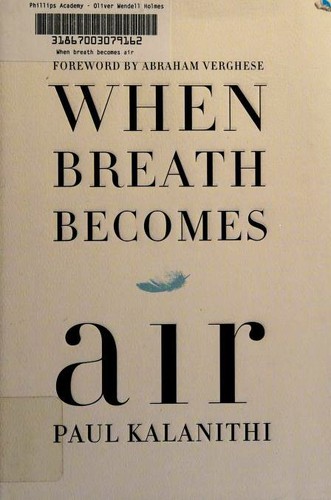
When Breath Becomes Air
Paul Kalanithi's posthumously published memoir follows his passage from literature student to neurosurgeon and, after a diagnosis of metastatic lung cancer at thirty-six, from physician to patient. Medicine had promised him a vocation at the border between biology and identity: neurosurgery could preserve life, but it also forced difficult judgments about what forms of life patients would consider worth living. Cancer makes those questions immediate and personal. Kalanithi must reconsider professional ambition, marriage, parenthood, time, and the meaning of action when the future can no longer be treated as predictable. The book does not offer a formula for accepting death. Instead, it examines how a person continues choosing and caring under radical uncertainty. A foreword by physician-writer Abraham Verghese places Kalanithi's unfinished work in context, while Lucy Kalanithi's epilogue recounts his final decline and gives the memoir an essential second perspective on illness, love,…
Where to buy or borrow
Are you selling this book? Bookstores, publishers, authors and libraries can be listed here for free. Request a listing
About this book
Deep Overview
Kalanithi first looks backward, asking why he chose medicine at all. His early education in literature taught him to approach suffering, identity, and death through stories. Yet language alone seemed insufficient; he wanted direct responsibility for human lives. Studies in human biology and the history and philosophy of medicine helped lead him toward medical school and eventually neurosurgery. The specialty attracted him because injuries and diseases of the brain can alter memory, language, personality, movement, and agency. A surgeon therefore works not merely with tissue but with the physical conditions that make a recognizable life possible.
His account of training complicates heroic ideas about medicine. Technical excellence matters enormously, but clinical judgment also requires understanding what a patient values. An operation can prolong biological existence while imposing losses that the patient may find intolerable. Kalanithi portrays the physician's task as interpretive as well as scientific: doctors must help people understand not only what can be done but what the available futures might mean.
Cancer overturns his own imagined future. Prognostic statistics provide population-level information but cannot tell him how to inhabit an individual life. He and Lucy must make decisions without knowing whether he has years or months. He returns to clinical work for a time, tests the limits of his changed body, and considers how ambition should function when long-range plans have become unstable. The couple's decision to have a child is presented not as denial of death but as a commitment to love despite foreseeable grief.
Writing becomes another form of responsible action. Kalanithi tries to articulate what remains possible when cure is unavailable and certainty has disappeared. His manuscript ends before his life does, leaving Lucy Kalanithi's epilogue to describe his final illness, death, and the family's experience around them. That change of voice prevents the book from becoming a solitary philosophy of dying. It shows that mortality is also relational: illness reorganizes a marriage, a family, and a community of care. The unfinished form ultimately reinforces the memoir's central insight that meaning is not secured by completing every plan. It emerges through attention, commitment, and choices made within limits.
Key Themes
**Doctor and patient perspectives:** Kalanithi's movement between these roles exposes differences in knowledge, power, vulnerability, and time. Clinical expertise does not protect him from the uncertainty experienced by patients.
**Identity and the brain:** Neurosurgery makes the connection between physical structures and personhood unusually visible. Decisions about treatment can therefore become decisions about memory, agency, communication, and acceptable quality of life.
**Uncertainty:** Prognosis cannot provide a private calendar. Kalanithi must choose a course without knowing how much time remains, making uncertainty a condition of action rather than a temporary obstacle.
**Vocation:** The memoir asks whether work is merely achievement or a form of service. Medicine and writing become complementary ways of attending to suffering.
**Love, family, and continuity:** Marriage and parenthood do not cancel mortality. They create relationships through which meaning and responsibility continue even when one person's life is ending.
Historical and Intellectual Context
The memoir also participates in modern medical-humanities discussions about narrative medicine, shared decision-making, and patient-centered care. These approaches challenge a narrowly technical model in which successful treatment is defined only by measurable survival or physical function. Kalanithi's neurosurgical examples sharpen the issue because interventions involving the brain can affect the capacities through which identity is expressed.
His literary and philosophical education places the clinical story in conversation with older traditions of writing about death, virtue, and suffering. The result is not a systematic philosophical argument, but a physician's attempt to test inherited ideas against bodily decline, clinical practice, and family responsibility.
Intended Audience
It may be less suitable for someone seeking detailed cancer information, a practical caregiving handbook, or a step-by-step method for coping with loss. Its primary mode is reflective and autobiographical, not instructional.
Reading Difficulty
The chronology sometimes follows remembered experience and reflection rather than a strictly documentary sequence. Readers may also want pauses between sections because the narrative includes terminal illness, physical decline, endangered pregnancies and infants encountered in clinical practice, difficult treatment decisions, and death. The book's brevity should not be mistaken for lightness.
Helpful Background Knowledge
Readers may additionally benefit from distinguishing cure from care. Even when disease cannot be cured, treatment can still aim to extend life, preserve function, relieve symptoms, or support goals important to the patient.
Why Read This Book?
The memoir is also valuable because it refuses the easy division between living and dying. Work, parenthood, treatment, writing, and love continue after terminal illness enters the story, but each acquires a different scale and urgency. Its questions reach beyond cancer: how should anyone choose when outcomes are uncertain, time is limited, and no decision can preserve every possible future?
Reader Takeaways
The book also encourages attention to medicine as a moral relationship. Good care requires scientific competence, honest communication, and curiosity about the life a patient hopes to preserve. Kalanithi's experience suggests that meaning need not depend on certainty, longevity, or the completion of every ambition. It can arise through commitments maintained under changing conditions.
Finally, Lucy Kalanithi's epilogue broadens the idea of authorship and legacy. A life story continues through the memories, responsibilities, and interpretations of those who survive.
Strengths
The book also connects abstract questions to concrete decisions: returning to surgery, discussing prognosis, choosing treatment, becoming a parent, and deciding how to spend uncertain time. Its unfinished quality is handled with unusual integrity. Rather than manufacturing closure, Lucy Kalanithi's epilogue acknowledges both the limits of Paul's account and the shared nature of his final experience.
Limitations and Scope
Because he died before completing the manuscript, some lines of reflection remain compressed or unresolved. The book gives greater space to questions of meaning and vocation than to healthcare inequity, treatment costs, or the prolonged practical work of caregiving. Readers should also avoid treating Kalanithi's choices—especially concerning work, treatment, faith, or parenthood—as a universal model for responding to terminal illness.
Important Concepts, People, and Institutions
**Lucy Kalanithi:** Paul's wife and a physician. She participates in the medical and family decisions at the center of the narrative and writes the epilogue, extending the story beyond Paul's surviving manuscript.
**Abraham Verghese:** Physician-writer and Stanford professor who contributes the foreword, situating the manuscript and its author for readers.
**Stanford University and Stanford Medicine:** Central institutions in Kalanithi's education, neurosurgical training, research, clinical work, and treatment.
**Neurosurgery:** More than a professional setting, it is the field through which the book examines the dependence of identity and agency on the brain.
**Metastatic lung cancer:** The diagnosis that reorganizes Kalanithi's sense of time and reverses his place in medicine from treating physician to seriously ill patient.
**Prognosis:** An estimate based on medical evidence that becomes ethically and emotionally complicated when applied to an individual future.
**Doctor-patient relationship:** A central moral relationship in the memoir, requiring translation between technical possibilities and the patient's conception of a worthwhile life.
**Vocation:** Work understood as a calling that joins personal ability to service, responsibility, and meaning.
**Medical humanities:** The interdisciplinary space connecting medicine with literature, philosophy, ethics, and history; Kalanithi's education and writing exemplify this approach.
Questions the Book Explores
How should physicians discuss uncertain futures without offering false reassurance or extinguishing hope?
What does medicine owe a patient when cure is no longer possible?
How do injuries and diseases of the brain complicate ordinary ideas of identity?
Can professional ambition remain meaningful after terminal diagnosis, or must its purpose change?
What responsibilities accompany the choice to create new life while confronting death?
How do literature, science, philosophy, and faith provide different languages for suffering?
What forms of continuity remain available when a life and a manuscript are unfinished?
Reading Group Guide
Compare scenes of clinical decision-making before and after Kalanithi's diagnosis. Notice how words such as survival, function, hope, and treatment alter when he becomes the subject of those terms. Groups with healthcare experience can discuss whether professional knowledge reduces fear or simply changes its form.
Give separate attention to Lucy Kalanithi's epilogue. Consider what it reveals that Paul could not narrate and how the change in voice affects ideas of privacy, family, and authorship. Another productive angle is the tension between achievement and vocation: identify moments when professional excellence serves others and moments when it risks becoming a measure of personal worth.
Discussion Questions
2. Why is neurosurgery especially suited to the memoir's questions about identity and meaningful life?
3. How does becoming a patient alter Kalanithi's understanding of medical authority?
4. What can prognostic statistics provide, and what can they never provide?
5. How does the book distinguish hope from certainty or optimism?
6. What changes in Kalanithi's understanding of work after his diagnosis?
7. How should readers interpret Paul and Lucy's decision to become parents under these circumstances?
8. Where does the memoir resist a conventional story of triumph over illness?
9. What does Lucy Kalanithi's epilogue add to—or complicate in—Paul's account?
10. Does the book present meaning as something discovered, created, inherited, or shared?
11. Which aspects of Kalanithi's social and professional circumstances make his experience atypical?
12. How might this memoir change the way clinicians and patients speak about a life-limiting diagnosis?
Sources and Verification
Comments
No published comments yet.
Available editions
Hardcover
First U.S. edition; hardcover
- Publisher
- Random House
- ISBN-13
- 9780812988406
- Publication date