
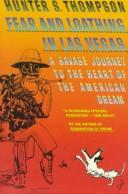
Fear and Loathing in Las Vegas: A Savage Journey to the Heart of the American Dream
A Savage Journey to the Heart of the American Dream
Hunter S. Thompson's 1971 book follows Raoul Duke, a journalist standing in for the author, and his attorney, Dr. Gonzo, on a chaotic trip to Las Vegas. Duke is meant to cover a desert motorcycle race and later a law-enforcement conference on drugs. Instead, the pair spend most of the book in a haze of drugs, wrecked hotel rooms and rental-car mayhem. Thompson uses the binge to ask what had become of the 1960s counterculture and of the American Dream. Part reportage, part fiction and part confession, it is the best-known example of gonzo journalism, in which the writer is the story. Often found on lists of books made into movies, it began as a Rolling Stone serial, with Ralph Steadman's illustrations, and has remained a cultural touchstone.
Where to buy or borrow
Are you selling this book? Bookstores, publishers, authors and libraries can be listed here for free. Request a listing
About this book
Deep Overview
The second movement of the book is a different assignment, a conference of district attorneys and police officials on narcotics and dangerous drugs. Setting two drug-saturated reporters among the people who regulate drugs gives Thompson his sharpest comic engine. The authorities seem as disoriented and self-deluded as the narrator, and the line between the lawful and the lawless is repeatedly blurred. Duke's trouble with hotel staff, waitresses, police and tourists reads as slapstick on the surface and becomes a study of institutional paranoia and consumer fantasy underneath.
Thompson's real subject is the American Dream, as the subtitle announces. Las Vegas is treated as a concentrated version of national appetite: easy money, spectacle, cheap thrills and a willingness to be entertained rather than informed. Duke wants to find the heart of that dream and keeps running into its glossy, frightening surface. Alongside this runs a more melancholy thread. Duke recalls the hope of the mid-1960s, when the counterculture seemed to be on the verge of changing the country. By 1971, with Vietnam and Nixon in the background, he sees that hope as spent. The comic frenzy often hides a sense of loss, and the famous reflective passages about a receding wave of optimism are best read against the jokes that surround them.
The composition history helps explain the form. Thompson's Sports Illustrated assignment was small, and his first submission was rejected. He kept writing anyway, and the material grew into a long work that Rolling Stone serialized in two parts in November 1971, illustrated by Ralph Steadman. Random House issued the book version the following year. That origin is visible in the structure: episodes that are self-contained enough to read as magazine set pieces yet linked by an accelerating, cumulative madness.
Thompson also builds a theory of method into the text. Gonzo journalism does not claim objectivity. It asserts that a participant's distorted, subjective record can capture a moment better than a neutral report. The reader is therefore asked to hold two questions at once: what actually happened, and what the exaggeration is trying to say. The book never settles the first and rewards attention to the second.
Key Themes
The decline of the 1960s counterculture: the book mourns the political and spiritual energy of the previous decade while mocking the drug use that had become its debased remnant.
Subjectivity and truth: because the narrator is unreliable, the book keeps asking whether distortion can be more honest than detached reporting.
Authority and hypocrisy: police, hotel managers and drug-enforcement officials are presented as no more rational than the outlaws they pursue.
Excess and its costs: the humour depends on escalation, but fear, paranoia and physical risk keep intruding, which gives the title's pairing of fear and loathing its force.
Friendship and exploitation: the bond between Duke and Dr. Gonzo is both comic partnership and a source of danger, and neither man is a reliable guide for the other.
Historical Context
In journalism, the 1960s and early 1970s saw writers such as Tom Wolfe push reporting toward scene-setting, voice and subjectivity under the label New Journalism. Thompson's gonzo approach was a more radical variant, which put the reporter's perceptions, mistakes and appetites at the centre. His earlier magazine piece on the Kentucky Derby, also illustrated by Steadman, is usually seen as the first full gonzo effort.
The book's publishing history reflects its moment as well. It began as a Sports Illustrated assignment and became a Rolling Stone serial; Rolling Stone was then a young magazine that bridged music, politics and counterculture. Thompson's work from the same period also includes reporting on the death of the Chicano journalist Ruben Salazar, which connected him to Acosta and to Los Angeles Chicano politics. Understanding these overlapping worlds explains why the book is at once a Vegas comedy and a political obituary.
Intended Audience
It is less suitable for readers who want a conventional plot, a reliable factual record of the 1971 Las Vegas events, or a sympathetic portrait of every character. People who are sensitive to extended depictions of drug use, reckless behaviour, or offensive language and attitudes should consider that before starting.
Reading Difficulty
The pace is fast and episodic, and the 1989 paperback runs about 204 pages, so it can be finished in a few sittings. Some references to 1970s politics, people and brand names may need a quick look-up for modern readers. Steadman's illustrations are part of the experience, and a reader should expect them to be included in the printed edition.
Helpful Background Knowledge
A glance at Las Vegas as a destination in the early 1970s, with its themed casinos and mass-market entertainment, will add context to the setting. Reading the famous Kentucky Derby essay first is optional, but it shows the method at an earlier stage.
Why Read This Book?
It also helps to explain a tradition. Many later writers who use a first-person, performative voice owe something to Thompson, and reading him at his most concentrated gives context for that lineage. If you are curious why a drug-soaked road story became a major piece of American literary culture, the book answers that more directly than any summary can.
Reader Takeaways
Readers can also notice how comedy is used to deliver political and cultural argument, how the narrator's unreliability produces both laughter and unease, and how a place like Las Vegas can be read as a symbolic map of national desire. Finally, the book invites a closer look at how the 1960s are remembered, and who gets to say what they meant.
Strengths
Its originality is real. It helped define a mode of reporting in which the writer's perceptions are the evidence, and it uses an apparently trivial assignment to say something broader about American culture. The reflective passages about the end of 1960s optimism give emotional depth to what might otherwise be a string of stunts.
Limitations and Cautions
The narrator and his companion behave recklessly and often cruelly, and the text contains offensive language and attitudes about race, gender and other groups. Critics and readers disagree about whether the book satirizes this behaviour or simply indulges it, and about whether it glamorizes drug use or exposes its toll. The treatment of Dr. Gonzo, drawn from a real Chicano lawyer but presented in the book with a different ethnic identity, is itself debatable. The repetitive escalation can feel numbing to some readers, and the political commentary is compressed and unevenly developed.
This is an edition-specific note as well: the 1989 Vintage paperback reprints the main text, and not the later anniversary or collected volumes that add supplementary material.
Important Concepts, People, and Places
Raoul Duke: the narrator and Thompson's fictionalized self, whose unreliable perspective shapes the book.
Dr. Gonzo: Duke's attorney and travelling companion, modelled on Oscar Zeta Acosta, whose behaviour pushes the trip into ever greater danger.
Oscar Zeta Acosta: the Chicano lawyer and writer who inspired Dr. Gonzo; he links the book to Thompson's coverage of Chicano politics in Los Angeles.
Gonzo journalism: the participatory, subjective style that the book exemplifies, in which the reporter becomes a central character.
Ralph Steadman: the British illustrator whose drawings accompanied the Rolling Stone serialization and the book.
Rolling Stone and Jann Wenner: the magazine and its publisher, who backed the long version of the story after Sports Illustrated rejected the first submission.
The Mint 400: the desert motorcycle race that supplies the original reason for the trip.
The narcotics conference: a gathering of prosecutors and police officials, which supplies the second assignment and the book's sharpest irony.
Las Vegas: the setting and chief symbol of American excess, spectacle and risk.
The American Dream: the central idea the subtitle promises to examine, treated as both aspiration and mirage.
Questions the Book Explores
Can a reporter who is high, biased and unreliable still tell the truth about an event or an era?
What happened to the political energy of the 1960s, and did the counterculture destroy itself or was it defeated from outside?
How different are the people who enforce drug laws from the people who break them, when both are shown as confused and self-justifying?
Where does comedy end and cruelty begin when a narrator treats other people as targets for his pranks?
Reading Group Guide
Groups may want to read a short passage aloud to hear Thompson's rhythms, and to look together at one or two Steadman illustrations to see how images shift the tone. It is helpful to set expectations about explicit content in advance so that members can speak candidly about which scenes they found stimulating, tiresome or troubling. Pairing the book with the Kentucky Derby essay or with a modern piece of first-person journalism can extend a second session.
Discussion Questions
2. How does the choice to blend fact and invention change the way you evaluate the narrator's claims?
3. In what ways does the narcotics conference function as a mirror for the main characters' behaviour?
4. How do the book's reflective passages about the 1960s change your reading of the surrounding comedy?
5. Is Dr. Gonzo a friend, a foil, a threat, or all three? What does the relationship add to the book?
6. How do Steadman's illustrations shape your sense of what is real and what is hallucinated?
7. Which scenes seem to satirize bad behaviour, and which seem to celebrate it? Do you always agree with the distinction?
8. Does the book feel dated, or does its portrait of spectacle and consumption still hold up today?
9. How would the book change if it had been written as a conventional, objective news report?
Sources and Verification
Comments
No published comments yet.
Available editions
Paperback
1st Vintage Books edition (1989)
- Publisher
- Vintage Books
- ISBN-13
- 9780679724193
- Pages
- 204