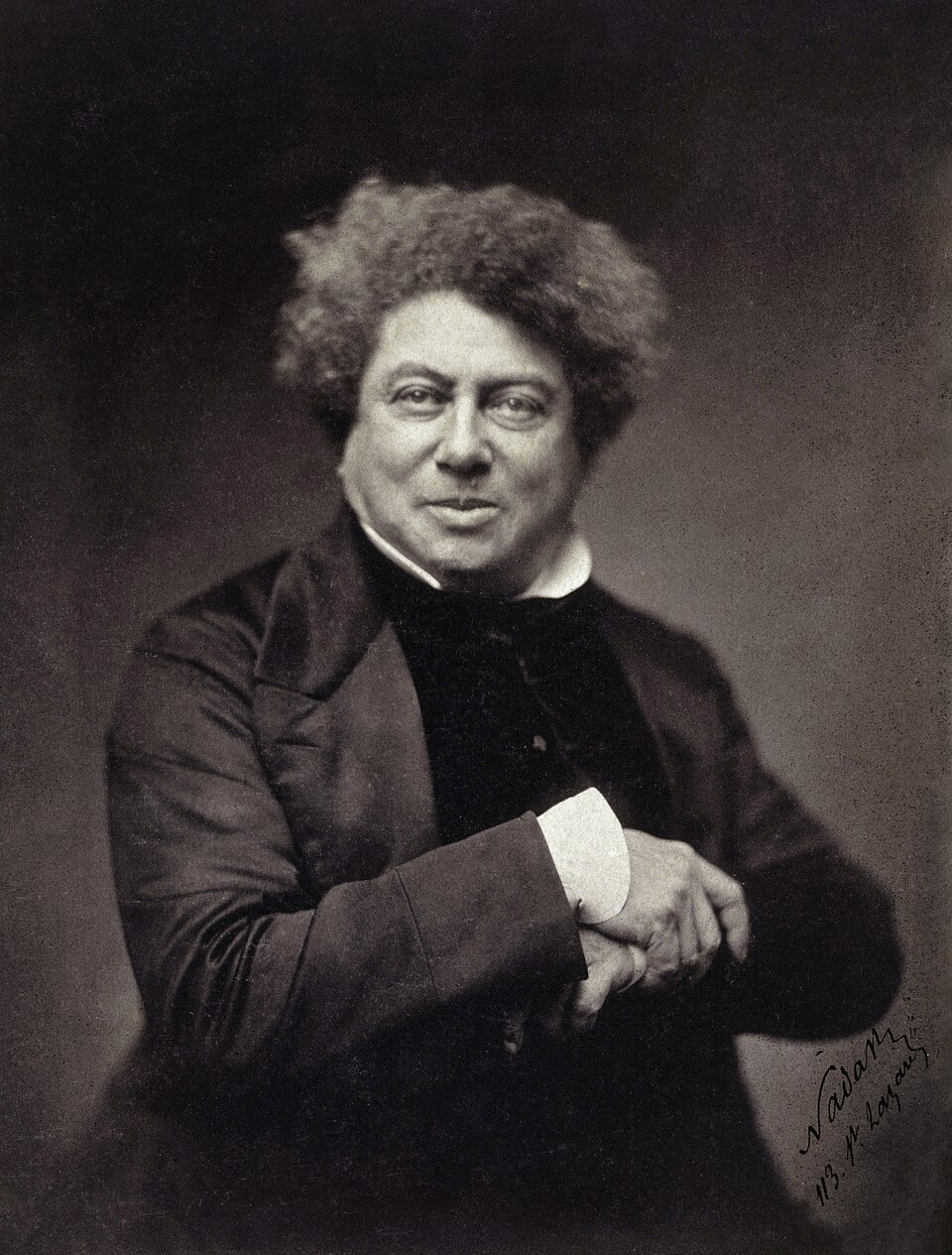
Photo of Alexandre Dumas
Photo: Nadar · Public domain · via source

Author profile

Alexandre Dumas

French playwright and novelist (1802-1870) who wrote The Count of Monte Cristo and The Three Musketeers. His fast historical adventures are built on betrayal, revenge and loyalty.

1 published book 0 published articles

About Alexandre Dumas

Alexandre Dumas, called Dumas père to tell him apart from his son of the same name, was born in Villers-Cotterêts in 1802 and died near Dieppe in 1870. His father was General Thomas-Alexandre Dumas, a soldier of the Revolutionary wars. His grandmother, Marie Cessette, had been enslaved in the Caribbean. Dumas first won a name in the theatre, with melodramas such as Henri III and His Court and Antony, and only then turned to the novel.

His fiction is historical adventure driven by plot. Real periods supply the setting, whether Napoleonic France or the age of the musketeers. Against that background he sets betrayals, disguises, duels and revenge planned over many years. Many of his novels first appeared in newspaper instalments, and you can feel it in the pacing. The Count of Monte Cristo ran in the Journal des Débats from August 1844 to January 1846. He worked out its plot with his collaborator Auguste Maquet.

In 2002 President Jacques Chirac had his remains moved to the Panthéon in Paris, where they now lie near those of Victor Hugo and Voltaire. The Three Musketeers and The Man in the Iron Mask are among the books his readers still carry to this day.

Start with The Count of Monte Cristo in Robin Buss's Penguin Classics translation, which has his introduction and notes. It is a very long book, at 1,312 pages. It begins with a young sailor, Edmond Dantès, wrongly locked up in the Château d'If, and the story pulls you along from there. If you finish it hungry for more, The Three Musketeers is the natural next step.

Published books

Author

The Count of Monte Cristo

Alexandre Dumas's The Count of Monte Cristo follows Edmond Dantès, a young Marseille sailor whose promising future is wrecked in 1815 when jealous acquaintances and a self-protecting magistrate send him to the Château d'If without trial. After years in prison, a daring escape and a fortune he was not expecting, he reappears in Paris and Rome as a mysterious, wealthy count, patiently dismantling the lives of the men who betrayed him. Serialized in a Paris newspaper in the 1840s, it is a landmark of historical fiction that combines adventure, courtroom intrigue, romance and moral argument about justice and vengeance. This Penguin Classics edition presents Robin Buss's complete English translation, which makes it a practical choice among classic novels to read for anyone ready for a long, absorbing story.

View book