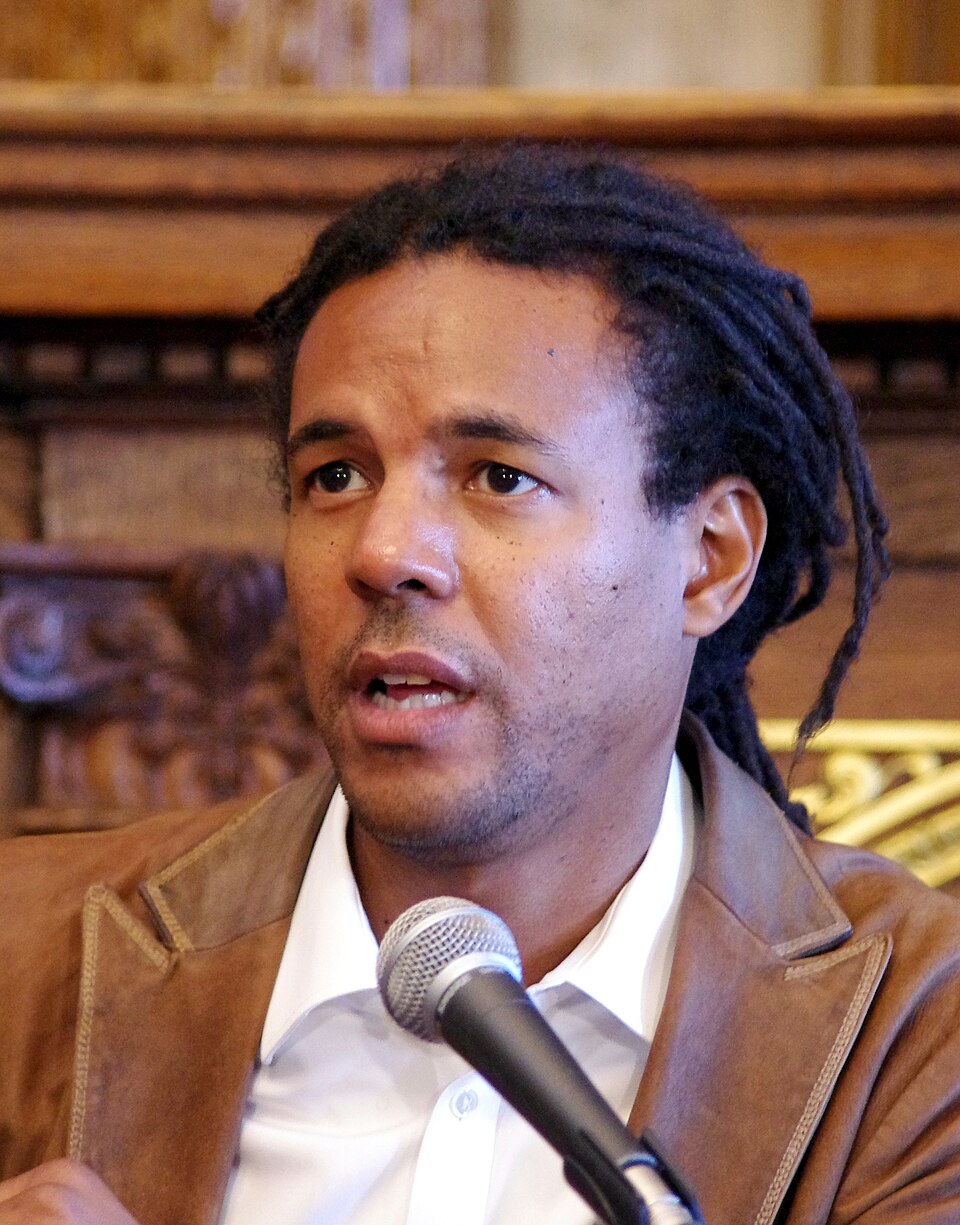
Photo of Colson Whitehead
Photo: David Shankbone · CC BY 3.0 · via source

Author profile

Colson Whitehead

American novelist and essayist Colson Whitehead writes formally inventive fiction about race, history and American institutions, moving freely among historical fiction, speculative fiction and crime.

2 published books 0 published articles

Official website

About Colson Whitehead

Born in New York City in 1969 and raised in Manhattan, Colson Whitehead graduated from Harvard and began his career reviewing books, television and music for The Village Voice. His debut, The Intuitionist, turned an elevator-inspection department into the setting for an unusual inquiry into race, power and belief.

Whitehead ranges widely across genres. Zone One recasts New York as a post-apocalyptic landscape, while Harlem Shuffle and Crook Manifesto use crime fiction to explore Harlem across changing decades. His novels often examine the stories America tells about itself, pairing careful historical research with satire, speculative devices or tightly controlled realism.

The Underground Railroad imagines the escape network as a literal subterranean railway carrying Cora away from a Georgia plantation. It won the 2016 National Book Award for Fiction and the 2017 Pulitzer Prize for Fiction, and Barry Jenkins adapted it as a television miniseries. The Nickel Boys, inspired by Florida’s Arthur G. Dozier School for Boys, follows Elwood Curtis and Turner through a brutal Jim Crow-era reformatory; it won the 2020 Pulitzer Prize for Fiction.

Start with The Underground Railroad for Whitehead’s blend of historical horror, allegory and narrative momentum. Readers who prefer a shorter, more restrained novel should begin with The Nickel Boys, whose plainspoken surface makes its moral shocks especially forceful.

Published books

Author

The Underground Railroad

Cora, an enslaved young woman on a Georgia cotton plantation, accepts Caesar’s proposal that they flee north together. In Colson Whitehead’s central transformation of history, the Underground Railroad is not merely a clandestine network of people and routes: it is an actual subterranean railway. Cora’s passage from state to state becomes both a suspenseful pursuit and a journey through sharply different systems of racial control. Slave catcher Arnold Ridgeway follows her while each apparent refuge reveals another way that American institutions can exploit, confine, erase, or terrorize Black people. Combining historical fiction with allegory and speculative invention, the novel examines slavery’s violence, the instability of freedom, and the repeated reinvention of white supremacy. Its episodic geography reaches beyond a single decade, making Cora’s flight a larger reckoning with American history and the distance between national ideals and lived reality.

View book

Author

The Nickel Boys

The Nickel Boys is a historical literary novel about Elwood Curtis, a studious Black teenager growing up in Tallahassee during the civil rights era. Inspired by Martin Luther King Jr.'s moral vision, Elwood believes that integrity and disciplined resistance can help bend society toward justice. An encounter with a stolen car—without his knowing participation in the theft—derails his plans and sends him to Nickel Academy, a segregated juvenile reformatory. Nickel presents itself as a place of education and rehabilitation, but its official mission conceals a system built on violence, exploitation, racial hierarchy, sexual predation, and administrative corruption. The institution distributes punishment arbitrarily while shielding employees from accountability. Black boys face especially brutal treatment, yet the novel also shows that institutional power can prey on any child made dependent and socially invisible. Elwood's friendship with Turner supplies the novel's central ethical tensio…

View book