
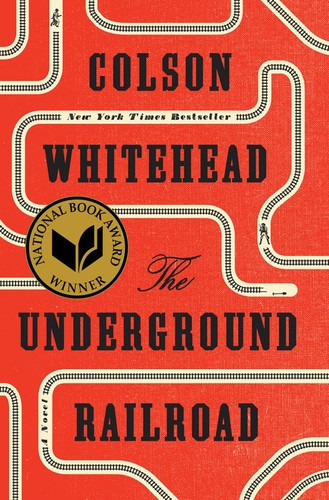
The Underground Railroad
A Novel
Cora, an enslaved young woman on a Georgia cotton plantation, accepts Caesar’s proposal that they flee north together. In Colson Whitehead’s central transformation of history, the Underground Railroad is not merely a clandestine network of people and routes: it is an actual subterranean railway. Cora’s passage from state to state becomes both a suspenseful pursuit and a journey through sharply different systems of racial control. Slave catcher Arnold Ridgeway follows her while each apparent refuge reveals another way that American institutions can exploit, confine, erase, or terrorize Black people. Combining historical fiction with allegory and speculative invention, the novel examines slavery’s violence, the instability of freedom, and the repeated reinvention of white supremacy. Its episodic geography reaches beyond a single decade, making Cora’s flight a larger reckoning with American history and the distance between national ideals and lived reality.
Where to buy or borrow
Are you selling this book? Bookstores, publishers, authors and libraries can be listed here for free. Request a listing
About this book
Deep Overview
Caesar, an enslaved man who has experienced a different household and learned to read, asks Cora to escape with him. Their decision begins a journey that Whitehead structures as a sequence of stations—geographical, moral, and historical. Beneath the ground runs a literal railway staffed by conductors and station agents. Above it, each destination offers another version of America’s racial order.
South Carolina initially appears to offer wages, education, housing, and civic inclusion. Its surface promise conceals paternalistic surveillance, coerced medical intervention, and a program designed to control Black life under the language of improvement. North Carolina presents a more openly exterminatory system: Black presence has been outlawed, public killings have become ritual spectacle, and the supposed removal of slavery rests on racial terror and replacement labor. Cora’s concealment there recalls the enforced isolation of fugitives while also making spectatorship important; from hiding, she sees how ordinary citizens participate in violence.
Arnold Ridgeway, a slave catcher who failed to capture Mabel, pursues Cora with both professional determination and ideological conviction. His belief in an American imperative of possession turns pursuit into more than a private vendetta. He embodies the claim that expansion, ownership, and domination are natural laws. Yet the novel also complicates simple divisions between heroic and villainous actors. Station agents, reluctant helpers, profiteers, informants, and bystanders occupy different positions within a system in which assistance can be fatal and neutrality can sustain oppression.
At the Valentine farm in Indiana, Cora encounters a Black community attempting to build collective security, education, and prosperity. The farm raises a crucial political question: whether freedom can be protected through accommodation, separation, self-defense, mobility, or some combination of them. Debate within the community shows that emancipation is not a single event but an unstable condition requiring institutions and shared choices.
By compressing and relocating historical patterns—including racial science, forced sterilization, lynching, and organized white terror—Whitehead rejects a neatly progressive timeline. The result is not a conventional reconstruction of one antebellum year. It is an allegorical map of recurring American structures, organized around Cora’s determination to preserve her personhood and continue moving toward a freedom the nation repeatedly postpones.
Key Themes
**The reinvention of racial domination:** Different states use different vocabularies—property, progress, medicine, public order, demographic purity—but repeatedly produce control over Black lives. The methods change while the hierarchy persists.
**Ownership and the body:** Slavery treats human beings as transferable property. The novel extends this logic into medical surveillance, sexual violence, reproduction, labor, and the denial of private space.
**Memory, records, and erasure:** Notices for fugitives reduce people to descriptions written by enslavers. Against those records, the narrative restores interior lives, family histories, motives, and contradictions.
**Resistance and complicity:** Flight, literacy, secrecy, armed defense, mutual aid, and community building all become forms of resistance. Whitehead also examines how institutions depend on informants, spectators, commercial interests, and people who obey without initiating violence themselves.
**America as promise and pursuit:** National ideals of opportunity and self-invention are set against conquest and forced labor. Cora seeks the mobility celebrated in American mythology while being hunted by a system built to deny it to her.
Historical Context
Whitehead’s novel is set broadly in the antebellum United States but deliberately disrupts chronology. Its world incorporates practices and ideas associated with later periods, including eugenics, compulsory sterilization, Jim Crow segregation, lynching spectacle, and organized attacks on prosperous Black communities. Readers should therefore approach it as historically informed allegory rather than a literal chronology.
The novel also belongs to a long literary tradition of narratives about enslavement and escape. Historical accounts by formerly enslaved people established testimony, literacy, family separation, pursuit, and self-emancipation as central subjects in American literature. Whitehead adapts those concerns while using speculative geography to connect slavery with later systems of racial control.
Intended Audience
Readers who require strict historical realism may need to adjust to the novel’s deliberate chronological distortions. Those sensitive to depictions of enslavement, sexual assault, torture, lynching, medical abuse, and racist violence should expect disturbing material. The book does not treat these subjects graphically for every scene, but it does confront them directly and repeatedly.
Reading Difficulty
The book’s emotional demands are substantial. Violence may occur abruptly, and the narrative’s restrained tone can intensify rather than soften its effect. Keeping track of locations, secondary characters, and the institutional logic of each state can help readers recognize the novel’s larger design. The publisher’s teaching guide identifies the book as appropriate for grades eleven and twelve with preparation and guided discussion.
Helpful Background Knowledge
It is also useful to know the broad outlines of Reconstruction, Jim Crow, lynching, eugenics, forced sterilization, and twentieth-century racial violence. That knowledge makes the novel’s collapsed timeline easier to recognize. No specialized study is required before reading; a brief historical overview can be enough to reveal where Whitehead follows the record and where he reshapes it.
Why Read This Book?
The book is also valuable as an example of historical fiction that openly departs from chronology to make an argument. Rather than asking only what slavery was like, it asks how its governing assumptions survive under new names. Cora remains the emotional center, preventing the allegorical design from becoming abstract. Her attention to land, bodily autonomy, literacy, kinship, and choice gives the novel’s large historical questions an immediate human scale.
Reader Takeaways
It also demonstrates how speculative invention can sharpen historical awareness. The chronological disruptions invite readers to compare slavery with later systems rather than isolating it safely in the past. Finally, the novel draws attention to the collective infrastructure behind both oppression and resistance. Laws and violence matter, but so do transportation, housing, medicine, newspapers, schools, workplaces, secret rooms, and the choices of ordinary participants.
Strengths
Cora is presented neither as a symbolic innocent nor as an uncomplicated hero. Her anger, judgment, fear, adaptability, and desire for self-possession give the story psychological weight. Short chapters centered on other figures broaden the moral field and show how slavery reaches beyond plantation boundaries.
Whitehead also uses restraint effectively. The prose often reports horror without ornamental commentary, leaving institutions and actions to reveal their own brutality. The recurring documents, measurements, medical procedures, public spectacles, and commercial transactions show how dehumanization becomes administrative and ordinary.
Limitations and Reader Considerations
The state-by-state structure can make some settings and secondary characters feel more emblematic than fully developed. That stylization is integral to the book’s method, but readers seeking a continuous realist social world may find the episodes comparatively self-contained.
The narrative centers one imagined route through U.S. racial history rather than attempting a comprehensive representation of enslavement across regions, nations, or Indigenous contexts. Its violence is thematically necessary but demanding, and guided discussion may be important in classroom settings.
Important Concepts, People, and Places
**Caesar:** An enslaved, literate man who proposes escape and introduces Cora to the underground network. His experiences show that conditions varied between enslaving households without making bondage legitimate or secure.
**Arnold Ridgeway:** The slave catcher pursuing Cora. His theory of an American imperative links individual capture to a national ideology of possession and expansion.
**Mabel and Ajarry:** Cora’s mother and grandmother. Their stories connect Cora to abandonment, inheritance, the transatlantic slave trade, and the effort to retain identity across generations of forced displacement.
**The Randall plantation, Georgia:** The starting point of Cora’s journey and the clearest expression of people treated as property within a violent agricultural economy.
**South Carolina:** An apparent haven where employment and services conceal surveillance, racial science, and violations of medical consent.
**North Carolina:** A state in which Black people have been outlawed and racial terror has become civic ritual, demonstrating that eliminating formal slavery need not eliminate white supremacy.
**Valentine farm, Indiana:** A self-sustaining Black community where debates over visibility, accommodation, resistance, and collective security bring the politics of freedom into focus.
**The Underground Railroad:** Historically, a network aiding escape from slavery; in the novel, a literal subterranean rail system. Its changing stations suggest that freedom must be imagined and built even when the destination remains uncertain.
**Fugitive advertisements:** Brief notices placed between narrative sections. Their language exposes how enslavers converted people into property descriptions while also preserving traces of individuals who resisted captivity.
Questions the Book Explores
How do systems of racial domination survive by changing their methods and public language?
Can an institution offer education, housing, medicine, or employment while still functioning as an instrument of control?
What obligations accompany witnessing injustice, and when does spectatorship become complicity?
How do family memory and inherited loss shape Cora’s decisions?
Which strategies can protect a threatened community: concealment, assimilation, separation, resistance, migration, or coalition?
What can deliberate anachronism reveal that strict historical reconstruction cannot?
How does the American ideal of self-making change when viewed from the perspective of someone legally denied ownership of herself?
Reading Group Guide
Compare the underground spaces with the public spectacles above ground. Stations and hiding places depend on secrecy, while lynchings and civic ceremonies turn violence into communal performance. Discuss how visibility alternately threatens, protects, and empowers different characters.
Notice the short chapters devoted to figures other than Cora. Consider what each shift changes about moral responsibility and what information the reader receives that Cora does not.
Groups may also examine recurring forms of documentation—advertisements, medical records, lessons, newspapers, and official descriptions. Ask who controls these records and whose knowledge they suppress.
For historical comparison, identify one deliberately displaced element in each state and research its actual period. The goal is not to correct the novel but to consider why Whitehead relocates it.
Discussion Questions
2. How does Cora’s relationship to her garden plot illuminate her ideas about ownership, inheritance, and home?
3. What makes South Carolina’s version of racial control initially attractive, and when does its underlying logic become visible?
4. How does public participation sustain the violence Cora witnesses in North Carolina?
5. In what ways is Ridgeway’s worldview specifically American rather than merely personal?
6. How do the chapters about Ajarry and Mabel reshape Cora’s understanding of her family history?
7. What competing visions of Black safety and progress emerge at Valentine farm?
8. How does literacy operate as a source of opportunity, danger, authority, or deception?
9. What is gained—and what may be lost—when historical fiction combines events from different periods?
10. Does the novel present freedom as a destination, a practice, a relationship, or something else?
11. Which secondary character most changes the way you interpret Cora’s journey?
12. How does the ending affect your understanding of movement and uncertainty throughout the novel?
Sources and Verification
Comments
No published comments yet.
Available editions
Hardcover
hardcover
- Publisher
- Doubleday
- ISBN-13
- 9780385542364
- Publication date