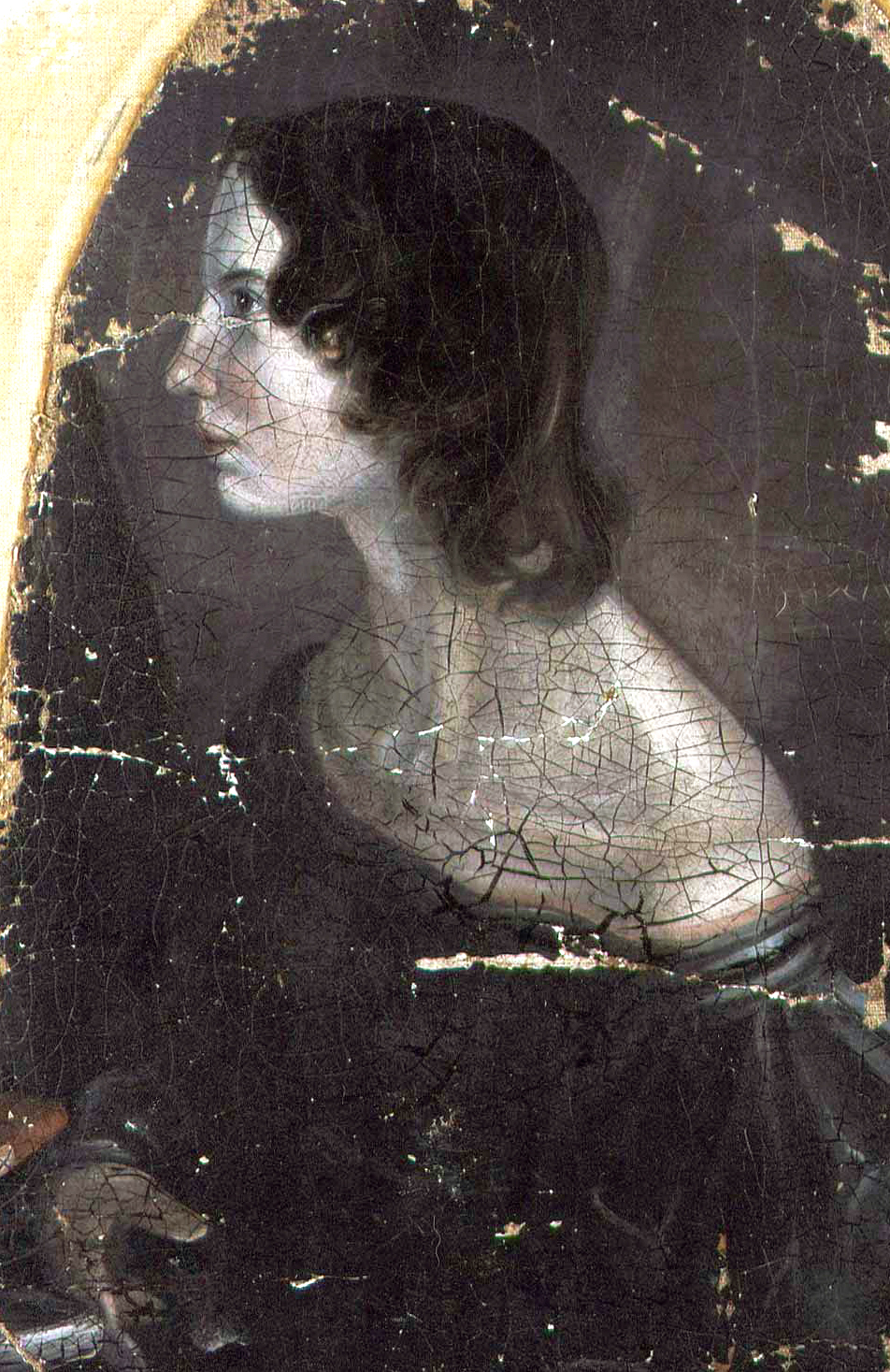
Photo of Emily Brontë
Photo: Branwell Brontë · Public domain · via source

Author profile

Emily Brontë

Yorkshire novelist and poet (1818-1848) whose only novel, Wuthering Heights, appeared in 1847 under the pen name Ellis Bell. She also wrote poems, many of them tied to Gondal, an imaginary land she shared with her sister Anne.

1 published book 0 published articles

About Emily Brontë

Emily Brontë was born in 1818 at Thornton in Yorkshire and spent most of her life in the parsonage at Haworth, where her father was the curate. Her mother died in 1821. Emily and her sister Anne invented an imaginary land called Gondal, and she kept writing about it into adulthood. Her time away from home was brief and unhappy: a few months teaching at Law Hill in 1837, then a stay in Brussels with Charlotte. She came back to Haworth for good in 1842 and died there of tuberculosis on 19 December 1848, aged 30.

She left one novel and a body of poetry. Wuthering Heights is a Gothic tragedy of passion and hatred set on the Yorkshire moors. Her poems are often rooted in Gondal and in the landscape around Haworth, and they show how much she took from Romantic writing.

Her first appearance in print was Poems by Currer, Ellis, and Acton Bell in 1846, a joint volume with her sisters that sold only two copies. Wuthering Heights followed in 1847, published by Thomas Cautley Newby under the name Ellis Bell. Its reputation grew after her death, and it is now counted among the great novels in English. A posthumous Complete Poems, with more than two hundred poems, was published in 1923.

Start with Wuthering Heights. It is her only novel and the reason she is read at all. The Penguin Classics edition listed here comes with notes and an introduction by Pauline Nestor and a preface by Lucasta Miller, which help a first-time reader find their way. If the book leaves you wanting more of her voice, her poems are the next step.

Published books

Author

Wuthering Heights

Wuthering Heights is Emily Brontë's only novel and one of the classic novels to read for anyone curious about Victorian fiction at its most extreme. Set on the Yorkshire moors, it follows two neighbouring households, the Earnshaws and the Lintons, and the foundling Heathcliff, who is raised among the Earnshaws, loses the woman he loves, and turns his bitterness into a campaign of revenge. A tenant, Lockwood, hears the story from the housekeeper Nelly Dean, so the reader sees a violent history through partial and sometimes unreliable eyes. The book spans two generations and asks whether cruelty can be broken or only inherited. It matters for its daring structure, its refusal of easy moral judgements, and its lasting influence on how literature portrays obsessive love, class resentment and the pull of place.

View book