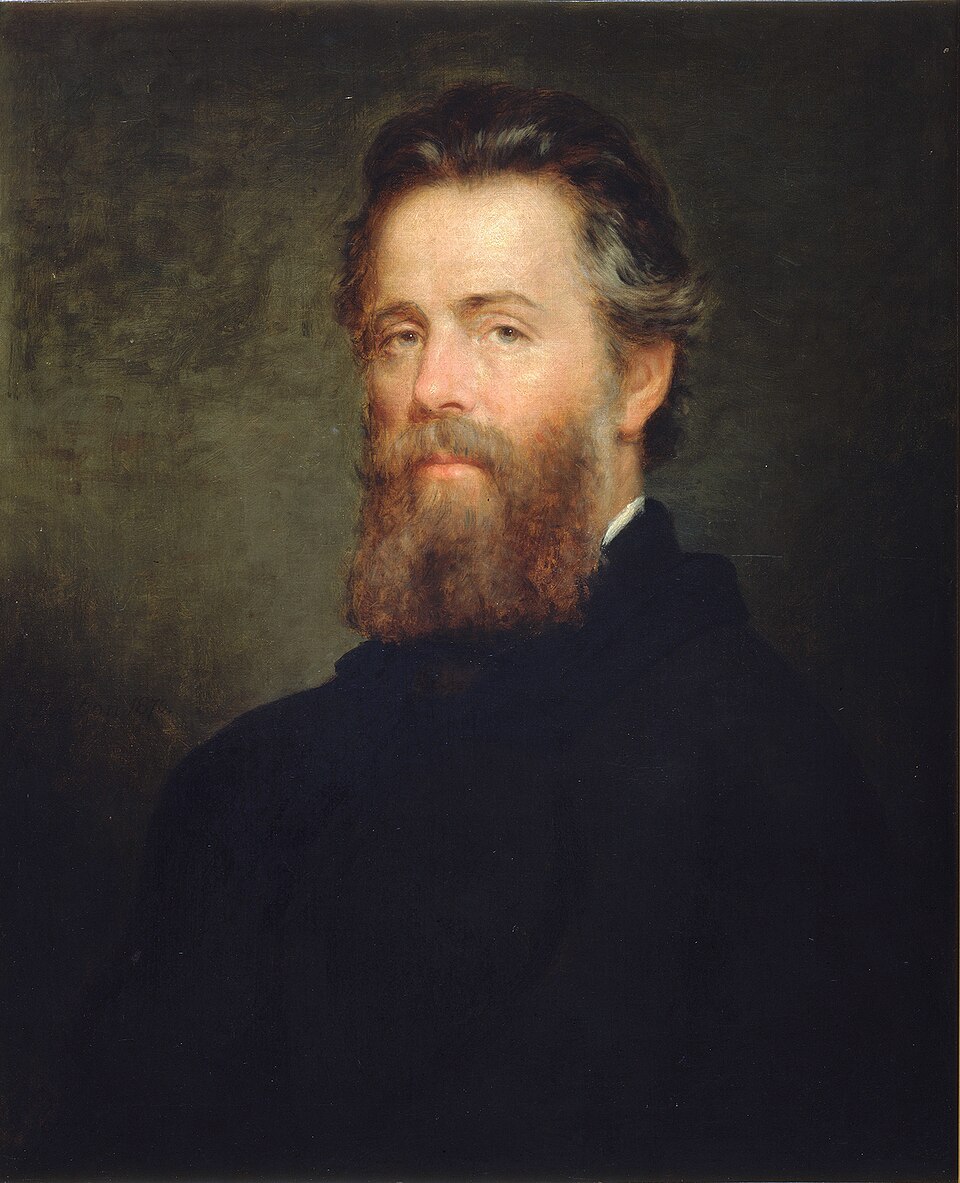
Herman Melville was born in New York in 1819 into a family whose fortunes collapsed while he was still young. He had little formal schooling and went to sea in 1839. In 1841 he shipped on a whaler bound for the South Seas, and the next year he jumped ship in the Marquesas Islands. That experience fed his first books, Typee (1846) and Omoo (1847), which sold well.
He did not stay with adventure for long. His allegorical Mardi (1849) failed, and he followed it with Redburn and White-Jacket, drawn from the hard life of ordinary sailors. Later came Pierre, a strange send-up of domestic fiction, and The Confidence-Man. His magazine stories include Bartleby, the Scrivener (1853) and Benito Cereno (1855). After 1857 he mostly wrote verse. Across all of it runs an interest in obsession, authority and power, and in how the American experiment was holding up.
Moby-Dick appeared in London in October 1851 as The Whale, and in New York a month later. It was largely ignored or mocked. Melville worked as a customs inspector from 1866, and Billy Budd, left in manuscript at his death in 1891, was not published until 1924. The turn came after Raymond Weaver's 1921 biography, which sent readers back to his books.
Start with Moby-Dick itself. The Penguin Classics edition listed here pairs the Northwestern-Newberry text with an introduction by Andrew Delbanco and notes by Tom Quirk, which help with the whaling lore and period references. Ishmael's opening chapters are an easy way in. Readers who want something shorter afterwards can try Bartleby or Billy Budd.