
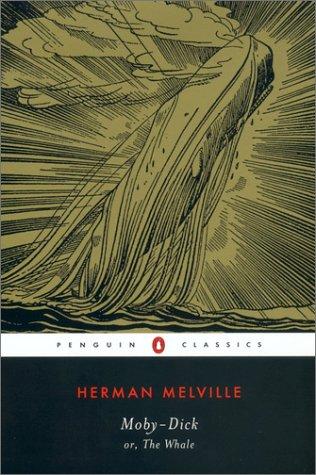
Moby-Dick
or, The Whale
Herman Melville's Moby-Dick follows Ishmael, a restless young New Englander who signs aboard the whaleship Pequod, and the ship's captain, Ahab, who has bound the crew to a private campaign of revenge against one white sperm whale. What begins as a sea story widens into an inquiry into obsession, authority, faith, race, labor and the limits of human knowledge. Melville interrupts the voyage with chapters on whale anatomy, whaling practice, art and scripture, so the hunt is also a book about how people try to describe something too large to master. Often counted among the classic novels to read, it is demanding, strange and funny. This Penguin Classics edition adds a scholarly introduction and explanatory commentary for modern readers.
Where to buy or borrow
Are you selling this book? Bookstores, publishers, authors and libraries can be listed here for free. Request a listing
About this book
The publication history adds to its distinctiveness. Because international copyright was weak, the first publication was the London version, The Whale, from Richard Bentley in October 1851. Harper & Brothers brought out the American Moby-Dick in November. The two texts differ, and Bentley's text was edited by the publisher to remove material thought blasphemous or coarse. This Penguin edition uses the Northwestern-Newberry scholarly text. Delbanco's introduction and Quirk's commentary help readers with nautical terms, biblical and literary allusions and period references. For anyone building a list of classic novels to read, it is an exacting but rewarding choice, and it suits readers who want the book's strangeness left intact rather than smoothed over.
Deep Overview
When Ahab appears, the book changes pitch. The captain lost a leg to a white whale on an earlier voyage, and he turns the ship's commercial purpose into a personal crusade. Ahab dominates the middle of the book through speeches, rituals and a constant pressure on his crew. The mates respond differently. Starbuck, the cautious Quaker first mate, objects on moral and practical grounds. Stubb treats the danger with irony, and Flask with a kind of blunt confidence. Meanwhile the harpooneers, the cabin boy Pip and the mysterious Fedallah suggest how many kinds of people a ship can hold, and how little say most of them have in where it goes.
What sets the novel apart is its refusal to keep the story in a straight line. Melville stops the narrative for chapters on how whales are classified, how a whale is cut up and processed, how whales have been painted and carved, and what the whiteness of the whale might signify. These digressions can look like interruptions, but they are the book's method. Ishmael keeps trying to build a complete account of the whale, and each attempt exposes the gap between the creature and any system of knowledge about it. The reader sees Ahab's single-mindedness from many angles: as heroism, as tyranny, as madness, and as a kind of rage against any force that will not answer to human will.
The narration also shifts. Ishmael is an engaging, self-mocking storyteller at the start, but later chapters read like stage scenes or inner speeches that no single sailor could have witnessed. This looseness is part of Melville's design. Moby-Dick is closer to an extended experiment in how fiction can think than to a tightly plotted adventure, and its ambitions run from the practical to the metaphysical in a few pages. A reader approaching the book should expect a hunt that is real and a subject that remains out of reach. Part of its enduring force is that Melville lets both statements stand without resolving them.
Key Themes
Knowledge and its limits runs through the cetology chapters. Ishmael classifies, measures and describes, yet the whale stays elusive, which raises the question of whether any human system can contain the thing it names.
Interpretation and ambiguity is central. The white whale carries many possible meanings, and the book declines to say which one is correct.
Community, hierarchy and labor appear in the portrait of a ship as a floating workplace. The crew is multiracial and multinational, command is absolute, and the commercial logic of the whale fishery shapes every decision.
Faith and doubt surface in sermons, prayers, oaths and challenges to divine order. Melville draws on biblical language while testing what it can and cannot explain.
Friendship across difference is most visible in the bond between Ishmael and Queequeg, which offers a counter-model to Ahab's isolation.
Nature and violence are shown in whale hunting itself, which the book presents with both awe and an unsparing look at what the industry costs.
Historical Context
The publishing context matters too. In 1851 there was no international copyright, so American authors often published first in Britain to protect their work. The London edition appeared in October 1851 as The Whale, in a small run of 500 copies. Harper & Brothers published the American edition under the title Moby-Dick in November, and printed about 2,915 copies. In the decades before Melville's death in 1891, only one further British and one further American edition appeared.
The book was dedicated to Nathaniel Hawthorne, a friend and fellow writer, and sits within the American Renaissance, a period of ambitious literary experiment in the United States. Its early reception was mixed and sales were modest. The novel's later reputation as a central American work was built in the twentieth century through scholarly and critical attention. The period of American expansion and slavery debates also forms an undercurrent: the crew and its hierarchies reflect the era's tensions over race, labor and national identity, although the book does not address them as a straightforward political argument.
Intended Audience
It may be less suitable for readers who want a fast, plot-driven adventure, since the story is regularly interrupted for reflection and technical description. It also contains detailed accounts of whale hunting that some readers may find hard to read. People who dislike archaic phrasing or digressive structure may do better with an abridged or audio version first, though that loses much of Melville's method.
Reading Difficulty
The length of this printing, listed by the publisher at 720 pages, includes the introduction, commentary and other apparatus, so the novel itself is somewhat shorter. The short chapters make it easy to read in small sessions. Many readers find it helpful to treat the technical chapters as part of the experience rather than as obstacles, and to use the commentary when a reference is unclear. The paperback is a standard trade format with small type, which can matter for long reading sessions.
Helpful Background Knowledge
It is worth knowing that Ishmael's narration is a literary device with flexible limits, and that the book was not widely praised at first. A brief look at Melville's life and earlier seafaring books gives a sense of how he arrived at this work. Readers who prefer to avoid plot information should skip the commentary until after each section.
Why Read This Book?
This particular edition adds practical value. It uses a respected scholarly text, and Andrew Delbanco's introduction frames Melville's ambitions and the book's place in American culture. Tom Quirk's commentary gives plain explanations of terms and references that might otherwise slow a reader down. For readers who have found the book intimidating, this combination offers a way in that does not simplify the novel itself.
Reader Takeaways
Readers may also reconsider ideas of heroism and leadership, asking at what point determination becomes a danger to the people it commands. The book encourages attention to the ship as a society, with its labor, its ranks and its many origins. Finally, it offers practice in reading slowly, tolerating ambiguity and following an argument that develops through scene, digression and image rather than through plot alone.
Strengths
Melville's prose is inventive and often funny, and the short chapters give the long text a flexible rhythm. The book's detailed picture of the whaling industry gives its larger questions a concrete footing.
As an edition, this Penguin Classics volume pairs a scholarly text with an introduction and commentary, which makes it a practical choice for both first readers and students.
Limitations and Cautions
The structure also demands patience. Readers expecting a continuous plot may find the digressions frustrating, and the symbolic readings of the white whale are contested rather than settled. The shifting narration leaves some questions about who is telling what unresolved. Finally, any commentary reflects its editor's choices, so readers who want other interpretations should consult additional criticism. Publication details for this printing vary slightly between catalogues.
Important Concepts, People, and Places
Captain Ahab: the commander of the Pequod, who drives the voyage toward his personal vendetta and embodies the book's questions about will and authority.
Moby Dick: the white sperm whale at the center of the story, treated as animal, symbol and rumor alike.
The Pequod: the Nantucket whaleship that serves as the book's world, a small society with its own hierarchy and work.
Queequeg: Ishmael's harpooneer companion, whose friendship challenges assumptions about civilization and difference.
Starbuck, Stubb and Flask: the three mates, who show different responses to Ahab and to danger.
Nantucket and New Bedford: the Massachusetts whaling ports where Ishmael prepares for the voyage, which ground the book in real American commercial life.
Cetology: the book's pseudo-scientific study of whales, which dramatizes the limits of classification.
Nathaniel Hawthorne: the author to whom Melville dedicated the book, a friend whose work was important to Melville's thinking.
Richard Bentley and Harper & Brothers: the London and New York publishers whose differing editions shaped the text's early history.
Northwestern-Newberry edition: the scholarly text that this Penguin Classics edition reproduces.
Questions the Book Explores
The book also asks how people of different origins and beliefs can live and work together under pressure, and what the sea voyage reveals about the societies that send ships out. It raises the question of how far a narrator can be trusted when he reports events he could not have seen, and whether telling a story can itself be a way of surviving it.
Reading Group Guide
Groups may find it useful to track one recurring element across the book, such as sermons, whiteness, hands and ropes, or Ishmael's changing voice. Members can also share how they handled the digressions, which often produces a useful split between readers who loved them and readers who resisted them. If your group wants book discussion questions beyond those below, the introduction and commentary in this edition give useful prompts. A short session comparing the novel's first line or opening chapter with its closing pages tends to be productive.
Discussion Questions
2. Is Ahab best understood as a hero, a villain, a tragic figure, or something else, and what in the text supports your view?
3. What is the effect of placing detailed chapters on whale anatomy and whaling practice among the dramatic scenes?
4. How does the friendship between Ishmael and Queequeg compare with the relationships among the officers and crew on the Pequod?
5. What do you make of the many possible meanings of the white whale? Does the book want us to choose one?
6. How does the Pequod work as a model of society, and what does it suggest about labor, hierarchy and power?
7. How do biblical and Shakespearean echoes shape your understanding of Ahab's speeches?
8. Where do you see humor in the book, and what does it add to the tragedy?
9. How do you respond to the book's depiction of whale hunting, and does the narrative encourage admiration, criticism or both?
10. How did the commentary and introduction in this edition change the way you read particular passages?
Sources and Verification
Comments
No published comments yet.
Available editions
Paperback
Penguin Classics paperback with introduction by Andrew Delbanco and commentary by Tom Quirk
- Publisher
- Penguin Classics
- ISBN-13
- 9780142437247
- Pages
- 720