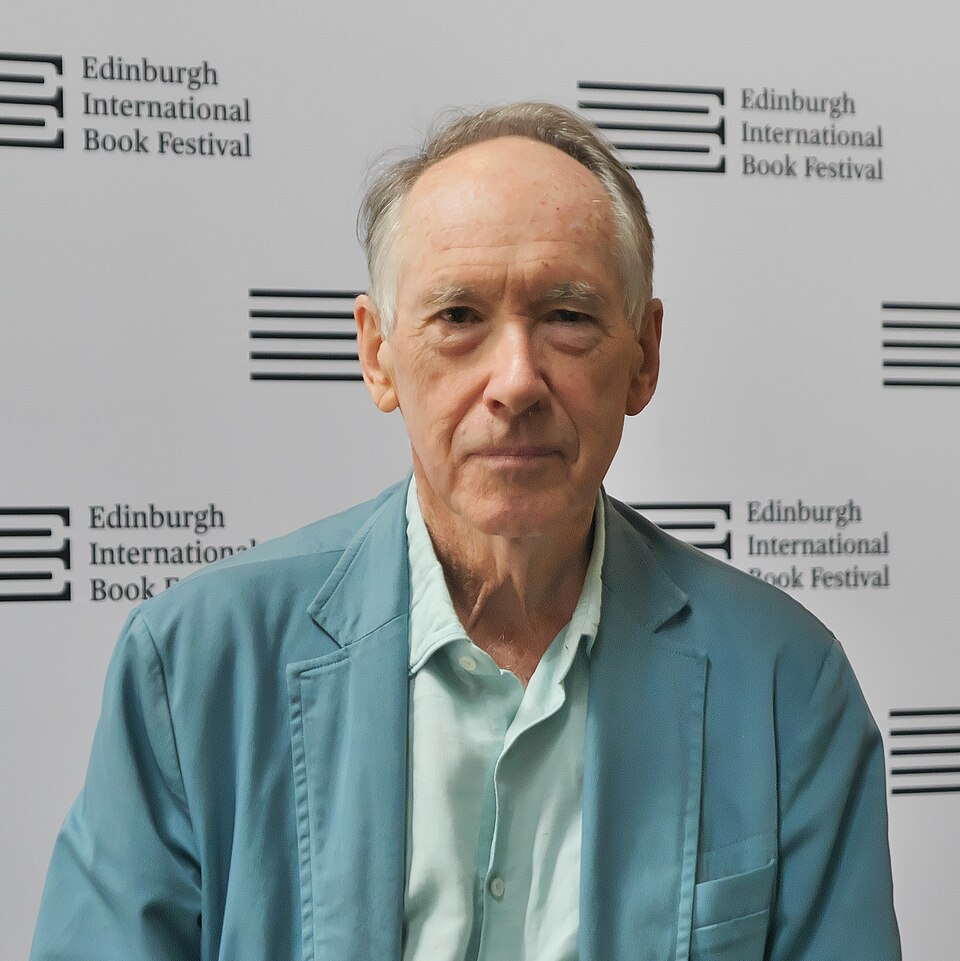
Ian McEwan was born in Aldershot in 1948 but spent much of his childhood in Singapore, Germany, and Libya, following his father's postings. The family settled back in England when he was twelve. He read English at Sussex and then took a postgraduate degree at the University of East Anglia, where the programme allowed a student to submit creative writing in place of a critical dissertation. His first book, the short-story collection First Love, Last Rites (1975), won the Somerset Maugham Award in 1976. The nickname "Ian Macabre" stuck after The Cement Garden (1978) and The Comfort of Strangers (1981).
The early fiction is compact and unsettling, built around obsession and transgression in a clipped, almost clinical register. The later novels widen their scope. Amsterdam (1998) reads like a sardonic social satire, tracking a marriage that falls apart around an academic conference. Atonement spans 1935, the Second World War, and 1999, tracing how a false accusation made by a thirteen-year-old girl ripples outward through a lifetime. The prose stays precise throughout; the calm surface is what makes the darker material harder to look away from.
McEwan has been nominated for the Booker Prize six times, shortlisted four of those, and won once, for Amsterdam. Saturday (2005) took the James Tait Black Memorial Prize the following year. Atonement was adapted into a 2007 film that won BAFTA and Academy Awards. He was appointed CBE in 2000 and made a Companion of Honour in 2023.
For a first read, Atonement is the natural choice. Its structure, built around a single narrator whose account shifts across three periods, shows off McEwan's control, and the question of whether a fictional story can repair a real wrong gives the book a weight that lingers. It is the title most readers reach for, and the one that best introduces the range of his concerns.